Which of the following has the thorniest dissonance: an early 18th-century dance-drama by Rebel, a symphony by Bizet, a concerto by Poulenc or a new work by South African composer Kevin Volans? If you think it's a trick question, you'll guess the right answer: the earliest. And which of the four sounds the least fresh and novel? My own take on that is the most recent.
If Volans's Edinburgh International Festival commission had flashed up a few individual ideas, and a little more rehearsal time had been given to the Bizet, this would have been an evening of sheer delight from the SCO and its principal conductor of one year Robin Ticciati rather than the curate's egg it turned out.
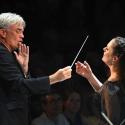
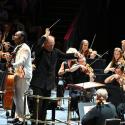
No problems at all, though, with the first half. In an unorthodox call for attention, the SCO players struck up with Jean-Féry Rebel's chord-cluster of seven notes, his representation of chaos at the beginning of his "symphonie chorégraphique", Les elémens, as Ticciati made his way to the podium. Foul soon gave way to fair as solo strings and flute took up the music of nightingales and Ticciati blended an almost romantic sense of line with underlying energy for the string of courtly dances. His great forebear with the orchestra, the late Sir Charles Mackerras, would have approved the marriage of modern instruments with period zest.
Rebel, so sure of his style at the end of a French courtly line, made a telling contrast with Poulenc, happily flitting between Mozart and Prokofiev with a seeming insouciance all his own in the Concerto for Two Pianos composed two centuries later. Could this really be the same Katia and Marielle Labèque I'd heard play the piece with the same orchestra in Edinburgh back in the early 1980s, before young Ticciati was even born? They looked the same, from a distance at any rate, and if Katia audibly fizzes less than she used to, she's still the wider characteriser, her sister the more reticent, chamber-musical artist. How they seemed to appreciate Robin the boy wonder's love of pregnant pauses and significant silences; and what rippling magic they still create in Poulenc's several homages to the gamelan.
Kevin Volans, please note: even here Poulenc still can't resist superimposing his own broad melody. Volans is the first to admit that his Symphony: Daar Kom die Alibama makes no use of the Cape Malay community song which greeted the confederate warship in 1863. "On the contrary," he states in his note, "in line with the avant-garde of the second half of the 20th century, there are no theme, no motifs, no development and no climaxes". That being so, you need to be a composer of striking individuality to say any more with just contrasting textures than Langgaard, Schoenberg and Ligeti have managed already. A few baleful woodwind chords apart, the progress of Volans's CSS Alabama is without compelling ideas, a crucial sense of underlying momentum or a sense of spatial drama - a journey to nowhere.
Tunes flowed freely again in the 17-year-old Bizet's effervescent Symphony in C. I'd expected taut charm from Ticciati here, and found it in the natural way he unfolded the melodic impetus of the packed-to-bursting Adagio, the drone bass of the scherzo's trio and a fast-moving finale with a last jeu d'esprit consummately despatched. But the first movement had a few rough edges from the strings as well as a surprisingly charmless oboe solo from Robin Williams. I know there's a feminine way of playing the instrument, but I prefer a bit of muscle, and Bizet's chief tunesmith needs character. Perhaps it would have all sounded a lot tauter and more personable in the SCO's smaller home, the Queen's Hall.
No problems at all, though, with the first half. In an unorthodox call for attention, the SCO players struck up with Jean-Féry Rebel's chord-cluster of seven notes, his representation of chaos at the beginning of his "symphonie chorégraphique", Les elémens, as Ticciati made his way to the podium. Foul soon gave way to fair as solo strings and flute took up the music of nightingales and Ticciati blended an almost romantic sense of line with underlying energy for the string of courtly dances. His great forebear with the orchestra, the late Sir Charles Mackerras, would have approved the marriage of modern instruments with period zest.
Rebel, so sure of his style at the end of a French courtly line, made a telling contrast with Poulenc, happily flitting between Mozart and Prokofiev with a seeming insouciance all his own in the Concerto for Two Pianos composed two centuries later. Could this really be the same Katia and Marielle Labèque I'd heard play the piece with the same orchestra in Edinburgh back in the early 1980s, before young Ticciati was even born? They looked the same, from a distance at any rate, and if Katia audibly fizzes less than she used to, she's still the wider characteriser, her sister the more reticent, chamber-musical artist. How they seemed to appreciate Robin the boy wonder's love of pregnant pauses and significant silences; and what rippling magic they still create in Poulenc's several homages to the gamelan.
Kevin Volans, please note: even here Poulenc still can't resist superimposing his own broad melody. Volans is the first to admit that his Symphony: Daar Kom die Alibama makes no use of the Cape Malay community song which greeted the confederate warship in 1863. "On the contrary," he states in his note, "in line with the avant-garde of the second half of the 20th century, there are no theme, no motifs, no development and no climaxes". That being so, you need to be a composer of striking individuality to say any more with just contrasting textures than Langgaard, Schoenberg and Ligeti have managed already. A few baleful woodwind chords apart, the progress of Volans's CSS Alabama is without compelling ideas, a crucial sense of underlying momentum or a sense of spatial drama - a journey to nowhere.
Tunes flowed freely again in the 17-year-old Bizet's effervescent Symphony in C. I'd expected taut charm from Ticciati here, and found it in the natural way he unfolded the melodic impetus of the packed-to-bursting Adagio, the drone bass of the scherzo's trio and a fast-moving finale with a last jeu d'esprit consummately despatched. But the first movement had a few rough edges from the strings as well as a surprisingly charmless oboe solo from Robin Williams. I know there's a feminine way of playing the instrument, but I prefer a bit of muscle, and Bizet's chief tunesmith needs character. Perhaps it would have all sounded a lot tauter and more personable in the SCO's smaller home, the Queen's Hall.
- The SCO and Ticciati dedicate their forthcoming concert performances of Mozart's Don Giovanni to Sir Charles Mackerras
- Ticciati conducts Glyndebourne Festival Opera forces in a Prom performance of Humperdinck's Hansel und Gretel on Tuesday 31 August