“How tired we are of travelling,” the soprano sings, underscored by a solo horn. The end is near: “Is this perhaps death?” No fuss, no drama, but weariness and a calm acceptance. Since Strauss and his wife Pauline were in their eighties and living quietly in Switzerland when he wrote Four Last Songs, it is clear that they had come to terms with their inevitable demise. In the end musically, Strauss pays touching tribute to his wife, the soprano, and to his father, Franz, the horn player. Throughout, we have the soaring vocal line supported by the brass. Here, that combination reaches its apotheosis. When all is sung and done, we have the lasting legacy being celebrated in this Strauss’s Voice series, now at its half-way point.
This concert reunited Anne Schwanewilms with conductor Markus Stenz and the Hallé. Having recorded the songs with Stenz and his Cologne Gürzenich Orchestra, as well as with the Hallé and Sir Mark Elder, the soprano evidently is comfortable with and trusts them. And it was clear that in Stenz she had a sensitive conductor, following her exquisite phrasing, particularly in “Im Abendrot”.
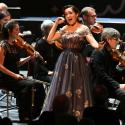
There were moments in the opening song, “Frühling”, when the enshrined contest almost between soloist and orchestra seemed in danger of going in the orchestra’s favour, but balance was quickly restored. Schwanewilms, a vision in red with a strong stage presence, stood motionless, hands clasped together, but not emotionless. In the September song she caressed the words of Hesse’s poem, “The garden is in mourning”.
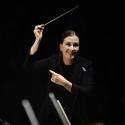
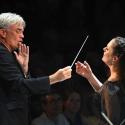
Stenz, crouching and coaxing, drew a pulsating opening from the orchestra
In “”Beim Schlafengehen", the third song, she was at her best. Following a lovely violin solo (Hallé leader Lyn Fletcher), her voice soared, full of feeling, to match the words, “And the spirit, unguarded, longs to soar in free flight”. Stenz drew some matchless soft playing from the strings.
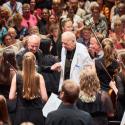
Finally, in Eichendorff’s poem “Im Abendrot”, which first got Strauss going on what turned out to be his valedictory song cycle, she caught the nostalgia and sense of fulfilment as life’s journey approaches its end. The crucial horn solo was finely played by Laurence Rogers. After taking her bow, to rapturous applause (well deserved), Schwanewilms turned to acknowledge him, signalling the meaningful link between soprano and horn.
As a curtain raiser to the main event, Stenz opened with a workmanlike performance of Wagner’s Siegfried Idyll, another work written in Switzerland and honouring the composer’s wife, Cosima, standing for all mothers and womanhood. After the lady in red came Brahms’s First Symphony, which was given a top-notch performance as Stenz, crouching and coaxing, drew a pulsating opening from the orchestra. Yet it was the second movement that was outstanding. Again, he had those strings playing with eloquent softness and, again, we had the poetry of Fletcher’s solo violin and Rogers’s solo horn. The finale had the strings shimmering beautifully in the build-up to Brahms’s famous grand tune, a challenge any day to Beethoven’s Ode to Joy, and to the all-blazing and uplifting conclusion.
But the image that sticks in the mind is of the lady in red, having sung with clarity, coloration and feeling, turning her back on the audience to gesture towards the horn player, like Pauline and Franz acknowledging Strauss’s heartfelt tribute to them both.