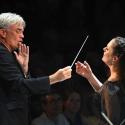
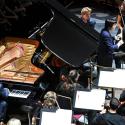
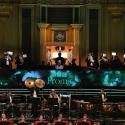
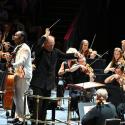
There are occasions when just one band isn’t enough. Hence the rare experience of the Hallé and the BBC Philharmonic joining forces for a performance, in the Strauss’s Voice series celebrating the 150th anniversary of the composer’s birth, of An Alpine Symphony under Juanjo Mena. With around 130 players at his command, on stage and off, along with wind and thunder machines, xylophone, castanets, cowbells and other paraphernalia, Mena had the palette for vividly bringing out all the richness of the orchestral colour.
Since this was Strauss’s last tone-poem, 15 years in the making since a day trip up the Bavarian mountain as a 15-year-old immediately inspired him to compose the first sketch, we can celebrate the legacy. Naturally, much had happened in that long gestation period, culminating in the death of Mahler in 1911 when the final phase of the writing was beginning. Nothing could be more descriptive than the 22 sections of the uninterrupted over-arching “symphony”, as we live through the expedition from sunrise to sunset, ascent to descent, in 50 minutes. You can see why it has sometime been described as “cinema music”, in the best sense.
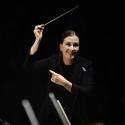
Mena’s conducting was expansive and expressive, showing admirable control and majestic pacing. But the score is wonderfully descriptive and imaginative. It can move from gentle raindrops to massive thunderstorm in an instant. Even Strauss rated it as “quite a good piece”. “At last, I’ve learnt to orchestrate,” he told the orchestra at rehearsal for the Berlin premiere in 1915, which he conducted himself.
On a personal note, this performance was dedicated on behalf of the horn sections to their highly esteemed Mancunian colleague Andy Jones, who died last summer aged 64, wishing him to be remembered “amidst all the horntastic Straussian glory”.
However, this celebratory series is entitled “Strauss’s Voice” and in the run-up to the Alpine showpiece there were songs. After a rousing opening with organ, fanfares and clashing cymbals by way of the Festliches Präludium, written for the opening of Vienna’s new concert hall in 1913, we had four songs with orchestra.
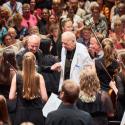
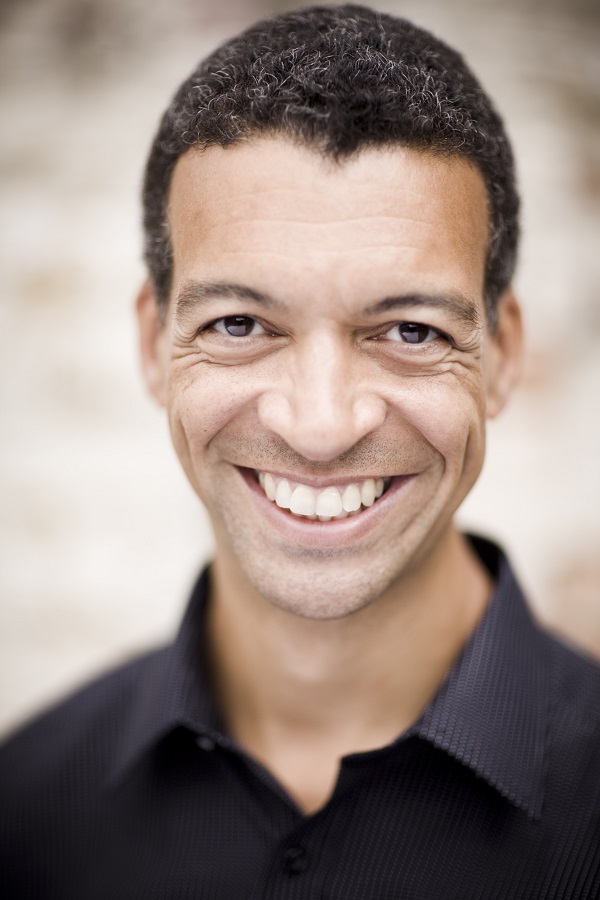 Soloist for the first three was baritone Roderick Williams (pictured right). Wth "Notturno", the longest of Strauss’s songs at around 15 minutes, he got off to a somewhat muted start but soon emerged to show his warmth, clarity and finely-judged inflexion. The song has a deathly theme as the poet-narrator has a vision in the moonlight of his dead friend playing a violin. It is sad and bleak, even though Death vanishes into darkness in the end.
Next comes "Hymnus", releasing the singer-poet into a much more upbeat mood, where the world takes on a “golden glow” as he praises the gods with his lyre. He sees life “through the looking-glass of poetry”. In the last of the three songs, "Pilgers Morgenlied (An Lila)", set to a Goethe text, the soloist moves up another gear to a real joie de vivre through love for Lila.
The last of the four songs, opening the second half of the concert and curtain-raiser to the Alpine Symphony, was taken on by another baritone, William Dazeley. And what a song. Entitled "Nächtlicher Gang", it moves us into a spooky world populated by skeletons, black dogs with red teeth and ghostly figures as the singer tries to find his way to his beloved. Again, the music is graphically descriptive, reflecting the spooks.
Every verse ends with the words “Es muss doch zur Liebsten geht!” – “There must be a way to the beloved one!”. And it doesn’t have a happy ending. It’s a real challenge for the soloist from the start as he battles against a mighty storm. Dazeley, animated and full of character, dealt with it admirably. The song title is translated as “Evening Stroll”. Some evening! Some stroll!