

Concert programmes are designed to make the mind flexible with constant contrasts. More often, though, the great is the enemy of the good-ish. Last night an Elgar masterpiece was always going to overshadow its second-half predecessor, a hazily pleasant piece for strings and – novelty value – six harps by the colleague Elgar called “dear old Gran”, candidate for this Proms season's resuscitation attempt Granville Bantock. And earlier, Sibelius bopped a BBC commission on the head with supernatural noises that could have been conjured yesterday.
Always beware – I’ve written it several times before, so this gets boring – a new work that begins with a gesture from out of an over-large percussion department. In the case of Param Vir’s Cave of Luminous Mind (The Transcendent Journey of Milarepa), it was a sudden attack from tubular bells and tam-tam, complementing flute, horns and harp. Much closer to the meditational technique of Tibetan Buddhism, I’d have thought, is the shimmer of four-part muted violins which begins Sibelius’s Violin Concerto, magically hushed in the hands of BBC Symphony strings under their new chief conductor Sakari Oramo. And there’s a composer who needs only one timpanist, not five percussionists wielding over two dozen instruments, to reinforce his magic.
Vir is certainly master of the orchestra: his late teacher Jonathan Harvey, to whom Cave of Luminous Mind is dedicated, did a good job alongside other mentors Peter Maxwell Davies and Oliver Knussen. There’s a virtuoso piano role, fearlessly taken by BBCSO orchestral pianist Elizabeth Burley, and harp writing to match Britten’s, gleaming in the hands of the incomparable Sioned Williams. But even with score in hand on a second (iPlayer) listening, I don’t sense any reflection of Buddhist yogi and saint Jetsun Milarepa’s move towards enlightenment, only stop-start sections of greater and lesser density in both the slow and the faster movements. And I’d question whether the "qualities of light" Vir writes that he has striven for are enough on their own; ‘timbral fragments’ and brief flashes of lyrical lines challenge a large audience’s powers of concentration over a 20-minute span.
 The energy behind even the most apparently still meditation shone out, on the other hand, in Georgian Lisa Batiashvili’s vibrant and personal interpretation of the Sibelius Violin Concerto; this was one of the few slow movements where I’ve been on the edge of my seat in every phrase. Seemingly improvisational, but married to the keenly propelled undertow of Oramo’s orchestra to a degree that you rarely hear in any concerto performance, her near-visionary playng projected radiantly into the vasts of the Albert Hall.
There are so many top-notch younger generation violinists around now that it would be foolish to say Batiashvili is absolutely the best, but for me she’s the most individual. Her Georgian encore with strings was charming, but there was an opportunity missed to hear one of Sibelius’s Humoresques: where else would these tuneful miniatures for violin and orchestra get performed?
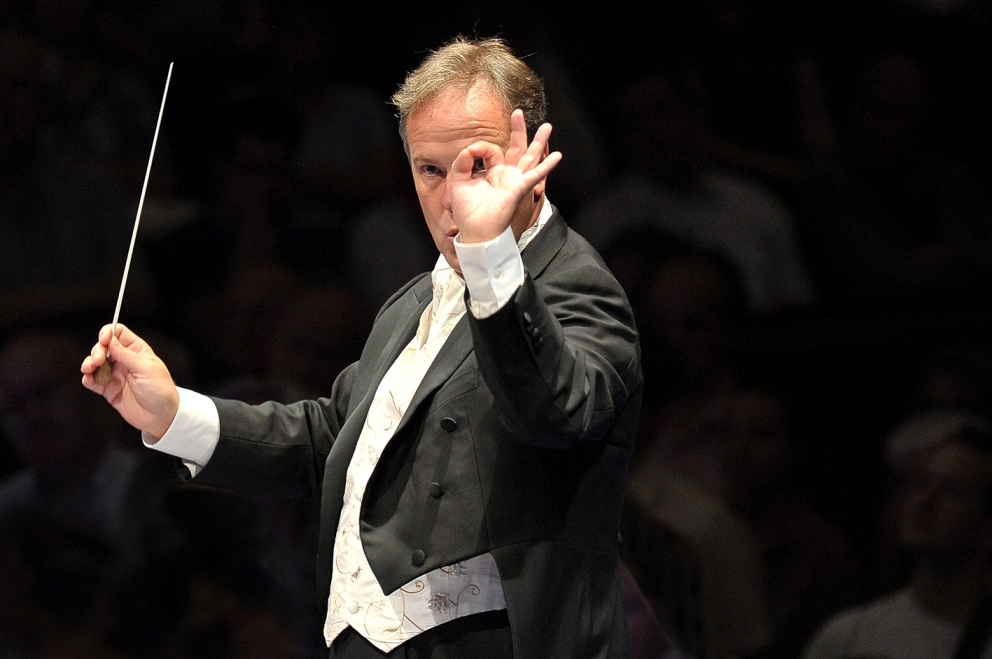
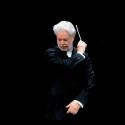
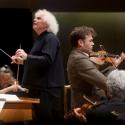
 Oramo (pictured above) has mastered the art of the difficult Proms pianissimo with his new band. It mesmerized a restless audience into silence seconds into Bantock’s Celtic Symphony, sounding at first like Ives's The Unanswered Question without the wonky trumpet solo.
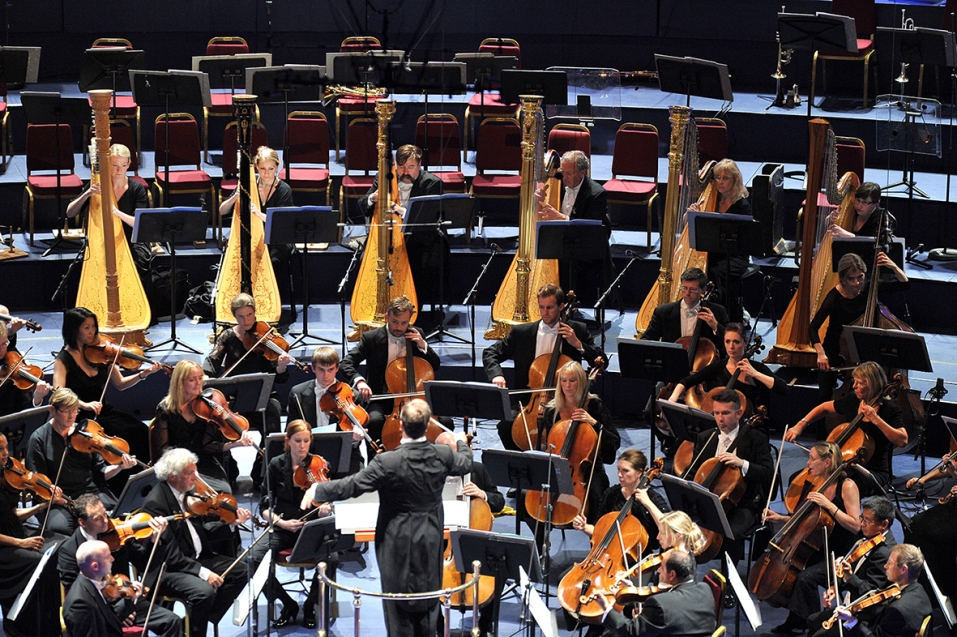
More a string sinfonietta with an indulgent role for the harps (pictured left) – only swirling their stuff just before the end – "the Celtic" could have been written at the end of the 19th century but actually received its premiere in 1942, eight years after Elgar’s death and with obvious though not ineffective debts to Vaughan Williams’s much earlier string writing. This is late Celtic twilight meandering, very crepuscular in the slow movement based on a Gaelic folksong, but so finely dominated by BBCSO cellist Susan Monks – excelling again in the "B. G. N" rhapsody of the Enigma Variations – that I’d like to hear her as soloist in the Elgar Cello Concerto.
This idiosyncratic, always energising conductor's take on the best-loved orchestral work of Elgar – a composer he has already shown an affinity for while at Birmingham and now over in Stockholm – was, like everything else in the programme, beautifully detailed to project and charm in the impossible space. For me, his control of late-romantic rubato is sometimes just a little pressed; while Ticciati’s LSO Enigma back in November soared, this one moved on with a touch of human impatience. There was less inscaping, and finally an unwillingness to give vulgar vent to the healthy boisterousness of the composer’s crowning self portrait. But the fastidiousness of the wind and string playing augurs very well indeed for Oramo’s regency with the orchestra. The only trouble is that, while this generous programme played to a full house, when they arrive in the Barbican this October the hall may only be half full, or less: an image problem the BBC has still to address.




Add comment