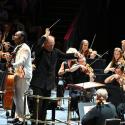
From sunset to sunrise, across aeons of time, usually flashes by in Schoenberg's polystylistic epic. Not last night at the Proms: Simon Rattle is too much in love with the sounds he can get from the London Symphony Orchestra - here verging on a Berlin beauty - to think of moving forward the doomed love of Danish King Waldemar and the beautiful Tovelille. Still, occasional stickings in the gold-studded mud apart, the variety and vividness of the work, the Albert Hall coming into its own as it often does for big chorus-and-orchestra events and the steady addition of more ideal soloists than the ones with which we started, worked their magic.
It may be because two nights earlier I'd heard Paavo Järvi and the Estonian Festival Orchestra give such a white-heat performance of Sibelius's Second Symphony - another work of huge originality from around the same time as Gurrelieder's 1900 inception - that the unfolding of Schoenberg's gorgeous love-themes came across as self-conscious, narcissistic even. The same had been true of Rattle's Wagner Tristan Prelude with the LSO at the Barbican earlier this summer. But then these two lovers weren't quite right in their roles, either.
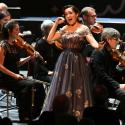
Waldemar needs to be a baritonal heldentenor with vivid involvement in the texts of what in effect are five Lieder interlaced with four from the soprano; Simon O'Neill's delivery was under-nuanced, the tone unballasted, so that when he did let rip at the top - which happened much more effectively in his later monologues - it came as a surprise. And Tove needs to be luminous, sensuous; Eva-Maria Westbroek is such a sympathetic, engaged performer that I wanted to love her, but the tuning was awry in what should be the bewitching echo of clarinet at the declaration of love, the wide-spread tone too monochrome. Miscasting, in short.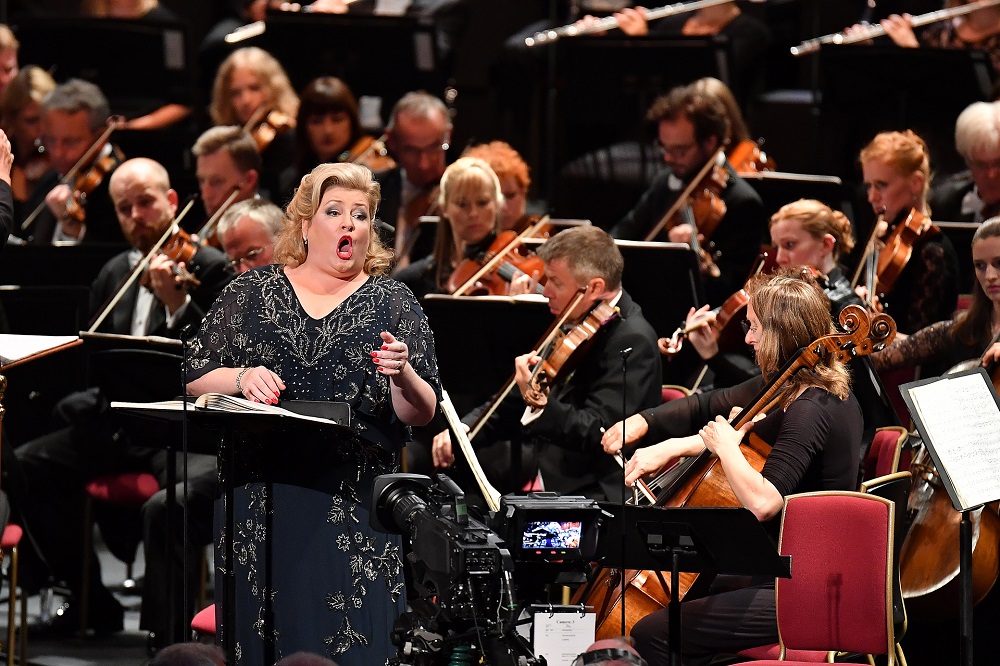 Everything we'd been missing came in spades as mezzo Karen Cargill (pictured above) turned the lamentatory screw in the Wood-Dove's plaint for the murdered Tove: here at last was a wealth of colours from cavernous chest-voice to bright high notes, and a commitment to match. Cargill's was the true vocal triumph of the evening, matched at the other end of the mood-spectrum by Thomas Quasthoff's narration of redemptive nature: such projection, such inflection of Jens Peter Jacobsen's strange visionary text in German and such ecstasy at the invocation which finally brings in the crowning sun-chorus.
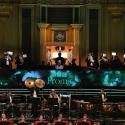
Combined forces of the London Symphony Chorus, City of Birmingham Symphony Chorus and Orfeó Català - Barcelonan choristers whose home thoughts must have been sombre indeed - seemed to rise up to the rafters behind the orchestra, filling every available space there, but to be honest they didn't quite make a noise to match. The men as God-cursing Waldemar's ghost riders should have raised the hair on our necks; they needed an injection of the raucousness we got from the National Youth Choir of Scotland in last week's Berlioz Damnation of Faust. In any case Rattle's brass - always resplendent, it has to be said, from the first trumpet solo onwarrds - was so much on the rampage that they proved stronger than the riders, and even the umpteenth percussionist whose duty it is to rattle chains couldn't be heard.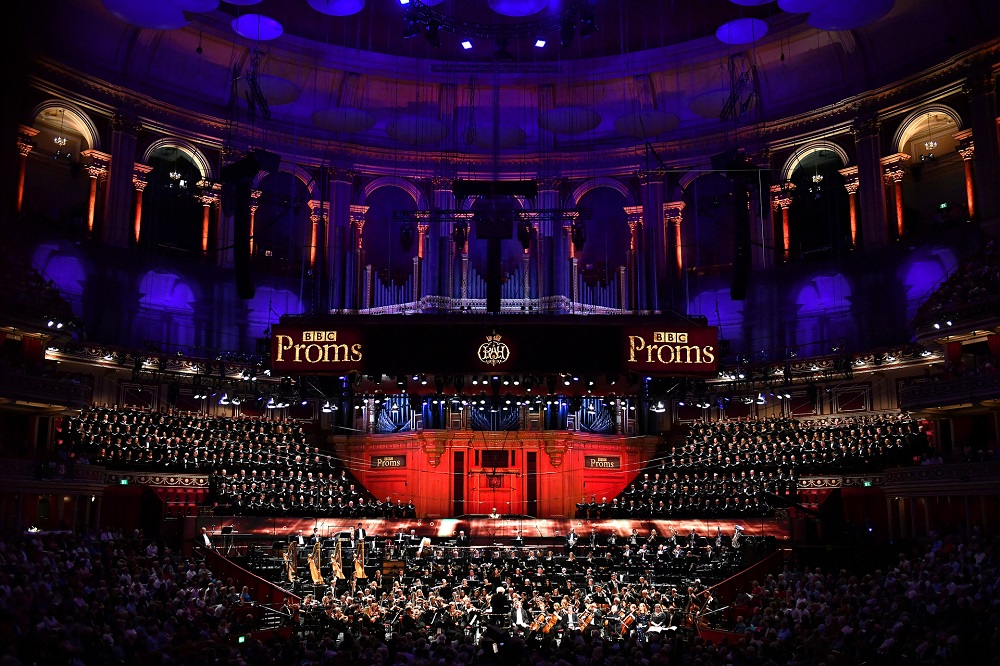 But what a miracle Rattle made of those portions of the score completed in 1911 after the discovery of a new Expressionism, above all the summer-wind sequence with Quasthoff and the cosmic cabaret as Klaus the Jester bowls forth to complain of his part in the wild ride. This is a part made for the splendid Peter Hoare, who would have been even more vivid still if he'd been onstage and liberated from the score. Here, and in Quasthoff's narration, it's most essential that audience members don't have their heads buried in their programmes and are able to follow the English translation on the big screens we'd had for the only time this season in Khovanshchina two weeks earlier. So for a third time this season, a plea must conclude the review - write to the BBC if you think surtitles should be obligatory for the big vocal works at the Proms - alongside immense gratitude that such a massive assemblage of musicians should be possible, and in the right place. The biggest, of course, is last: a blazing affirmation of the C major that Schoenberg had abandoned by the time his hymn to universal love stunnd Vienna in 1913.
- Listen to this concert on the BBC iPlayer for the next month.
- BBC Four screening on 3 September at 8pm
- More classical music reviews on theartsdesk