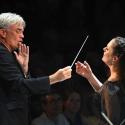
Salome was not to get her head on a silver platter: Jennifer Davis, due to sing the bloody final scene of Strauss’s opera, had been experiencing abdominal pains during her first pregnancy – mother and child are fine – and had to withdraw at a late stage. Yet Jakub Hrůša, witness to her potential in the Royal Opera revival of Wagner’s Lohengrin which led to his appointment as Pappano’s successor there, took the Philharmonia all the way in a still-dazzling programme.
In fact this performance of the replacement work, Strauss’s Don Juan, a familiar test-piece of interpretative skills, would have been enough to get Hrůša the job as chief conductor anywhere. It wasn’t just the sheer, flying elan and the characterisation of the lover-adventurer which dazzled. The supreme skill of knowing when to offer a momentary space, an extra resonance in a pause or transition, gave the ultimate stamp to the best live performance of the symphonic poem I’ve heard in concert, putting recent accounts by Rafael Payare (faceless) and Andris Nelsons (lingeringly self-indulgent) in the shade. On this evidence, the Philharmonia sounded like the sleekest orchestra in London, with airborne strings, horns flawlessly rampant in the protagonist’s high noon and an exceptionally resonant but still poignant solo from oboist Timothy Rundle.
This time the extra dazzle came from the astounding artistry of the sliding, snapping trombonesIn addition to the deeply loving victim of Juan’s caprices, Rundle also got to characterize an obsessive teaser and a shy youth mugged by a prostitute’s pimps in two of the most lurid, dazzlingly scored dance dramas in the repertoire. A dash of smeary satire capped the seven-veils synthesis of Salome’s obsessive and infatuated themes – no mere tawdry titillator, this – and Hrůša’s razor-sharp marshalling of flesh-tearing forces in the Suite from Bartók’s The Miraculous Mandarin more than held its own against the stunning performance from Klaus Mäkelä and the Oslo Philharmonic I heard in the Norwegian capital last year. This time the extra dazzle came from the astounding artistry of the sliding, snapping trombones and clarinettist Mark van de Wiel in the “decoy games” which finally lure a mysterious mandarin to the girl’s room (the suite spares us the attempted murder-every-way inflicted on him by the pimp-thugs).
Hrůša’s special gift to a lucky audience was the most persuasive, achingly beautiful account of his compatriot Dvořák’s narrative masterpiece The Golden Spinning Wheel; what an abundance of great love-melodies, delicately or opulently scored, and how well Hrusa judged every colour. The anomaly of Dvořák’s greatest genius in orchestration being lavished upon a detailed fairy-story, with its gruesome-happy tale of a girl being chopped to bits and restored to life when the eponymous spinning wheel tells the truth of her murder, meant that many audience members might have been left wondering what was going on when; a preliminary reading of the Erben tale on which the work is based, or selective supertitles giving the key points of the story, as we often got when Esa-Pekka Salonen conducted the Philharmonia in complex scenarios like that of The Miraculous Mandarin, would have helped. Yet again, though, the spellbinding chain of solos and selectively-scored beauties was probably enough to provide a golden thread for everyone.