The BBC Philharmonic were right to bill Garrick Ohlsson, soloist in Brahms’ Piano Concerto No. 1, as the main attraction in Saturday’s concert.
The septuagenarian American is a force of nature and an exceptional artist: his playing of Rachmaninov in his last visit to Manchester remains in the memory as an exhibition of mastery. So it was again, in another concerto thick with notes.
But those notes were played with entrancing grace and melodic power, as well as virtuosity, and delicacy of touch as well as insight. Clara Schumann (whose performances did much to establish it at first) said there was “something spiritual” in the central Adagio movement, and with Ohlsson’s mediation you can tell what she meant. The long-breathed movement reached a finely built climax as it was meant to, and expired with mystery and gentleness in its coda and the benediction of the cadenza that ends it (but for the last eight bars).
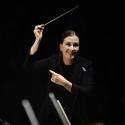
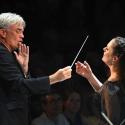
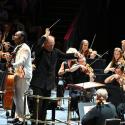
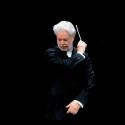
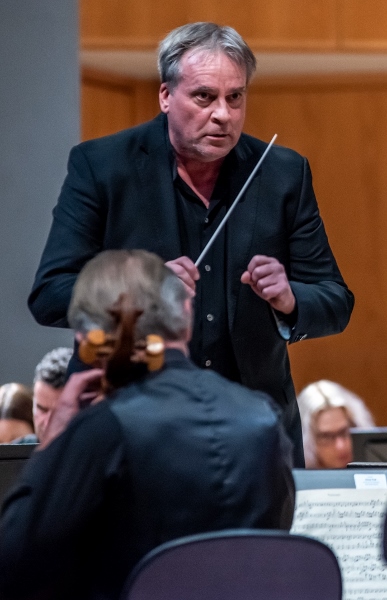 The BBC Philharmonic under John Storgårds (pictured left), with strings 50-strong, was a rich and resourceful partner in the enterprise, but the prevailing impression was of a blend of tone rather than a battle. There were solo contributions of great beauty, from two guest principals notably: KyuSung Lee leading the horns and Rachel Clegg playing oboe. And the Philharmonic cello section, led by Peter Dixon, matched the exalted quality of the piano’s pianissimo and dolce in the opening of that slow movement. In the finale the piano’s high figuration had a liquid quality and the espressivo episode recalled the beauties of the slow movement, to complement the thunderous energy released elsewhere.
(Untiring, Ohlsson followed it with the late Brahms Intermezzo in E major as an encore – another entrancing Adagio.)
It was a sound idea to make the concerto the last scheduled item in the programme, and also to precede it with Schumann. This was the Third Symphony, with the same smaller orchestral strings numbers as employed in the concert’s opening overture, Weber’s to Oberon. A swift time-travelling journey through the Austro-German Romantic tradition was the plan, and Weber’s writing, representing its early phase, received a varied range of tone and colour, as befitted its place in that succession. The violins began their unmuted, still soft (but “fiery”) main opening theme with accuracy and delicacy, Midori Sugiyama being in the leader’s chair, and Storgårds ensured there were periods of restraint in the remaining textures, the better to dramatize the many crescendos.
But the Schumann was another thing. People complain about Schumann’s orchestration (some even alter it), disliking its potential for thickness owing to his liking for doubled lines: others have demonstrated that it is more often a matter of how it is played – there is transparency there to be found if you know how. I’m not sure that this performance entirely found it, however, and a different kind of articulation might have lightened the music in its more vigorous passages.
The sound of all five horns in unison was magnificent, unsurprisingly, and gave the finale a great send-off, and there was a spring in its step by that point, a variety of accent and an exciting acceleration at the end, but those qualities had not always been apparent previously. Nonetheless, the solemn fourth movement – inspired by the massive sky-scraping bulk of Cologne Cathedral – with trombones purring in the texture like the engines of giant machinery, emerged as the heart of the work. This is where I imagine the first listeners would have heard Herr Doktor Schumann showing off his learning and capacity for writing neo-ecclesiastical counterpoint: the sonority was remarkable and the structure, almost throughout, finely illuminated.
- To be broadcast on Radio 3 on 11 November
- More classical reviews on theartsdesk