

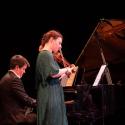
Because it was the capricious Finn who got us going and provided us with the evening's only chunks of nourishment. His performance of Rodion Shchedrin's Fourth Piano Concerto was joyous and thrilling. I wasn't expecting a great deal from Shchedrin after the critical drubbing the opening salvo in this mini-celebration received on theartsdesk. But, despite passages that stewed in a vat of concentrated Shostakovich for far too long, I was pleasantly surprised overall.
The piano voice of this Fourth Concerto is quite unlike any other. Soaked in Carnatic flavours and free-form jazz, it emerges into the light in neither the usual heroic gallop or maudlin mope.
Here we have a diffident gait, a self-critical, stuttering, nervous daydream of a wander. One that is somehow refulgent through its hesitancy. Imagine Mahler at an ashram and you'll get a decent idea of the blissful disorientation of this concerto.
The work is filled with pulling and pushing, magnetic fields of attraction and repulsion with which Mustonen - the most scampish of virtuoso pianists - played a sweaty game of hopscotch. His dry-as-dust touch was perfect for the creation of these agogic games. One felt like time itself was being bent in his whimsical flights. I have no idea what string theory is, yet I imagine a musical manifestation of it might resemble Mustonen's peculiar, now taut, now springy, pinballing weave.
One thing troubled me, however: Shchedrin's orchestration. He seemed to have a tin ear for colour. Gergiev could have been to blame for this but it's unlikely - it's the one thing that he really does have a grip on almost always. So the best of Shchedrin was to be found in the piano work, which riffed in its own idiosyncratic way and avoided old Soviet tropes that disabled other parts. Then again, the attractive cacophony of peeling bells that runs through the final movement was a hoary old idea but pleasing nonetheless.
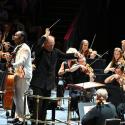
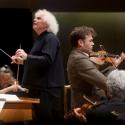
Then, as night follows day, an interval. And. Gulp. Mahler. Gergiev's unique way with the Austrian was present from the off. The opening of Mahler's First moved with all the elegance and suppleness of Silvio Berlusconi's face. Creak. Crack. Crick. This was tension not of the dramatic kind but of the leather trousers kind. A slip of a movement - liminal, weightless, living mostly above the treeline - had mutated into a puffy, corporeal sausage of a thing.
He almost rescued it in those moments of cradling tenderness in the Trio and the final movement, but soon enough we were off again, Looney Tunes-style. Beep, beep!
With this deformity at the heart and soul of the work, Gergiev understandably just kept applying the slap of louder sounds and more and more vulgar balancing to hide his creation. Landscaping went out the window. As did detailing. And what we were left with was a few madly inappropriate moments of cartoonish CGI. He almost rescued it in those moments of cradling tenderness in the Trio and the final movement, but soon enough we were off again, Looney Tunes-style. Beep, beep!
- Buy Gergiev's Mahler on Amazon
- Find out about the rest of the LSO's season
- See what's on at the Barbican this season





Add comment