Every now and then a concert programme comes along that fits like a bespoke suit, and this one could have been specially designed for me. Two established favourites from big names of the 20th century plus a new-to-me piece by a forgotten figure worthy of re-discovery.
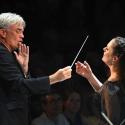
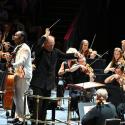
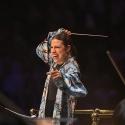
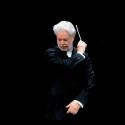
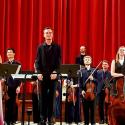
And the LSO under Susanna Mälkki didn’t disappoint in any regard: this was a great night in the Barbican hall. I came across the black American composer Julia Perry (1924-1979) a few years ago, but this was my first chance to hear her music live. There are a few black and women composers getting performed these days who, I fear, aren’t quite as good as everyone wishes they were, but Julia Perry feels more like the real deal. A student of Dallapiccola and Nadia Boulanger, her burgeoning career was cut short by a stroke at the age of 46, and her music subsequently vanished. The unenticingly-titled A Short Piece for Orchestra, written in her 20s, is a terrific calling-card for her music: a dense and impactful overture that is far weightier than its eight-minute duration would suggest. It's somewhat in the mid-20th century Americana style of William Schuman or Walter Piston, with plenty of bite in the harmony and colour in the instrumentation. Susanna Mälkki (pictured below by Mark Allan) revelled in the quicksilver changes of direction and the insistent rhythms – and my only complaint was it was over too soon, the final dash to the line felt a bit precipitate and under-written. But Perry is well worth discovering: her Piano Concerto, featured alongside Doreen Carwithen’s on Samantha Ege’s recent album, is a welcome addition to the catalogue.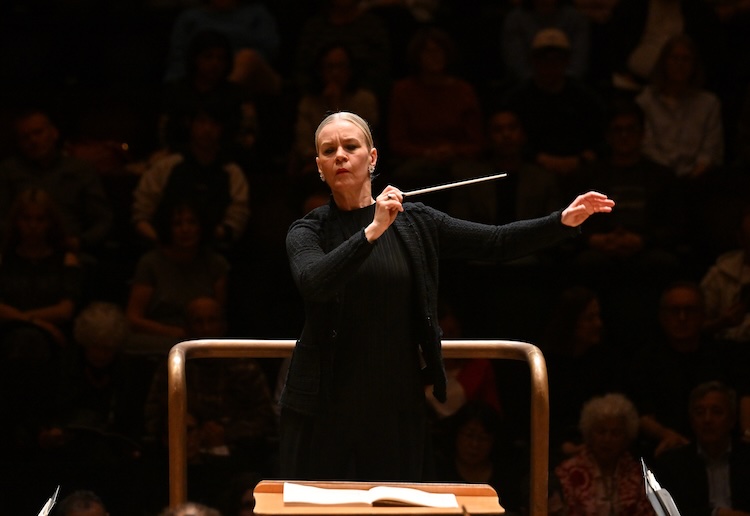 Stravinsky spent most of the 1920s avoiding writing for strings, so it was something of a surprise when he popped up with a Violin Concerto in 1931. It is heard more often these days, which I am all for, its playfulness and transparent scoring making for a much better live balance between soloist and orchestra than, say, the Berg. It was assertively projected by Leila Josefowicz, looking like a dancer from an early Stravinsky ballet in her plaits, colourful dress and peasant sandals. She dug into her strings for the syncopations of the first movement, was skittish and discursive in the second, before finding a pained lyricism in the third. This is the emotional centre of the piece, and very heart-on-sleeve for Stravinsky, although he always hides behind baroque figuration and ornamentation. It always brings me to the verge of tears.
They took the final “Capriccio” at such a lick things threatened to come unstuck for a moment, but Mälkki was soon back in complete control, conducting with appropriate angularity but also a lightness of gesture. Josefowicz turned the final pages into a wild dervish dance which had distinct echoes of Stravinsky’s stamping peasants, even when dressed up, as here, in powder and a periwig.
If Perry’s Short Piece felt like a mini-concerto for orchestra, after the interval we got the full-fat version by Bartók. This started deliberately, cellos and basses in a gradually unfurling melody in fourths, then became stormy and brooding – but Bartók gets all the sternness out of the way in the first movement. After that, the woodwind team get centre stage, duetting in the “Game of Pairs” (it’s invidious to mention anyone, but the bassoons were terrific), the central Elegy featuring a lovely piccolo solo and the fourth movement a spotlight on the violas, who get the best tune in the whole piece. The last movement has an American accent, somewhat akin to Perry’s, as Mälkki drove the orchestra home, timpanist Nigel Thomas with his foot on the accelerator.