

It’s probably a bit early to be getting misty-eyed about the approaching end of Sir Mark Elder’s time as music director of the Hallé, but the programme he and they have just finished touring in the North of England will have been, for many, his real farewell.
Its last outing was at the Bridgewater Hall yesterday, and it was (characteristically) a blend of the much-loved and familiar and something adventurous and new.
That second element comprised the European premiere performances of a new piano concerto written and played by Sir Stephen Hough – titled The World of Yesterday, it was commissioned by the Hallé, and its first performance was only in January (in Utah).
The reference is to Stefan Zweig and his nostalgia for pre-First World War Vienna, but Hough explains that he’s also thinking of “the history of the piano concerto form itself” – a vehicle for composer-pianists from Mozart to the 20th century to show what they could do, imaginatively as well as technically. Not all virtuoso pianists were great composers, of course, but Sir Stephen is such a gifted polymath that anything he does is of interest. Add to that the fact that his musical career began with the Hallé Orchestra 50 years ago, and that he played with them and Sir Mark in the latter’s first season as music director, and there could hardly have been a more fitting choice.
It's a 20-minute, three-part exploration of two simple motifs, announced at the outset: the structure is straightforward (and explained with clarity in Hough’s own programme note). The language is fundamentally tonal but with varying quantities of spice – you might hear echoes of an eclectic combination of other creative minds, from jazz pianist Bill Evans (whom Hough cites in his note) via Delius and Noel Coward to Rachmaninov. At its centre is a long, flowing waltz melody followed by a number of variations, with lavish use of the orchestra’s colourful resources, and there is much display for the soloist, from a showy cadenza near the beginning to a non-stop, staggeringly energetic, high-speed “Tarantella Appassionata” to finish. With Sir Mark at the helm, the temptations to sink into big-band schmaltz or grandiose bombast were mainly avoided, and Hough’s own remarkable playing became the focus of the performance.
 He followed it with a brief encore in Frank Bridge’s Heart’s Ease – in part a tribute to another pianist, Kathryn Stott, also much loved in Manchester and beyond, as she retires from public performances this year.
Sir Mark’s programme, apart from the concerto, was nostalgic too, for anyone who remembers the music with which he won audiences’ affections in the early years of his time with the Hallé. Dvořak’s Scherzo Capriccioso was something of a showpiece for the orchestra – again, as then, a kaleidoscope of instrumental colour and richness, with the emphasis on capriciousness but all under sure control, and the rich sauce of sentiment applied with the judicious skill of a master chef.
Butterworth’s A Shropshire Lad rhapsody was one of those pieces with which he re-created the quintessentially English sound of the orchestra for the 21st century, with delicate sweetness from the strings, beautiful wind solos and a sonorous brass chorus – it was all there again.
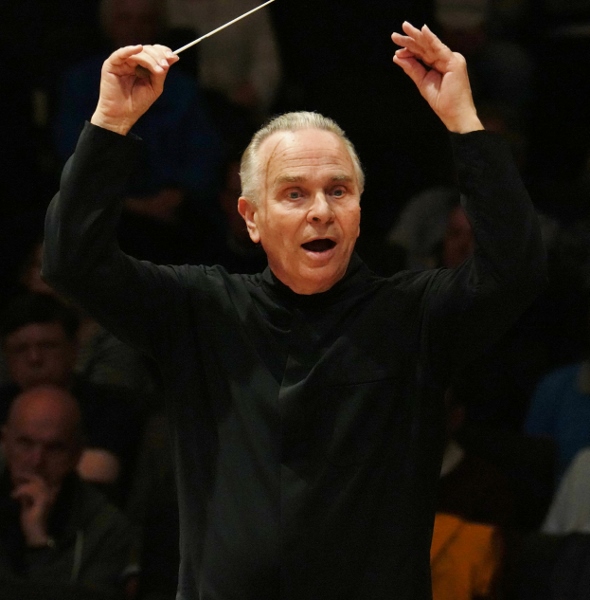
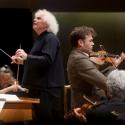
And of course Elgar’s Enigma Variations brought many of the same qualities. The interpretation is one of insight and magnificence: Elder (pictured above) delivers Elgar’s textures with crisp clarity, an enchanting combination of melodic nuance and grand flow, and a range of colour from gossamer lightness to thunderous roar. I actually wrote that last sentence when he did the work in 2002, but I can’t see any need to revise it for this performance. If anything, the caressing portamento from the violins in the first enunciation of the theme, the sense of gentle affection for the “friends pictured within”, the choral balance of voices and delightful articulation in the strings (led now by Roberto Ruisi) and the thrilling climaxes have all matured and are now possibly even richer than before.
- To be broadcast on Radio 3 on 22 May
- More classical reviews on theartsdesk




Add comment