

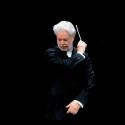
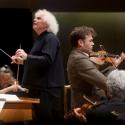
Sir Mark Elder conducted Bruckner’s Symphony No. 8 for his first time in last night’s Hallé series concert, a reflection of his untiring exploration of new territory even as he nears the end of his time as the orchestra’s music director.
So this was quite a ground-breaking event. And for the audience it was like seeing an old master in vivid colours after restoration.
The concert began with the Hallé Youth Choir singing Bruckner’s Os Justi motet, conducted by their own director Stuart Overington – an astonishingly good bit of unaccompanied singing which stayed dead in tune and reached its own ecstatic heights in just a five-minute span, the slow, simple and stable setting of “in corde ipsius” making its sincere and powerful impact.
Bruckner on a bigger canvas, with a Wagnerian-size orchestra and the playing time of a football match to expand his thoughts, can be equally sincere and powerful. One lesson from the symphony’s performance was that sonorities matter, immensely. Sir Mark had the orchestra spread over an extended platform, with his three harps on high at the back, and the brass (including four-plus-one horns and four more doubling as Wagner tubas, the bass tuba next to them) spread to the right and left. The quality of the brass tone was a thing of wonder, resplendent in their grandest moments, and subtly fascinating towards the close of the long Adagio third movement.
The strings, with Roberto Ruisi leading, were warm and intense, and the wind finely balanced and pure. Bruckner was an organist, and as he uses his forces in choruses you can often fancy him reaching for a favourite stop and enjoying its individual quality.
The emotional temperature was inexorably increased, with resolute, emphatic climaxesSir Mark used the 1939 Haas edition of the symphony, one which is based on Bruckner’s final published version of 1890 but not quite true to it. It puts back in a few passages from the 1887 first version which Bruckner decided – some say was persuaded – to leave out later, but not including a triumphant peroration to the opening movement, which, following his later thoughts, was completely abandoned; and so it dramatically ends in a doom-laden timpani beat and a kind of death-rattle from very soft violas and cellos.
It made a vivid contrast with the muscular and thrusting opening of the symphony’s opening and also the tender and appealing themes that follow, and we might imagine there being intimations of mortality there (which Bruckner seems to have had in mind).
That’s the kind of storyline that often appeals to Sir Mark – the timpani solo role, marking a challenge to the optimism of much of the music, recurs in the second and fourth movements and stood out in its presentation here.
The Scherzo movement was strongly driven (its allegro moderato marking is the same as that for the first movement) but has a strange Trio section in which the harps first appear – more tinkly than ethereal in their prominence – but in the Adagio they were part of the passionate ensemble sound, and the emotional temperature was inexorably increased, with resolute, emphatic climaxes and a near-hysterical outburst from the brass leading to the point where Bruckner even allows himself two clashes from the cymbals.
The finale is a complicated structure like the first, and the most Wagnerian in its musical content, and this time leads to a triumphant ending. Sir Mark did not drag it out but kept the shorter repeating phrases supple and varied, and when the final leading-themes-all-combined coda came it was as near to explosive as an orchestral texture can be. He may have hoped for an awestruck silence after the last note, but didn’t get one: at least it showed how much the whole enterprise had been appreciated.
- To be broadcast on Radio 3 on 5 March
- More classical and opera reviews on theartsdesk




Add comment