

Ben Gernon’s calm and clear way of conducting an orchestra (something he once told me he’d observed in the work of his mentor, Colin Davis) is good to watch and, I would guess, welcomed by those he directs. Since his time with the BBC Philharmonic as principal guest conductor (2017-2020) he’s been a welcome visitor to them in Manchester and Salford, and this programme pulled a good crowd and was indeed very rewarding.
That doesn’t mean that everything they did together was perfect, but when it worked, it worked beautifully. Beginning a programme with something that needs instant tenderness and delicacy is a test at any time: it’s not easy. Shostakovich’s arrangement of “Prelude (Dawn on the Moscow River)” from Mussorgsky’s Khovanshchina opera got there in the end, though, as, after birdcall effects in the woodwind that were vividly avian, the strings began to produce the kind of gentle intensity that Gernon had probably been hoping for from the start. The final phrase, from John Bradbury’s pure and poised clarinet, brought a deliciously dying fall to the entire sequence.
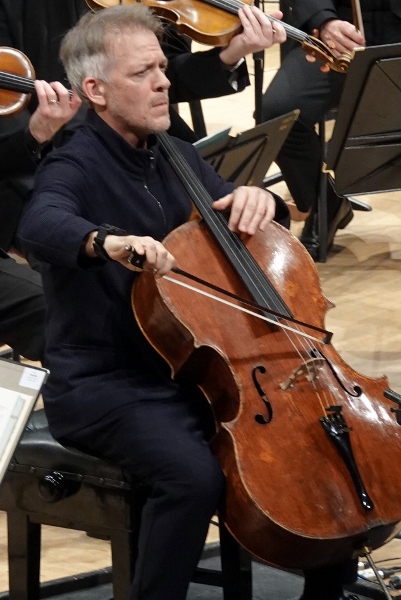 There’s more tenderness and delicacy in Anna Clyne’s DANCE, her already much-loved cello concerto of 2019, which was performed by Alban Gerhardt (pictured left). Despite the title, it’s not all bouncy stuff by any means, more often dreamily intriguing in its five discrete movements that explore repetition, cycles and repeated cycles (or loops, as we say in these days of electronica). There are simple things to enjoy here: lovely short phrases that were heard from the cello and then the wind in the opening movement, folksong-style tunes with drone effects in the second, repeating sequences of harmonised textures, chaconne-style, in the third, a kind of multi-voice canon in the fourth, and a really lovely melody in the fifth, to bring everything to a close. In it all the cello has to soar and fly to stratospheric heights of harmonics at times, to sing from a soulful D-string at others, to grumble away in its nether regions sometimes, and latterly to scrub frantically as a prelude to the luminescence of the last few minutes. Gerhardt was the master of all these – self-effacing enough to avoid hogging the limelight, but serenely focused where the solo role called for star quality.
Rachmaninov’s Symphony No. 2 was again a work that called for a sweet, pure blend in its opening bars and didn’t entirely get it. But Gernon can build a thrilling crescendo, and the Philharmonic was soon in its familiar, full-throated voice. The allegro of the first movement was neatly done, the rhythmic units well shaped and the string tone nicely varied, with only the briefest of fuzzy lines here and there.
Things really came right from the second movement on. That scherzo was driven and powerful, the orchestra playing like the virtuosi they frequently can be, and the adagio third movement, much as it might often seem a simple wallow in romantic feeling, was controlled, integrated and genuinely expressive. The finale’s impact was fresh and exhilarating, from Gernon’s emphasis on making rhythmic detail audible in its welter of big, resonant sound, and his insistence on keeping the pulse moving despite the temptations of those big, heroic cadences.




Add comment