

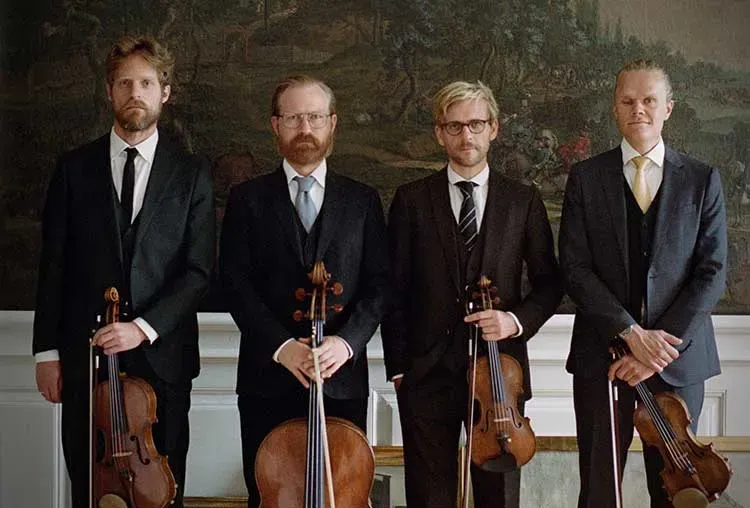
Danish by name, and very much Danish by appearance (the cellist is Norwegian, but we’ll let that go). This quartet combines a glorious selection of blonde beards and moustaches and eyelashes and floppy fringes with playing that is joyful and life-affirming, both in the sound the players produce, and the evident joy they have in playing together. This was my first time hearing the Danish Quartet, but I am determined it won’t be the last.
They played three pieces, starting with Stravinsky’s Suite Italienne, an arrangement of an arrangement of an arrangement. It’s based on Stravinsky’s ballet Pulcinella, in which added the composer spiced up some baroque chamber pieces with all the right wrong notes. He then later scored a suite of movements for violin and piano – and now the Danish Quartet have rendered that for string quartet. It works brilliantly. As you would expect for an arrangement credited to the whole group, there are solo spots for everyone, and even when the tune is in the first violin the lower parts have tremolos, and left-hand pizzicatos, and harmonics and a hundred different textures. The dissonances were leant into with relish, and at the point when it’s like a record gets stuck and the same cadence is repeated eight or nine times, the quartet performed this bit as much as played it. They were witty and brittle – but also touchingly involved in the “Serenata”. Apart from the tempo of the finale being a touch on the safe side I couldn’t have loved it more.
Shostakovich’s Third Quartet starts with a blithe, even naïve, tune that could not be more misleading about the emotional fireworks that follow. It’s not long before this neoclassical language becomes more expressionist, and the quartet followed the contours of a familiar Shostakovich emotional journey. The second movement was my favourite, the playing ironic and detached, right up to the utterly peculiar, and brilliantly voiced, final chord. The third movement was ferocious and driven, and the fourth as impassioned as the second was impassive. The fifth movement almost felt superfluous, until the resolution in the final couple of minutes to a frozen chord with wisps of violin melody flickering over it, played with utter restraint, with almost nothing there.
After the interval Ravel’s String Quartet offered something warmer, delightful in a different way. If the playing had a couple of blemishes they were easy to overlook as the sense of common purpose between the players, and their immersion in the music trumped everythin. Although the tempo of the second movement felt once again a bit steady the third was rapt. I can scarcely remember a Wigmore audience quite so silent and attentive – giving way to ringing cheers after the furious finale.



Add comment