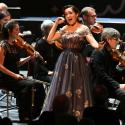
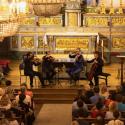
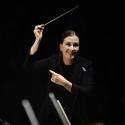
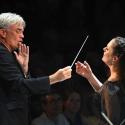
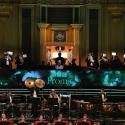
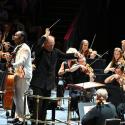
Last night was meant to be a celebration of Beethoven and Barenboim. But we had a gatecrasher. And at the opening concert of the first cycle of the Beethoven symphonies at the Proms for 60 years, the name on everyone's lips was neither Beethoven nor Daniel Barenboim, but that of Pierre Boulez. Though modest in its manner of musical expression, the near 50 minutes of continuous music that make up Boulez's chamber work Dérive 2 dwarfed the two Beethoven symphonies that stood either side of it and dominated the tone of evening. There was bafflement from some in the audience, wide-eyed wonder from others.
Barenboim will have known this would happen. There's no way that Beethoven's energetic but slight early symphonies could ever have stood up to Boulez at his longest and most complex. By Boulez's own admission, Dérive 2 is one of his most difficult works to follow. Was Barenboim's decision to pitch this curveball at the audience so early in the cycle an act of perversity? The way he went about the Boulez suggested his aim was merely elucidation of a work he no doubt cared about.
Barenboim pushed the Beethoven symphonies in a Romantic direction
Dérive 2 begins in chaos. And it's a chaos that is often so chaotically delivered by some orchestras that it's sometimes hard for the brain to make sense of. Barenboim provided a clarity but also dynamism to the start that meant we could register the freneticism and then follow the music as it calmed and ordered itself. After this, the piece eschews all extremes: of register, timbre, dynamic and speed. The 11 instruments all inhabit the middle ground. They are there to tell a story - an epic one - and need to work together to do so. Barenboim's guiding hand was beyond reproach in this, offering lucidity and purpose to each episode and an overall momentum that created a gripping whole.
Whenever the textures began to become tiring, Boulez offered something new, another view on material that he has been working and reworking for the past 30 years. Highlights include the concertante oases - the many sensual arias that wafted refreshingly up from the individual musicians of the West-Eastern Divan, most memorably from the liquid marimbaphone of Noya Schleien and the plangent cor anglais of Cristina Gomez Godoy. Then there was the moment the chamber orchestra appeared to become a shattered mirror, the musical thread temporarily in pieces, the musicians throwing Messiaen chords at each other. The entry of a unifying rhythm signifies the beginning of the end of Dérive 2 - and what an end it is.
The Beethoven symphonies were crude partners to this beguiling middle and sat either side of the Boulez like two big, red clown's cheeks. Having beefed up the forces of his West-Eastern Divan Orchestra and decided to wave his baton around like a tennis racquet, Barenboim pushed the works in a Romantic direction, authorising his strings to slather every phrase with vibrato and portamento and turning up the dynamic instructions to a maximum and the rhythmic tensions to a minimum. Presumably he felt he needed to accommodate the orchestra to the hall. But on the back of the Boulez, he surely could see that the Royal Albert Hall repays subtlety far more than crudity and approximation.
Romanticising the Beethoven also failed to make sense in another respect. One could only have constructed a conversation between the early symphonies and the Boulez if all the works had been presented in chamber form. As they were not, the Beethoven symphonies came across as a bit brutish and second rate, the Boulez outshining them in terms of a breadth of musical vision, form and thought. And I'm not sure that's what one ought to be thinking at the start of a Beethoven symphony cycle.