

So polished and passionate are the 11 world-class players of Ensemble 360, pioneering music in the round in Sheffield and elsewhere for the past 21 years, that you'd be grateful enough to hear them in wall-to-wall standard fare. But the Sheffield Chamber Music Festival has been about so much more, featuring special curator-performers - pianist Kathryn Stott and cellist Steven Isserlis in previous festivals I was fortunate to attend, this year soprano Claire Booth - and working with top-class folk from other disciplines. This year's triple bill of Samuel Beckett, Morton Feldman and the two together with actors Siobhán McSweeney and Jonjo O'Neill will remain an immortal highlight.
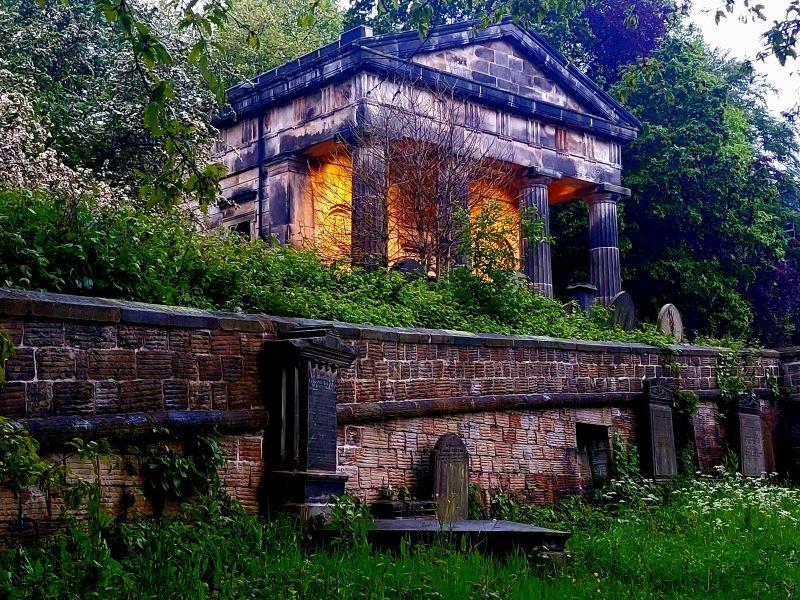
But so, too, for me were the sunrise and sunset concerts in Samuel Worth's noncomformist temple within Sheffield General Cemetery (pictured below). Getting up at 4.15am for "Birdsong at Dawn" isn't for everyone, but I've done it four times - twice for the birdsong alone (actually not exceptional in Sheffield after a big rain shower), twice for that and the music (the previous occasion was a clavichord recital to sunrise over a lake at the Göttingen Handel Festival).
The programming of both concerts was ideal. Tim Horton, a supremely versatile pianist, was exploring Messiaen's Catalogue d'Oiseaux for the first time. We heard two of these steroidal birds as well as "Le rouge-gorge" from Petites esquisses d'oiseaux and Le Merle noir with the fabulous Juliette Bausor, also London Philharmonic Orchestra principal; there's no finer flautist in the UK.
Bausor's sharing of the honours brought us more consonant Couperin, Rameau and Telemann (two of the exquisite Fantasias). There was bright respite in Vivaldi's Cantabile from Il Gardalino and Saint-Saens's blissful "Aviary" from Le carnaval des animaux (complete performance of which was a highlight of 2024, though Bausor wasn't there then).
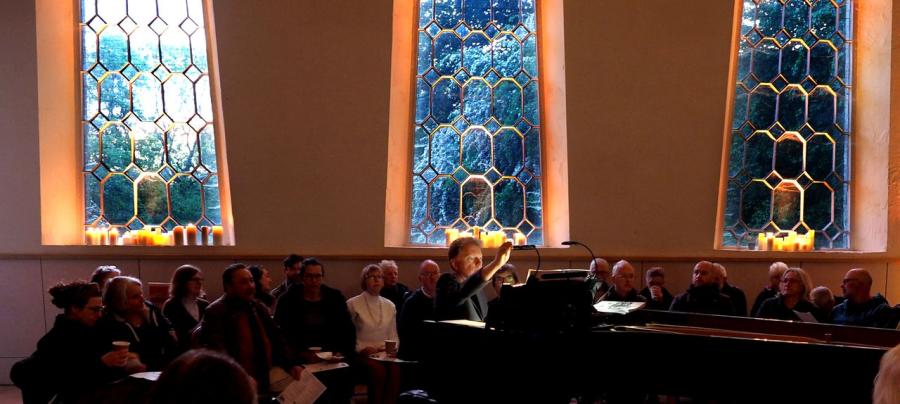
Horton chose Messiaen's "Le Loriot" as the big climax, finally coming to rest on the last of many juicy major chords, with even a simple trill at the extreme top end of the register, and the final dazzling was the finale of Martinů's First Flute Sonata, enlightening us as to a possible avian source for the composer's favoured reiterated thirds. "More Martinů next year, please" was my familiar plea; Bausor fully agreed.
We then joined a bird walk around the cemetery with Tom McKinney of BBC Radio 3 fame, his talk packed with fascinating information, a lot of it a bit lowering - so many birds seen as evil omens, for heaven's sake - and not much sound to go on, though blackcaps were duetting vivaciously. I caught more, mostly with my McKinney-approved Merlin app, behind the superb (and free) museum on Kelham Island in the afternoon, thanks to bank swifts and swallows dominating the number of species.
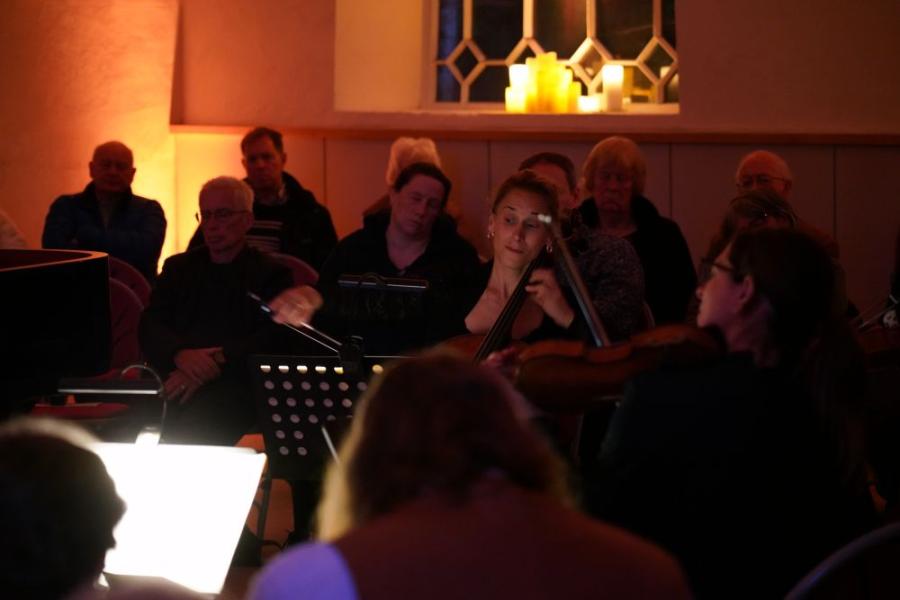
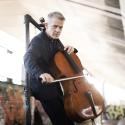
The sunset event back at the cemetery brought seven of the Ensemble 360 group together, again with immaculate planning: the slow movement of Weber's Clarinet Quintet is strange indeed, Pierrot howling at the moon, in a work which is surface Rossini with a dark hinterland, wildly virtuosic in a way that the better-known Mozart and Brahms specimens are not; Robert Plane dazzled, and at one point had a startling duet with cellist Gemma Rosefield (pictured above with viola-player Rachel Roberts). As for the long Adagio of Korngold's Piano Quintet, its theme quotes "Mond, so gehst du wieder auf" ("Moon, thus you rise once more") from the Abschiedlieder. so here's another nocturne, and similarly an unrestful one, twice exploding into wild dissonances.
The 22-year old's piano writing (for himself) makes this a splurgy, over-long experience, especially in the first movement where the form is difficult to trace; but it's fascinating, all the same, and Horton managed the insanely flamboyant piano writing with his usual fearlessness. In a way, the pitting of lush major chords against a going-off-the-rails took us back to the world of Messiaen, so the experience came full circle. And it was admirable to have all three of the strings' companions talk about their chosen works, starting with Adrian Wilson on Mozart's Oboe Quartet with its high-lying writing, and the most concise and beautiful central movement of the evening.
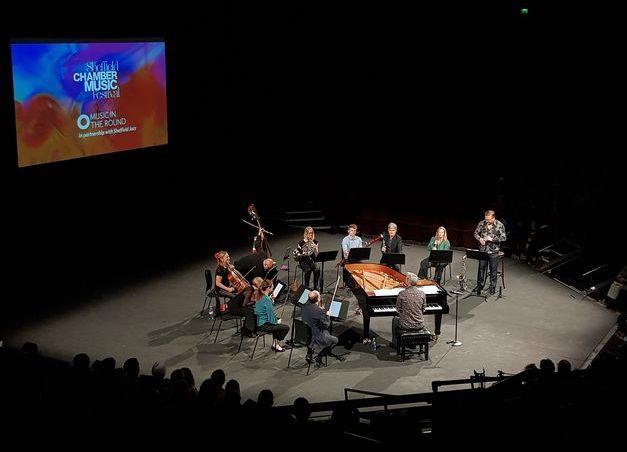
If Korngold outstays his welcome, that's typically him. Debussy had no say in the matter when Gwilym Simcock extended the movements of his Children's Corner Suite in the main Crucible Theatre the previous evening. It might more aptly have been called Curate's Egg. The jazz additions and interludes sometimes worked, more often didn't. Best, perhaps, were "Serenade for the Doll", with some sweet high extra lines, and "The Little Shepherd", kept relatively simple with lovely wind solos. Ravel's Pavane pour une infante défunte had no such interventions; the arrangement was fine, the effect as poetic as you can get in this little masterpiece.
Curator Claire Booth joined the lineup for the second half. This, too, was very much hit-and-miss. Purcell's "O Solitude" got fussy treatment, Booth is no master of the long line, which made Faure's "Après un rêve" something of an endurance test.
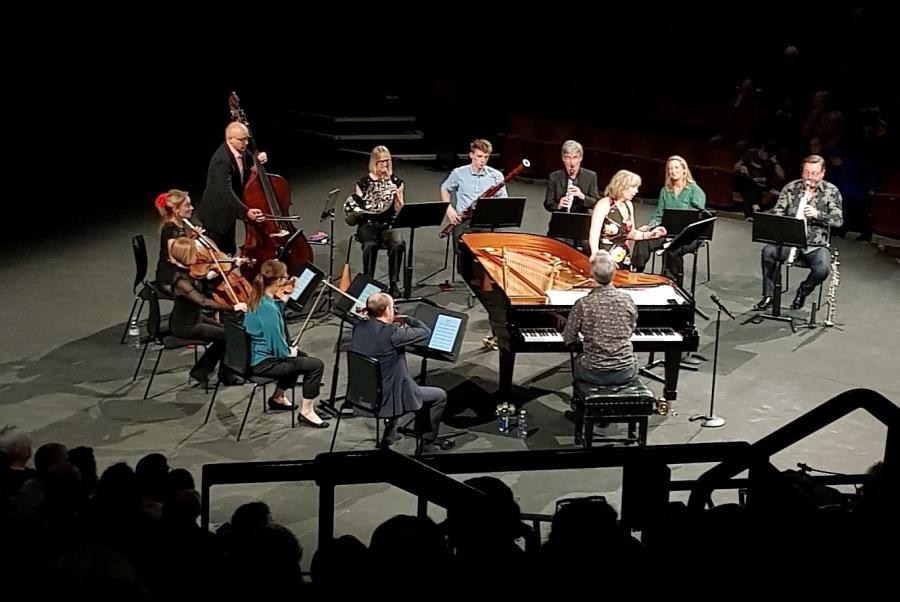
I had expected more in the light of Booth's excellent Grieg and Musorgsky discs with Christopher Glynn, and indeed the diction and delivery of "Blueberry Slope" from Grieg's Haugtussa (Mountain Maid) song cycle were on a different level, while one of Tove's "songs" from Schoenberg's Gurrelieder worked magically well. Simcock's best moments were in duet with saxophonist Rob Buckland, but together he and Booth made a serious miscalculation in up-tempoing Weill's "My Ship" from Lady in the Dark; as with some of the Debussy pieces, its beauty lies in its simplicity.
The gift to be both simple and somehow complex was shared by two colossal originals, Samuel Beckett and Morton Feldman. Relatively late in the day, Siobhán McSweeney was announced as one of the actors: delight enough for fans of her Sister Michael in Derry Girls and MC of the surprisingly congenial Traitors Ireland. I was lucky to have seen her in a Cork production of Happy Days, where in Beckett's female Hamlet role she equalled memories of Juliet Stevenson and Lisa Dwan.
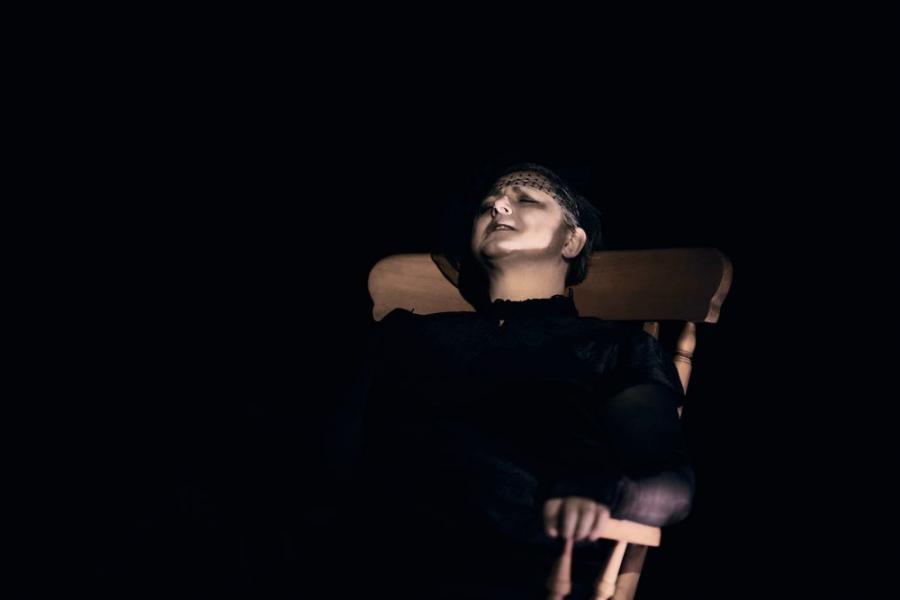
As directed by Vicky Featherstone, McSweeney triumphed again in Rockaby, her recorded self running through several octaves in Beckett's musical refrains, the figure in the rocking chair on a revolve occasionally echoing the words on the cusp of audibility. The essence of going gently into that dark night - until the sudden shock of "fuck life" towards the end - held a tensely silent audience spellbound in the Crucible Playhouse: full credit to them for playing such a crucial role.
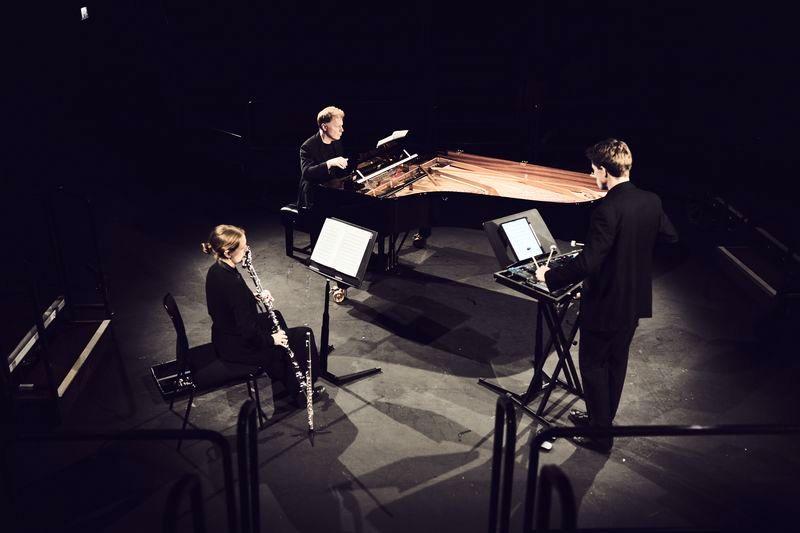
Whoever put this sequence together - Booth or Music in the Round, or both - deserves credit for something that has to be seen elsewhere (I'm trying for Dublin). Because Feldman's Why Patterns? began in the same only subtly shifting twilight world, only to evolve way beyond simple minimalism, to offer miraculous contrasts in textures shared between Horton, going from high to low on the keyboard, tintinnabulating Lewis Blee and Claire Wickes ranging from one flute to another (down to bass).
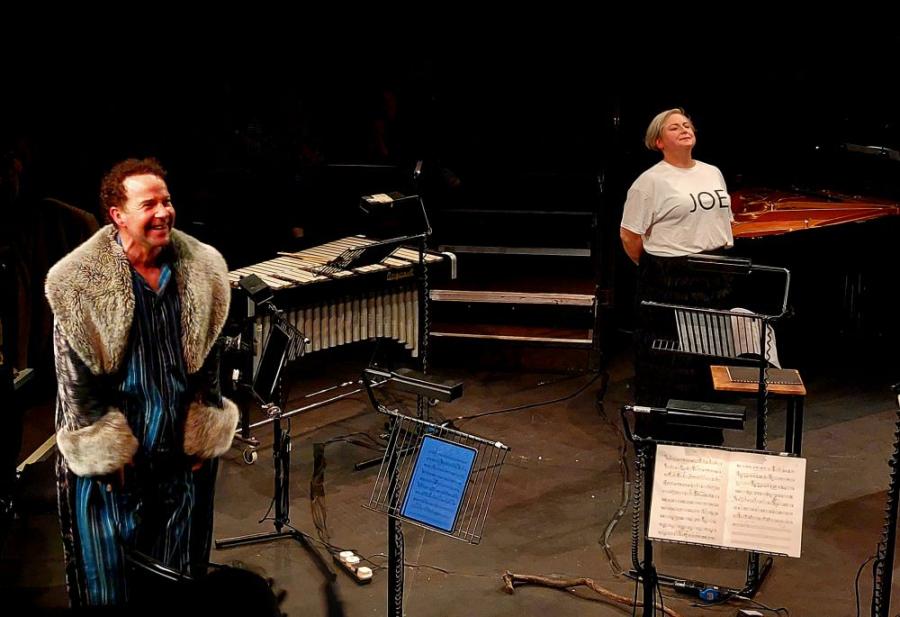
All good triple bills need sublime or divine comedy to end, and there were plenty of laughs to be had, mostly from McSweeney, in Words and Music. Beckett originally wrote it as a radio play in 1964, giving free rein to his cousin John for the music. The "characters" are Joe (Words), the steward of a wonky Prospero, Croak, whom he/she addresses obsequiously or even ironically as "My Lord", and Bob, whom Joe clearly disdains (collective name for the musicians). Croak gives out themes - "Love", "Age", "The Face", but has shuffled off by the time sublimity is achieved.
And it is especially, poignantly so, in the score Feldman composed in 1987, just a few months before his death from cancer. He'd become friends with Beckett through their work on an opera, Neither: the earlier parts of this evening had already shown how ideally suited they were, whether together or apart. It's hard to evoke the magic of this "show", or the hilarity achieved by McSweeney's nuancing, in perfect tandem with Jonjo O'Neill's charismatic Croak.
I hope more people get a chance to see and hear for themselves, By the time of my departure, SCMF 2026 had many more events to go, including Julian Philips' Henny Penny: A Children's Opera, Kurtág's Kafka Fragments and Gavin Higgins' Speak of the North. But I'd certainly had my vision.





Add comment