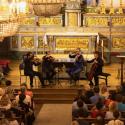
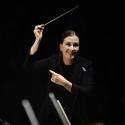
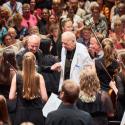
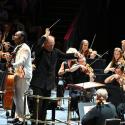
One top student orchestra playing on its own can be exciting enough. Two playing together can produce a charge of dynamite that might not leave the building standing. That was so anyway in last night’s Prom, when players from New York City’s Juilliard School and London’s Royal Academy of Music, by now frequent collaborators, joined up to shake the earth with thunderous brass, swooning strings, diamond precision, a velvet bloom – every characteristic of a world-class orchestra except the honour of being conducted by Lorin Maazel.
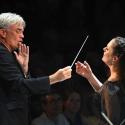
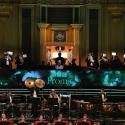
Instead the podium was occupied by America’s favourite composer, John Adams. He came naturally enough carrying one of his own scores, City Noir of 2009 – 35 minutes of urban jiggling and smooching in desperate need of a firmer structure. But at least his conducting had drive and a point; so had the other works in the programme. Top of the pyramid for me was Respighi’s Roman Festivals, the most vulgar by far of the composer's Roman trilogy, and the least played. Sharing its shape with ancient Rome’s Circus Maximus, a location vividly depicted in the first movement, the Albert Hall proved the perfect venue. And its organ proved invaluable, jacking up the decibel level just when you thought Respighi had peaked, garlanding the orchestra in a lustrous reedy resonance that definitely shook my timbers.
Puddles glisten in the night, spider women spin their webs, bullets rain down
Watching Adams conduct this brazenly colourful, skilfully concocted monster brought its own joys. "Sock it to me, baby!": that’s what his body language said as he bent his knees, outstretched both arms, and implored players to blow their top or sprinkle on more chocolate sauce. Respighi’s piece – hideous and loveable at the same time, part Stravinsky pastiche, part warbling spirit of Mario Lanza – deserved nothing less.
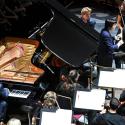
After that big gargoyle, Ravel’s G minor Piano Concerto, far superior as music of course, appeared a bit lost in the Albert Hall. Imogen Cooper’s long experience performing Mozart came through in her light, incisive keyboard touch and the poise bequeathed to Ravel’s jazz inflections. The orchestra’s own skills in colouring and shaping were clear enough too. But when you’ve just enjoyed a roaring organ, a drunken trombone, and lions chewing Christians, the performance did seem rather distant and small.
Bigger sounds arrived again with Adams’ City Noir, first performed in Gustavo Dudamel’s inaugural concert as Music Director of the Los Angeles Philharmonic. LA’s also the city depicted – the city of Raymond Chandler’s thrillers and 1940s film noir, where puddles glisten in the night, spider women spin their webs, bullets rain down, and deadbeats collapse at dawn. The youngsters from RAM and the Juilliard took Adams’ multi-layered textures and jittery rhythms in their stride, with stand-out contributions from the leery trombones, Patrick Posey’s smoky alto sax, and the frantic percussion tattoo.
None of them, though, could give the music what the composer failed to provide. Here were three baggy movements, forced to struggle towards symphonic breadth without the musical argument and architecture to make the goal achievable. Still, enough moaning. We had those great musicians after all, and we had the Respighi. And it didn’t rain.