There’s a sense of cheerful abandon about Manchester Camerata’s Mozart concerts with Jean-Efflam Bavouzet and Gábor Takács-Nagy that is hard to resist.
So it wasn’t exactly the programme originally advertised, and the concept of performing and recording all Mozart’s piano concertos with all his opera overtures has stretched a bit as time has gone by, but this was the penultimate in a series that began not far off 10 years ago – and they were going to have fun.
The concerto element, in strict fact, was Johann Christian Bach as recycled by Mozart: three piano sonatas by the London Bach turned into concerto-style pieces by the Austrian teenage virtuoso and finally given Köchel number 107 but not included in the conventional total of his 27 piano concerti.
And the opening item from Takács-Nagy and the orchestra was not strictly an opera overture, either, but five orchestral items from vocal and instrumental music written for the play Thamos, König in Aegypten by Mozart later in his career. The first gave us a doom-laden opening of almost Don Giovanni-like quality, and the entire piece is an intriguing combination of gracefulness and stormy, stressful interruptions – at least as Takács-Nagy conceived it in performance… any drama on stage could hardly hope to keep up with this level of intensity. Rachel Clegg contributed a beautiful (and, indeed aria-like) oboe solo in the second piece, and the set was completed with music that remained continually explosive, even amid strains of general rejoicing at the triumph of the good.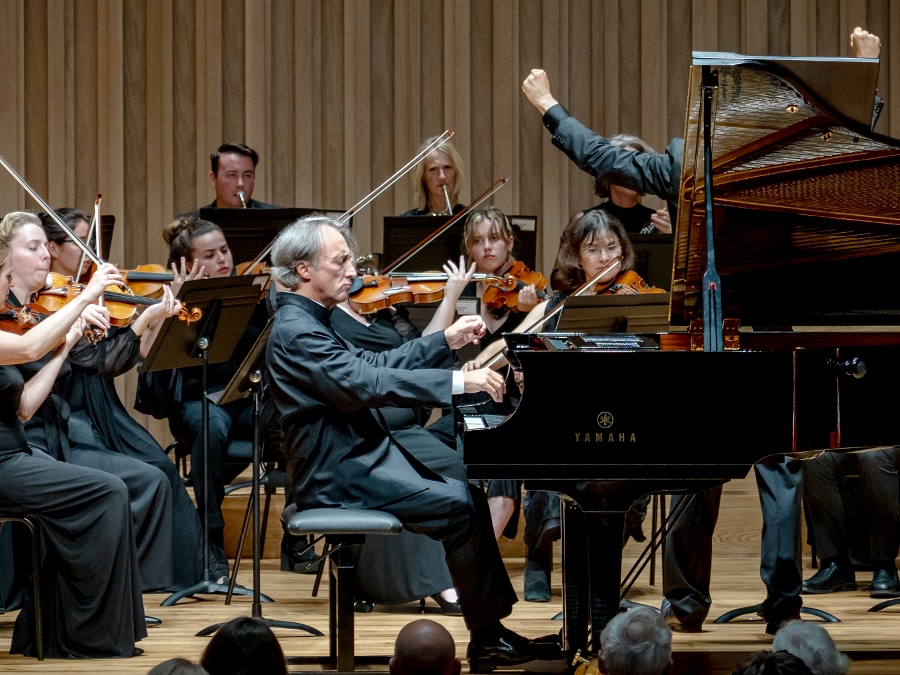 Three actual opera overtures were inserted as the evening continued: the early one of Mitridate, re di Ponto, which features a pair of flutes engagingly in its three-section structure; the brief allegro prelude Ascanio in Alba, with chattering string motifs and an enviable sense of enjoyment; and the late creation written for the (nearly all) lost opera buffa La sposa deluso, in which we heard a nice kind of mock solemnity with a lugubrious wind-led melody in its second part.
Other than that, it was JC Bach as realised by Mozart and interpreted by Jean-Efflam Bavouzet. He took different approaches to each of the three sonatas-become-concerti. For the opening of the first (it’s in three movements, the last a minuet and trio) he used a great deal of detached articulation, quite percussive in effect, though smoothed by the pedal, and imparting a sense of vigour and busyness which the orchestra emulated. The slow movement, too, was characterized by crispness, and the minuet began that way but suffered from a little trip-up and re-start in mid-flow. This concerto, interestingly, had some pure Mozart writing in it, as there is an extant first-movement cadenza by him which Bavouzet used – apart from a couple of dramatic dissonances, it feels completely in style, though Bavouzet was seeking (I think) a touch of mystery in it at one point.
The second of the K107 three, in two movements, brings pure galanterie from J C Bach. Bavouzet adopted smoother articulation from the outset, with a first movement cadenza by Wolfgang Jacobi that explored the themes on a substantial and virtuosic scale, and the theme-and-variations of the second movement afforded him more scope for colour and variety than anything before, as it alternates high spirits with returns to the dreamy atmosphere of the song-like theme. One variation was almost a send-up, the third a helter-skelter of triplets which went down so well that it and its predecessor became an encore for the whole concert at the end.
The third piece of Bach-Mozart recycling is the shortest and brings plenty more of the galant style, with a first movement based on brief themes and a “fantasy” development exploring varied keys and adding drama (another cadenza by Mr Jacobi introduced its own harmonic wanderings and thematic games in varied rhythmic garb), and a second based on a simple tune effectively shared, in Mozart’s hands, between solo and orchestra.
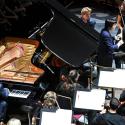
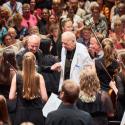
There’s interest here in seeing the bones of ideas and structures that Mozart was to develop himself so effectively in later days, and the instrumental parts he wrote for the J C Bach are all for strings but with no violas, creating a soundscape of their own. Caroline Pether led the Camerata, as always, with assurance and enthusiasm (see picture below). The entire "Mozart, Made in Manchester" project does not pretend, as I’ve noted before, to “authenticity” but is often historically informed, and the Yamaha piano used by Bavouzet has a clear but resonant sound in the bright acoustic of the Stoller Hall at Chetham’s School of Music: combined, these things make for a rich mine of stimulation and charm.