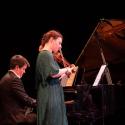
How do they do it? Bach and Angela Hewitt, I mean, transfixing and focusing the audience in the Wigmore Hall – at home, too, hopefully, thanks to the livestreaming– through 13 and three-quarter fugues and four canons, all starting in the same key and (until the last) on the same theme, plus a benediction, the glorious whole amounting to an hour and a half without a break.
It’s a pity we couldn’t have had the kind of spoken introduction Hewitt gave in a New York performance, but there are always the notes to her 2012 Hyperion recording, in which she prefaces her specific observations with the assertion that she had at first been unexcited by the prospect of approaching The Art of Fugue. “The 'Goldberg' Variations and much of the Well-Tempered Clavier seem like child’s play in comparison,” she writes. “Its severity can be daunting, but also completely overwhelming, both intellectually and emotionally. And now I realize it is anything but boring.”
There was no fear of boring the listeners in an interpretation where every line speaks, or rather sings, for itself. Initial austerity is banished by harmonic waywardness, earth-shaking grandeur, playfulness, even humour. The definition was epitomised by the way Hewitt energetically lifts her hands off the keyboard at the end of each fugue (which also obviates the pedal "twang" you often get from the Wigmore Steinway). I might have guessed what she tells us about how she approached the work in her study, “singing each voice in turn and marking in the breathing points – which come at different times in different voices. There is no escaping that if you want it to make musical sense.” And human sense it made at every point, with spacious articulation and Hewitt’s own very careful dynamic grading (Bach provides none). 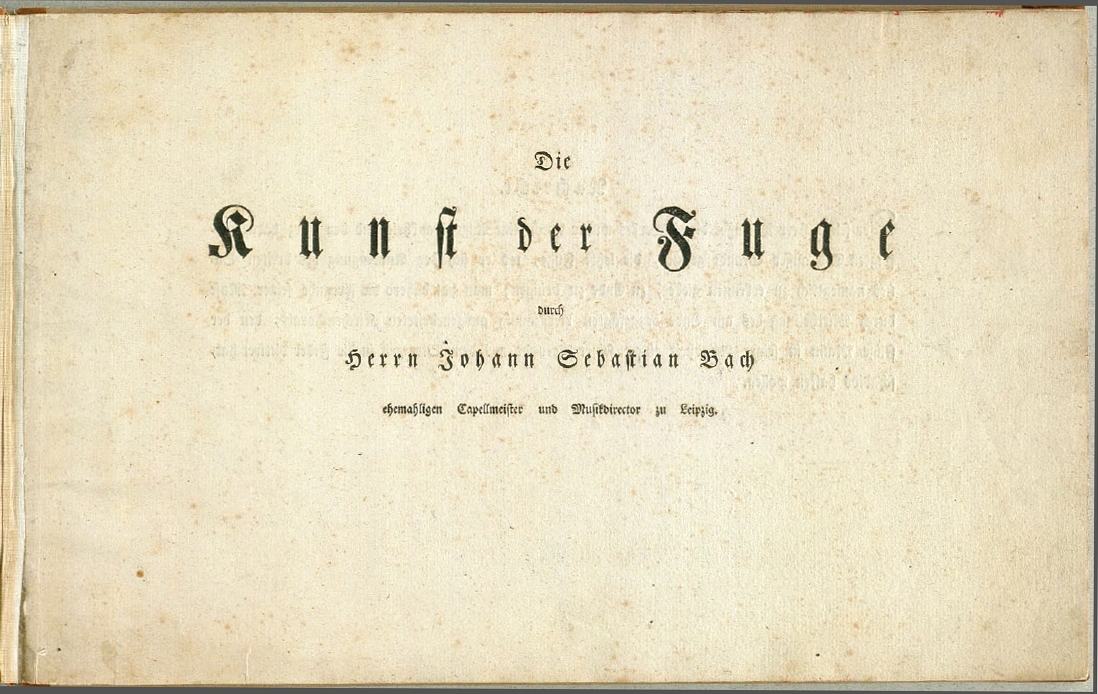 Two lofty cornerstones made us reel: Contrapunctus (as Bach calls each fugue) 6, with its high, lucid and proud double-dotted rhythms of the “stylo Francese”, its extended opulence, and Contrapunctus 11, taking us ever deeper into a maze with giddying chromaticism at its heart. All dodecaphonic 20th century music sounds boringly predictable alongside this. But there was also the sense of fun and games: the cuckoo thirds of Contrapunctus 4, and the not-so-unlucky 13, its dancing wit belying the mathematical genius with which Bach makes this mirror-reversible in its second rendition; as Hewitt writes, not only does he “turn this fugue upside down, he also turns it inside out: the top becomes the middle; the middle becomes the bass; and the bass becomes the top!”
Would the two-voice canons introduce a note of detachment, of austerity? Not a bit of it: they “spoke” as well as the others, while at the same time providing the listener with some relief in clearly making out the lines. Clearly the crowning glory is Contrapunctus 14, taking us back to the heart of darkness that so often lightens in the course of a fugue. Only this one has three subjects, three distinct sections, the last of which spells out B (in German, B flat) A C H (the German B) before combining the three subjects. Plausibly, Bach would have added a fourth: the theme on which all the other fugues are based. He didn’t; was it as simple as laying down his pen and dying, as CPE Bach wrote on the score (pictured below), or did he leave the completion open to others? 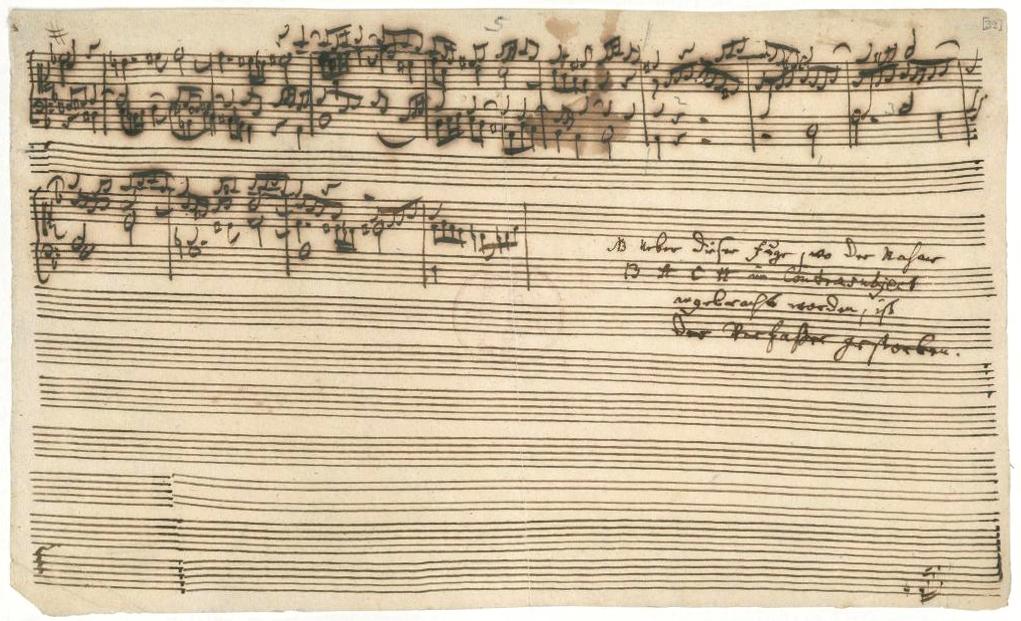 It doesn’t matter: Hewitt’s trailing into a long silence, in which she seemed to be freeze-framed at the piano, gave us the goosebumps you can only get at a live experience – when would this end? The answer came with the gravely beautiful benediction based on the chorale “Before your throne I now appear”. Whether Bach dictated this on his deathbed, as legend has it, or not doesn’t matter; in Hewitt’s loving hands it gave the best possible blessing to an intensely human experience. If I end on a quibble, it’s only because I was jolted out of being in another place by the tones of the presenter, and it looked as if the pianist was too. Only applause matters after an experience like this, and even that’s an optional extra.