

Unlike Schubert, Mendelssohn and Shostakovich, Mozart composed nothing astoundingly individual before the age of 20. That leaves any odyssey through his oeuvre, year by year – this one will finish in 2041, by which time I’ll be nearly 80 if I live that long – with a problem effectively solved by Ian Page and his Classical Opera in placing works by contemporaries of various ages alongside young Amadeus’s efforts. For the music of the nevertheless precocious nine/ten-year-old of the year 1766, directness of communication was everything, not a problem given Page’s players and two bright young singers who’ve taken off immediately after leaving music college, soprano Louise Alder and tenor Benjamin Hulett.
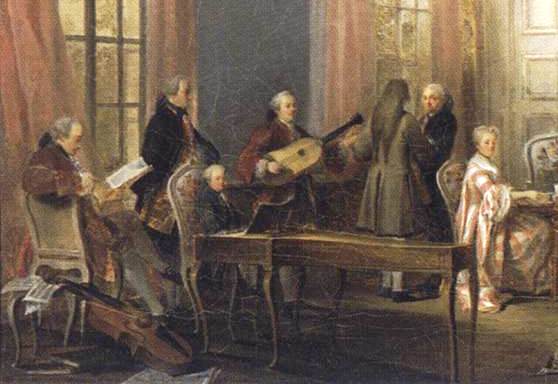
This period-instrument band is superlative, a healthy mix of young musicians with well-established names like horn-player Roger Montgomery and harpsichordist Christopher Bucknall. The opening symphony, sinfonietta more like, Mozartino’s B flat major effort now numbered Five, flashed past so swiftly that you only just had time to absorb the rapier-like strings projecting so cleanly in the Wigmore, especially incisive when doubled by the two oboes (Mozart at the keyboard among musicians in Paris, 1766, pictured below). Principal oboist James Eastaway brought astonishing artistry to bear on the slow movement of Bohemian Johann Baptist Vanhal’s Symphony in G minor; its naivety could border on the inane, but sweet high tone and discreet ornamentation of the main theme’s return kept it charming. And there was more work for Eastaway in the lovely trio of the Menuetto.
 Real individuality was to be found here, starting with the chromatic minor-key opening answered by a blaze of major light; Page, so good at getting pianissimos from his players, made sure the exposition repeat was even quieter. The orchestra blazed in a proto-Beethoven explosion, the first movement of Franz Ignaz Beck’s Symphony in D, looking forward to the iconoclastic master in its fierce tremolos and sudden accents; the manner is perhaps more interesting than the matter. A final symphony only recently attibuted definitively to Wolfgang rather than father Leopold, the "Old Lambach", showed some promise in the first movement – its stalking bass lines probably share no more than a convention of the time with the "Lo conosco?" sequence from Figaro – and perfect competence in the second and third. Page engagingly told us that this would not be a performance anything like as "authentic" as the first, since Leopold denounced each section, and some of the players, as absolutely awful.
The interloping symphonists were needed to ballast the often charming gaucheness of the boy Mozart. Two concert arias were small pickings for a singer as consummate as Alder, who had to contend with thick middle textures in “Per pietà”, sadly the plea not of Da Ponte’s Fiordiligi’s but of Metastasio’s Artaxerxes, and only really got to show her subtlety in two cadenzas (the second especially impressive with a diminuendo on the high note). She palpitated more maturely against the pizzicato heartbeats of an aria from Guglielmi’s Lo spirito del contradizione and charmed us in an artless ditty by JC Bach for the Vauxhall Pleasure Gardens. Despite clear diction, though, Alder was not best served by the amplifying, voice-muddying Wigmore acoustic (both the Royal Albert Hall and the Sam Wanamaker Playhouse, however, have already served her to perfection).
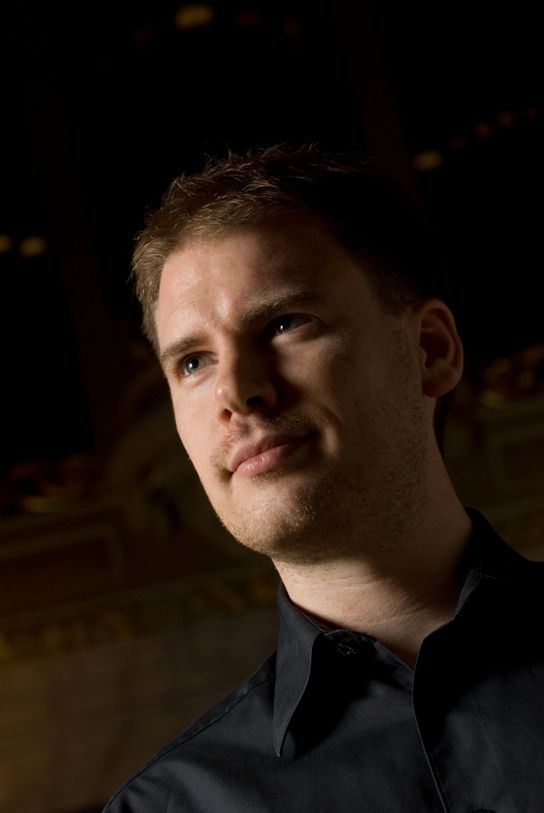 Hulett (pictured right by Hans Lebbe), sounding far more virile in this tricky space than your average ex-choral-scholar tenor, was favoured with the gravity of the “Et incarnatus est” from Haydn’s Missa Cellensis – the repeated words don’t really fit the music, but never mind – and the most interestingly orchestrated of the arias, from Jommelli’s Il Vologeso, where the strings have an elaborate weave in the recitative and hold the foreground in the aria proper. Jommelli’s notching-up of operas (80) seems to have been subordinate to Guglielmi’s (95), but he had the greater reputation in his time, and it will be fascinating to hear the complete Il Vologeso from Classical Opera in April.
The tenor’s last aria was a compulsory piece of grovelling by the young Mozart, newly returned from an exhausting European tour, at the feet of Salzburg’s Prince-Archbishop (“so great and so many are Sigismund’s merits that our feeble skills are unable to fathom that venerable heart”). It was the only piece on the generous programme which slightly outstayed its welcome, regardless of varying qualities – quite a feat of good planning and energetic execution on Page’s part.



Add comment