The first thing to make clear is that Robert Mapplethorpe, notorious for his photograph of himself with a bullwhip up his arse, is not really a photographer: he is a sculptor who works in the medium of photography. What else can explain the marble and ebony of his chiselled subjects, or the fact that most of the works selected for this show as responses to Mapplethorpe are sculptures?
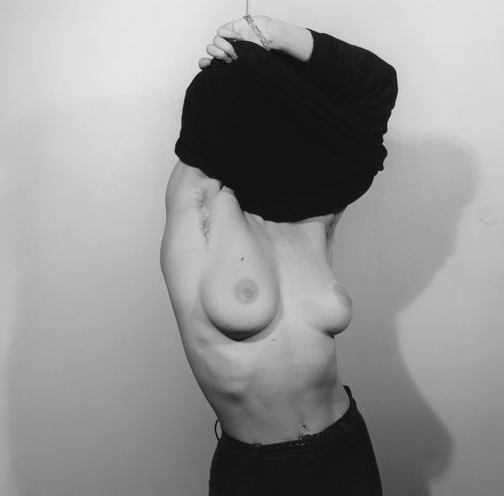
The Derrick Cross series is a perfect example. A nude, athletic black model looks like he has been hacked out of marble and then smoothed to a sheen by a loving creator, and the simple, still setting suggests a photo taken in a gallery, the subject an Apollo or Hercules lately recovered. We see several angles and poses, each deliberate and monumental. Lisa Lyon (pictured below), taking off her black top and exposing her breasts, does not even look like she has been interrupted, like this is an action shot – she is perfectly still, her ribcage delicately showing through her skin.
Even the bullwhip photo, present here, comes across as if Mapplethorpe is trying to colonise a new realm of sculpture with new poses and new boundaries. Clad in leather, bent forward, the whip trailing out of his bottom and lying along the floor, like the tail of a docile animal, Mapplethorpe stares defiantly at the camera as if to say, I too am a subject worthy of a sculpture. Instead of the flexing athletes and surprised goddesses of the Greeks, Mapplethorpe is extending sculpture to modern humans and reclaiming the primacy of the identifiably human body from Henry Moore et al.
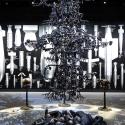
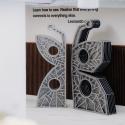
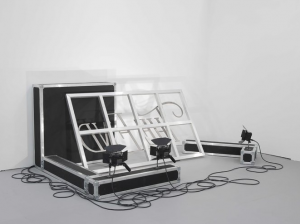
The responding works have been well chosen. Banks Violette’s Not Yet Titled (The End Edition) (pictured below) has the words “The End” in languid script cast in steel mounted on a steel frame, seen from behind leaning on a case, like a rejected prop. It feels like you are looking behind the final shot of a Hollywood film – when those words roll up, they are really as hard and comfortless as steel – and both the grey of the steel and the destruction of a certain mystique are concerns of Mapplethorpe’s.
 A great discovery is Marc Swanson’s Untitled (Vertical Shirt and Chains Box), where two T-shirts have been bleached by the sun so they resemble a cowhide, then stitched together and stretched in a wooden frame from which thin golden chains are suspended, suggesting the sort of bondage we see in other Mapplethorpe photos. There is a tinkling glamorous tension in this work, from a gay Brooklyn hipster raised on an upstate New York farm.
Tom Burr’s Blue Folding Screen, (or, Blue Movie, 1969, aka Fuck) is a wood and Plexiglass screen, matt black on one side, cerulean blue and reflective on the other. As you stand in front of the blue side, you realise that although screens are meant to block vision, this one shows us back to ourselves. This evokes Mapplethorpe’s concern with mirrors both real (several of which are on display here) and metaphorical, in the form of his photographs.
The show, curated by the Scissor Sisters (who used Mapplethorpe’s photo of Peter Reed, buttocks clenched, on the cover of their latest album), also features some of Mapplethorpe’s more humorous and less-seen works, like a collage called Freaks, where old cut-out photos of two obese people are placed in planes of bright colours and look rather jolly, instead of victimised. But it is in the sculpture of his photographs that we see Mapplethorpe’s brilliance, giving back the human form dignity and permanence and monumentality in art, none of which can ever be perpetually sustained in life.
- Robert Mapplethorpe: Night Work runs at Alison Jacques Gallery, Berners Street, until 19 March
- Find Scissor Sisters on Amazon