

Great excitement at the Artes Mundi Awards in Cardiff’s National Museum last night as the UK’s largest cash prize for the winner of any UK contemporary art competition - a staggering £40,000 - was presented to the Israeli artist Yael Bartana. Two hours before the announcement, the judges were still undecided but the white smoke moment saw Bartana’s two films (part of an ongoing trilogy) land the cheque.
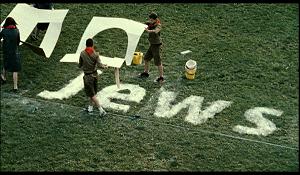
Like many of the 500 contenders, Bartana works with documentary film. She applies it to interesting challenges to the meaning of Zionism today and plays with the idea of returning Polish Jews to Poland: a reverse migration depicted through the construction of a kibbutz in the suburb of a Polish town and subtly developed into a ghetto with the appearance of a prison camp (see picture below). Bartana views Israel’s crisis of identity and relationship with Palestine from a distance, through life in Amsterdam, and she shares dual citizenship with many of the eight short-listed candidates.
 The majority are from Eastern EU and post-Soviet countries, with the Peruvian Fernando Bryce now resident in Berlin, the Bulgarian Ergun Çavusoglu in London, and Albanian Adrian Paci, in Italy. Their life stories inspire themes of migration, immigration and travel – subjects examined in the most literal representation by Gulnara Kasmalieva and Muratbek Djumaliev’s 5-channel video documentary of the continuous flow of lorry traffic carrying goods from their home in Kyrgyzstan’s capital Bishkek, to China.
Chen Chieh-Jen’s video interpretation of the consumer boom in Taiwan is countered by images of abandoned factories (bust). In similar vein, Fernando Bryce rewrites history through presentations of old newspaper articles and adverts. In post-Soviet Russia, Olga Chernysheva’s films confirm her move from the sensitive documentary photography which launched her and include scenes in museums in Wales and Russia, carrying soundtracks in each language.
Always interesting and truly international, the Artes Mundi exhibition (at the National Museum, Cardiff until 9 June) again confirms the shift from conventional photography as the chosen media to express the theme (“One world, all humanity”) to film and video - a source of discussion on the website http://www.artesmundi.org. But that shift enables richer, more layered expressions of the artists’ conceptual plans. My unease is with the decision to award the entire £40,000 to one artist instead of also benefiting a perhaps smaller shortlist.
Sue Steward

Add comment