

The Aviva studios in Manchester consist of an open plan warehouse with black walls and no windows. The space is vast, dark and difficult to occupy, but since Ai Weiwei’s work tends to be large, gloomy and uncompromising this, in a way, is a perfect marriage. Don’t expect a bundle of laughs, though.
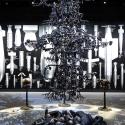
The first thing you see is a huge chandelier made of Murano glass. Traditionally these flamboyant lights are a riot of baroque shapes and gaudy colours. But Ai’s three-tiered monster consists of three tonnes of black skeletons (main picture). Called La Commedia Humana (The Human Comedy), it hangs above a heap of corpses made of black pvc.
The dead may be migrants who drowned during a hazardous crossing, since nearby hangs a 49 meter long dinghy carrying hundreds of similar figures alongside unfortunates who have fallen into an imaginary sea.
History of Bombs 2019/25 (main picture) demonstrates other ways to die. Filling an entire wall are rows of bombs pointing downwards as thought raining from the sky. Ranging in size from a hand grenade to the Tsa Bomba, a 50 megaton hydrogen bomb, these gleaming missiles are a chilling sight. A display of human ingenuity focused on ever more devastating ways to kill even more people, they are made of Lego bricks – toys for the boys.
One of the few light-hearted pieces on show is also made of Lego. Napoleon on a Zebra (2023) is a spoof on Jacques-Louis David’s 1801 portrait of Napoleon on a rearing charger, supposedly leading his troops over the Alps to conquer Austria. Such is the painting’s propaganda appeal that it may have inspired the absurd photo of a bare-chested Vladimir Putin riding bareback. But swapping Napoleon’s horse for a zebra (in reference to France’s colonial ambitions in Africa) complicates the message and weakens the work. It’s a mistake repeated throughout the exhibition; so many conflicting messages vie for attention that they tend to cancel each other out.
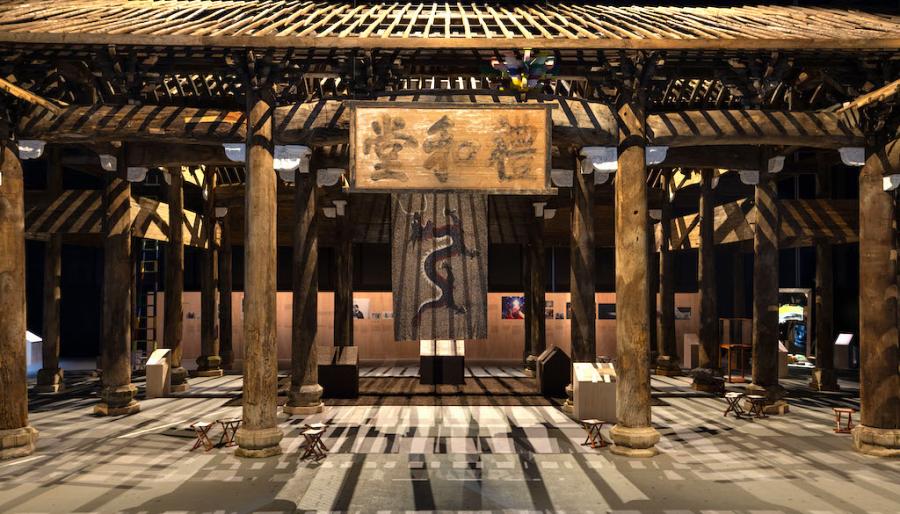
Ai lived in the United States for 12 years and, when he returned to China in 1993, he was shocked by the changes taking place. The urban fabric was being torn apart to make way for apartment blocks while historic buildings were being dismantled and burned or sold off for timber. Ai spotted the beams of a Ming dynasty temple stashed in a carpenter’s yard and, luckily, was able to save the ancient structure. Restored to its former glory, the Wang Family Ancestral Hall (pictured above) now fills one end of the studios.
Standing inside this majestic building, you hear a voice reciting a roster of names; it commemorates the children killed in the Sichuan earthquake of 2008, when their jerry built schools collapsed. Shortcuts taken by corrupt builders contributed to the deaths of 5,197 students. The poorly constructed schools crumpled like a house of cards while, thanks to dedicated craftsmanship, the temple stood for over 1500 years. The contrast makes for a powerful comment on changing values and priorities.
Inside the temple is Teahouse (2011). Standing on a thick bed of tea leaves are three little houses made of compressed tea. Britain’s enthusiasm for the drink brought wealth to families like the Wangs, but also created a trade imbalance that led to the opium wars. Placing the work inside the temple is confusing, though. It’s an unwanted distraction, especially as the shifting trade relations between China and the West are the subject of Eight-Nation Alliance Flags 2024, the most striking installation in the show.
The flags (pictured below) represent the eight nations who, in 1900, formed an unholy alliance to invade China. Hungry for new export opportunities, Britain, France, Germany, Italy, Japan, Russia, the United States and the Austro-Hungarian Empire joined forces to open up Chinese ports to foreign trade. And fabrics from the cotton mills of Manchester, whose output earned the city the nickname of “Cottonopolis”, were among the goods needing a bigger market.
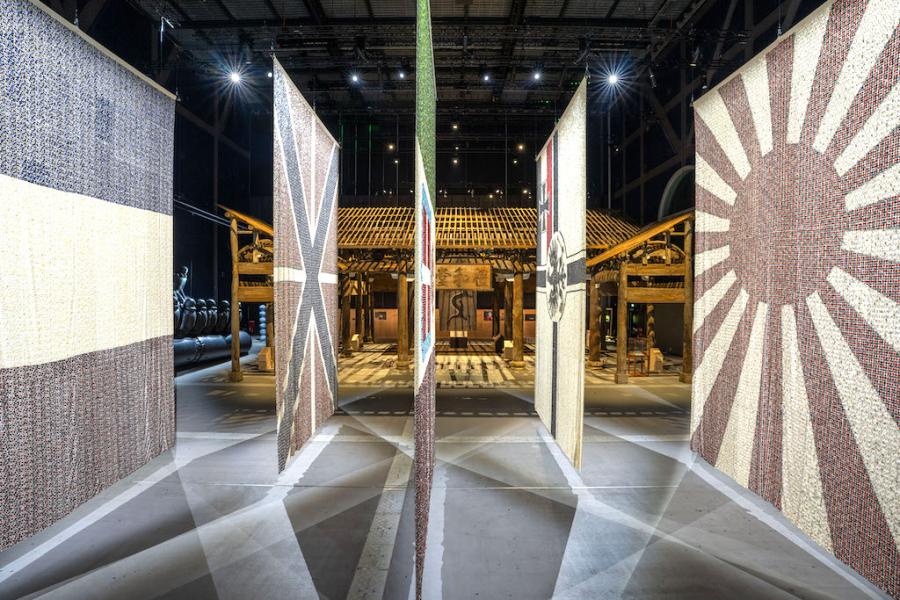
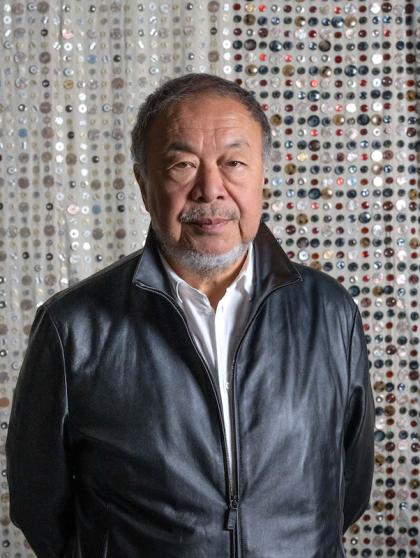
Ai recreated the designs using 9,000 different kinds of buttons that together weigh 30 tonnes (pictured above right: Ai Weiwei in front of an All-Nation Alliance Flag). And the labour involved in sorting, selecting and sewing the buttons onto lengths of cloth echoes the tedium of working in the cotton mills. Ai bought the buttons from a company in Croydon bankrupted by the invention of zips and velcro, so the flags are a comment on changing market forces as well as on fluctuating Anglo-Chinese trade relations which now favour China, once more.
Ai’s fascination with history as well as current affairs leads him in dozens of different directions. This informs and enriches the work, but when too many scenarios are juxtaposed, the frames of reference competing for attention become too much to take in. Lengthy explanatory texts fill a show which is more like a history lesson than an art exhibition. “I’m interested in ideas”, say Ai, “how to conceptualise them, how to create a language and find possibilities. That matters to me more than the final object.” And it shows… More editing please !



Add comment