

Lucy Bailey's production of Christie's Witness for the Prosecution, first staged at County Hall in 2017, has a few years to make up on The Mousetrap's near 70, but it has already proved its staying power, despite the hiatus of the lockdown months.
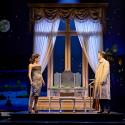
The venue is inevitably a significant part of its attraction. The courtroom at County Hall - once the chamber which saw the political debates of the Greater London Council - is a magnificent, atmospheric space, standing in for the Old Bailey. A statue of Justice, scales in hand, presides over the action and 12 members of the audience are co-opted as jurors. Using a mix of traditional court format and a simple stage, which allows for a visit to the barrister's chambers, with audience on three sides in a fan shape, William Dudley's design exploits the room's polished-wood solemnity to the full. Christie's attention to the detail of court proceedings - she researched her subject exhaustively and sought expert advice - also pays dividends as time and again a word or reported action is seen in a different light when examined by Defence or Prosecution, so that guilt and innocence seem to slide in and out of view. For the lawyers, getting to the truth is clearly secondary to winning the gladiatorial encounter. 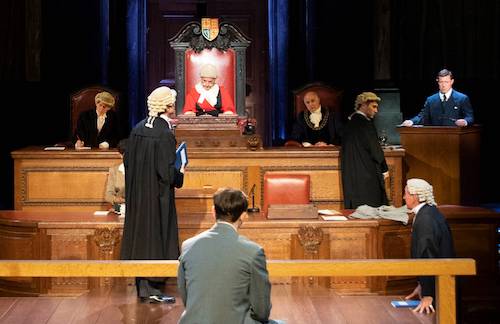 Christie adapted her short story, originally published as "Traitor Hands", for the stage, emphasising the court duel and adding a surprise at the end. It was a great success in London and on Broadway in the early 1950s and the famous film starring Marlene Dietrich and Charles Laughton was released in 1957. Sarah Phelps's version in 2016, the latest for television, may be the one most audiences are familiar with. If so, they are in for a shock.
It would, of course, be unforgivable to give too much away: there are surprises up to the last minute. Leonard Vole (Joe McNamara) an unemployed mechanic, is accused of murdering a rich older woman who has named him in her will. There is blood on his sleeve, which he claims came from an accidental cut while preparing ham at home. But was he at home? What part does his German wife - if she is his wife - intend to play in his defence or prosecution? A woman shaking the certainties of this overwhelmingly male system can't help but resonate now.
 The swaggering barristers sound like actors, but only to the extent that real counsel often do, relishing the overlap between theatre and courtroom and taking pleasure in performance and occasional wit. Despite the setting being post-World War II, there is a whiff of the penny dreadful, in keeping with the era of the surroundings. Christie's indulgence in melodrama is enthusiastically embraced by Bailey and emphasised by Mic Pool's stentorian soundscape, but events nevertheless unfold rapidly, convincing in the moment.
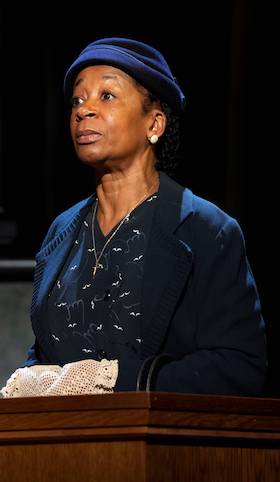
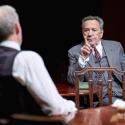
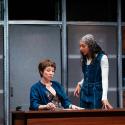
One of the notable things about this new cast is that several are making their West End debut, including Joe McNamara as the accused, callow (or is he crafty?) Leonard Vole. Emer McDaid, best known for Game of Thrones, is sassy, bold and potentially dangerous as Romaine Vole, Jonathan Firth as determined Sir Wilfrid Robarts for the Defence, Miles Richardson as Mr Myers for the Prosecution and Martin Turner as Mr Justice Wainwright exude the confident superiority of their class and calling, while Yvonne Gidden (above) as the murder victim's housekeeper is memorable for her garrulous certainty of Vole's guilt. Altogether, including the brown-overalled "tradesmen" changing the sets, they add up to an efficient ensemble in Lucy Bailey's highly enjoyable production.
Verdict: Guilty of providing gripping entertainment. Sentence: Probably several more years.




Add comment