David Hemmings was, by his own later admission, a knowing and bumptious boy when Britten cast him as the ill-fated Miles in his operatic adaptation of Henry James’s The Turn of the Screw. The upheaval Hemmings wrought in Aldeburgh’s Crag House when Britten and his life-partner Peter Pears were living there has potential for a similar ambiguity to the opera’s carousel of what’s innocent and what’s “depraved,” and Kevin Kelly has realized the essential drama in it.
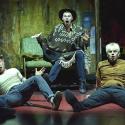
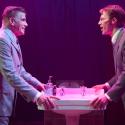
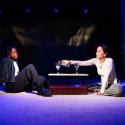
The main problem is that no 12-year-old of unbroken voice was going to act in a more explicit take than the opera’s on who is poisoned victim and who snake given the very tricky issue of pederasty. The solution is as good as it can be: present a well-spoken Hemmings in later life looking back on the best time of his life, the inspiration of working with a great genius, and then let him loose as Master David the cheeky Cockney (from Tolworth?) Liam Watson pulls off the double-act plausibly, and there’s no false note in the acting of the other leads as their characters variously come under his spell – or not, in the case of Peter Pears. Simon Willmont (pictured below, right, with Gary Tushaw as Britten) has the benefit of some of Kelly’s best writing in the strongest dramatic confrontation, Here the boy – described in reality by his older self as “more heterosexual than Genghis Khan”, a curious line which hasn’t found its way in to the play – furiously throws all the prejudice inculcated by his father against “you homos” in the face of Pears’s fatherly concern. 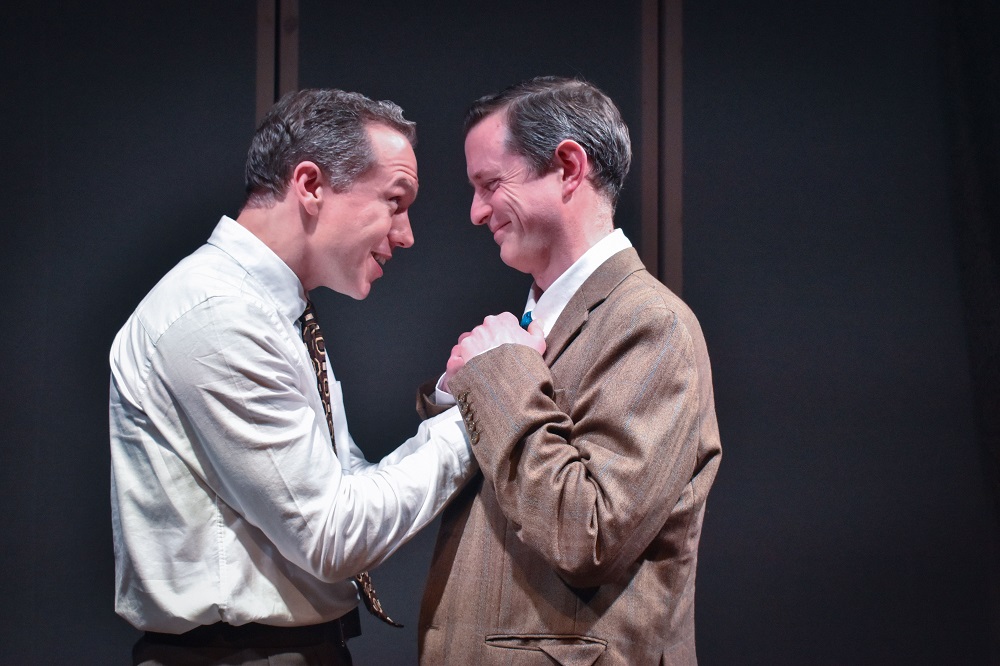 Kelly wants to gain as much sympathy as he can for the difficulties of the musical couple’s way of life at a time – the mid-1950s – before homosexual acts were legalized. Imogen Holst, Britten’s wonderful amanuensis, is propositioned by the composer for a “white marriage” with Pears to keep up appearances, and turns him down with quiet dignity in Jo Wickham’s fine portrayal (strange coincidence: the play Ben and Imo is due to open at the Royal Shakespeare Company’s Swan Theatre later this month). Gary Tushaw (pictured below with Wickham) is immensely charismatic as a Britten of infinite variety; the complications of his infatuation with young David are registered in another excellent scene where he, too, becomes a kid in their horseplay. Kelly has a good point in asking who Britten really is within the context of the opera: perhaps the Governess, more sinned against than sinning? For those of us who know the text, the insertion of lines from Myfanwy Piper’s libretto into the mouths of Britten and Pears (who of course created the role of the sinister dead valet Peter Quint) can feel a bit clunky, but the intention is good.
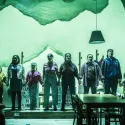
There’s always the danger of packing in too much information: the audience has to be told about the James adaptation, the dangers facing gay couples, the various relationships, and sometimes you feel a hand on your shoulder saying “have you got that?” Least successful is a nightmare scene where Britten is faced with a judge who threatens him with obliteration of his life’s work. Oscar Wilde and Alan Turing pop up somewhat arbitrarily, though Jonathan Clarkson, whose main role is as director Basil Coleman, acts well throughout. 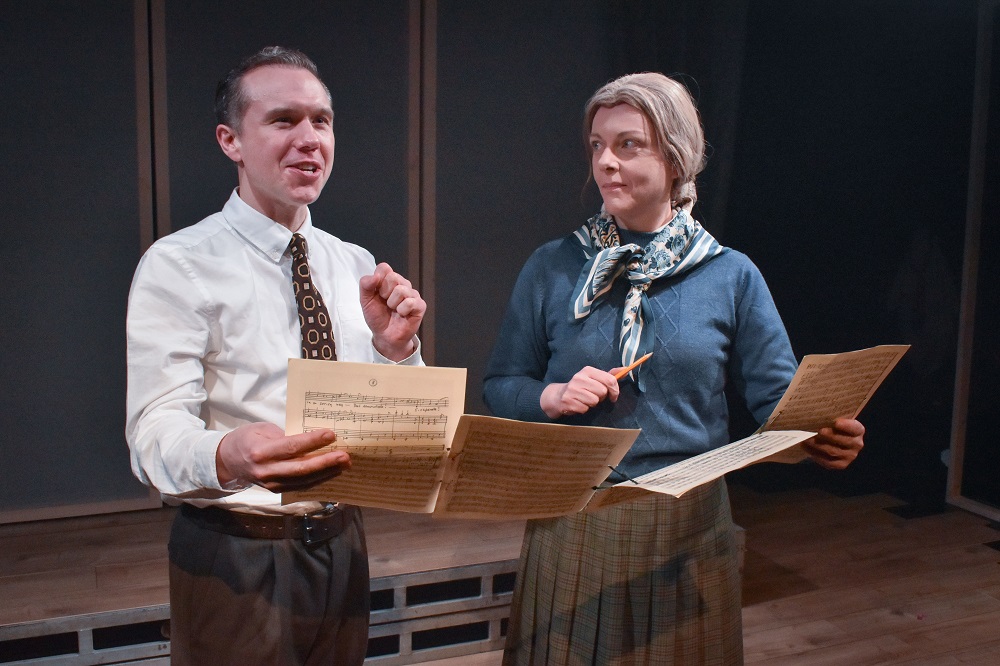 There’s also a “what the heck?” feeling about the composer introducing the boy to his Young Person’s Guide to the Orchestra aka Variations and Fugue on a Theme of Purcell, where we leap unfathomably to the later stages within seconds and a bit of mad conducting seems totally out of place. The music – Handel and Vaughan Williams as well as Britten – is well sung when live, but the visuals are weak; it would surely have been better for the strong acting to take place within a black box rather than the flimsy framework which passes for “design”.
It might have overburdened the drama to explain that the young man who was Britten’s “Young Apollo” in his first love affair, Wulff Scherchen, was in his late teens to Britten’s early twenties when the relationship was consummated; and a crucial dimension which has always pained me, Britten’s confession to several reliable collaborators that he was raped by a master at his school, isn’t brought in to the picture. Kelly and his director Tim McArthur are clear, as any responsible Brittenites must be, that though the composer might have harboured sexual desires towards pre-pubescent boys, he never acted on them (well, not beyond a kiss, in a relationship obliquely referred to here).
Were it not for the acting, I’d say stick to the chapter “Malo…than a naughty boy” in John Bridcut’s superbly nuanced Britten’s Children (Faber), a major source of lines for Hemmings drawn from the interview conducted in what was originally a television documentary (Kelly fails to give credit in his acknowledgments). But the performers’ hard work, and the ongoing efforts of the King’s Head in its new, underground venue, deserve our support.