You could say that the Titanic has been done to death, and that any new show would really need to say something different, something so far unknown, unearth a new angle, find new facts. To some extent, Treasured does that. Who’s ever heard of Mouser, the Titanic cat, who is supposed to have carried all six of her new-born kittens off the ship in Southampton? Allegedly her feline prescience sensed impending doom.
White Star had also, it seems, wanted to build the ship in Liverpool – for which read Birkenhead on the other side of the Mersey – but the contract went to Harland and Wolff in Belfast. What did happen at the point of the centenary commemoration in the spring was that Liverpool was forgotten. Belfast, Southampton, New York and London all featured prominently. Yet Liverpool was the port of registry of the ship and it was the headquarters of the White Star Line which owned the ship as well as its arch-rival of the time, Cunard. A fair proportion of the crew and officers came from the Merseyside area too.
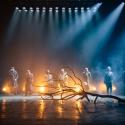
A projection screen falls from the full height of the cathedral ceiling. A stage runs around a quarter the length of the main nave
So, in the words of artistic director Jen Heyes, it seemed entirely appropriate to bring Titanic “home” for this commemoration. It was appropriate, too, that Treasured should take place in Liverpool’s titanic Anglican Cathedral where the massive space is used to spectacular effect in a work which batters the senses.
Even the weather obliged at last night’s first performance, as the audience was asked to enter the building through the Lady Chapel which entailed a long walk through wind, driving rain and near darkness. The idea was that the journey started there. For, in a smallish tableau in the centre of the cleared chapel space, an historical archivist was trawling through papers in boxes labelled National Maritime Museum of Canada. While walking round, Brendan Ball, principal trumpet of the Royal Liverpool Philharmonic Orchestra played a haunting, almost jarring melody.
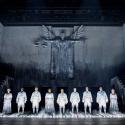
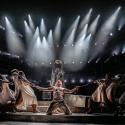
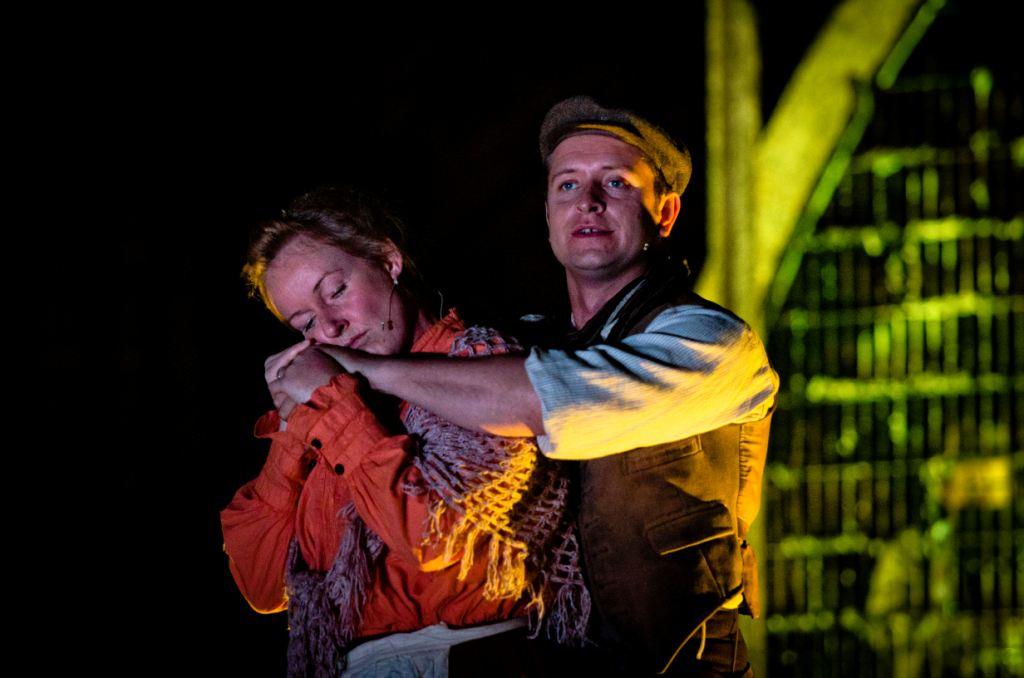 Out of the chapel and into the main cathedral space, you walk behind the high altar, past one passenger sitting here, a pile of cases there, a lost pair of child’s shoes cast aside. And then the full scale of the production actually hits home. A projection screen falls from the full height of the cathedral ceiling. A stage runs around a quarter the length of the main nave. And those are just first impressions.
The piece is written – words and music – by Irish composer Ailís Ní Ríain already heard in Liverpool in works for contemporary music group Ensemble 10:10. The music, often introspective, rarely became intrusive. But it is the pacy performances from the actors which make the piece work – for the most part. That pace seems to falter towards the end, however, as the show doesn’t seem to know how to end. There is a point when a newspaper seller comes down the stage bearing the placard "Titanic Disaster: Great Loss of Life" and the narrative seems to draw to a close – only to start off again for another half hour.
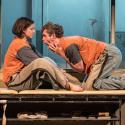
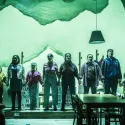
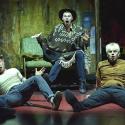
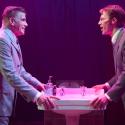
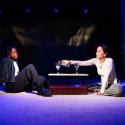
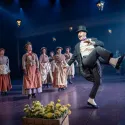
Powerful performances come from the actors playing the family of the Irish shipbuilder (Laura Campbell and Christopher Hollinshead) and some of the steerage passengers who came off so badly. For once, this was not a story told from the perspective of a first class passenger – always the easy option since these were the ones who survived, in large part. Instead we heard from the likes of Lucy, the first class stewardess (Nicola Bentley), a survivor whose voice is often lost in the melee.
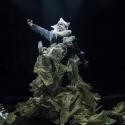
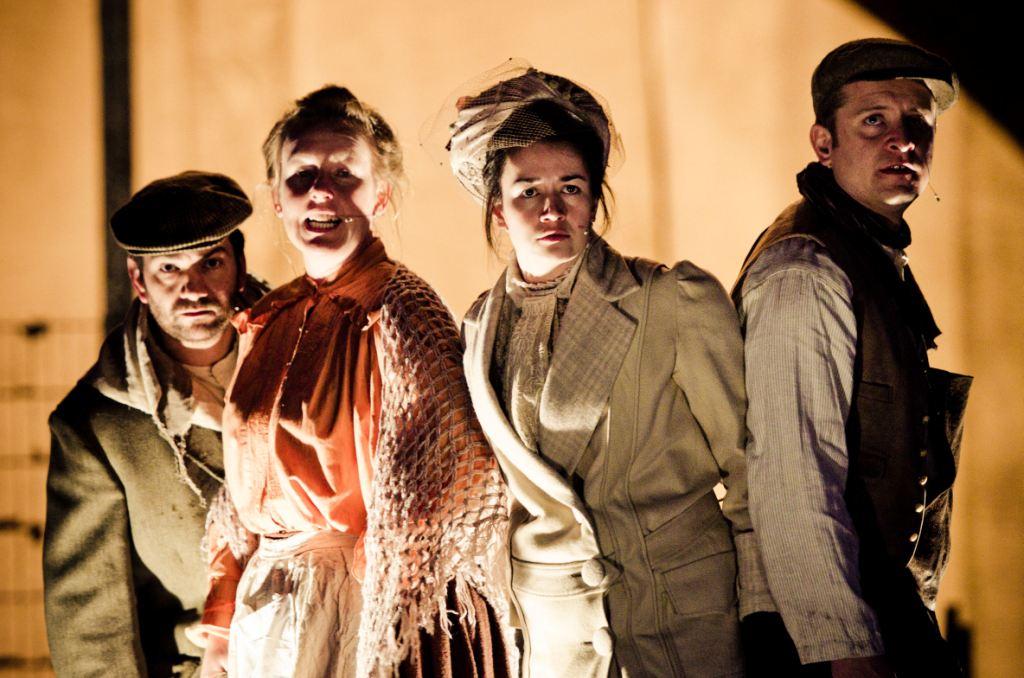 The really eerie moments come from the projections onto the huge wall spaces of the cathedral. It is uncanny to witness the ship sailing down into the nave. To find yourself underneath looking up at the hull sailing overhead is chilling. A high-wire act features a young woman descending into the deep and drowning, her lifeless body hanging a hundred or so feet up in the rippling blue space of the cathedral.
Treasured is a clever, eerie, disturbing piece of work. Cut to the Chase Productions told a tale of dreams shattered, of greed which met a sorry end, of power and dominance which met the power of nature – and came off the worse. It should be seen.