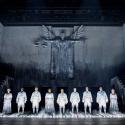
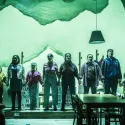
This warm-hearted production of E Nesbit’s most famous novel premiered to glowing reviews at its site-specific venue last summer. I didn‘t catch it last year, but I doubt this swift revival is any less captivating, nor the new cast any less sure-footed or engaging. Marcus Brigstocke has taken on the role of the gruff but loveable station master Mr Perks, whilst the three adult actors playing the children - Amy Noble as the sensible Bobby, Tim Lewis as the ever so mildly rebellious Peter and Grace Rowe as the charmingly ditzy Phyllis - bring just the right balance of earnestness and humour, buoyancy and depth to their parts.
Playwright Mike Kenny has cleverly adapted the story as a memory play: the “children” play adult characters looking back as well as re-enacting their childhood selves. This brings an added emotional texture to the story whilst reinforcing themes of lost innocence and aching nostalgia. It also ensures that when the trio are finally replaced by real child actors in the beautifully choreographed closing sequence, there’ll be very few adults in the audience who won‘t leave the theatre just a little moist-eyed. Indeed, that usually anodyne and heartily off-putting recommendation “suitable for kids from eight to 80” - and a few years either side - has rarely come in such a persuasive package.
Reassuringly, there’s little that feels forced, as there often is, in these adults playing youngsters. There is a respect for the seriousness of childhood. Just as Nesbit implicitly understood the deeply felt emotional dramas that are played out in childhood - the author lost her own father when she was just four - so the actors defly avoid the saccharinely cutesy in their interpretations, snugly fitting into their roles in a way that seems refreshingly natural, and with a physicality wholly convincing.
The movable acting area on which much of the action takes place is a masterstroke
This doesn’t mean there aren’t laughs aplenty: Phyllis’s goofiness is both funny and endearing, made even more so because Rowe - who shines in the part - plays the youngest of the siblings with a winning combination of wide-eyed naivity and self-awareness. The children's various escapades - diverting a train crash that will certainly prove fatal, rescuing a boy who’s been injured on the tracks (the awkward flirtation that follows between him and Bobby reminds us that she is on the cusp of womanhood and is leaving the security of childhood behind), befriending the “old gentleman“ who will prove in part their saviour - are, of course, typical of the adventure genre. But central to Nesbit’s story is always that sense of loss which is grounded in real and deeply felt experience, and Kenny’s adaptation serves it well.
Joanna Scotcher’s award-winning set is an ingeniously conceived, fully-fledged Edwardian period piece: there’s a wooden footbridge at one end of what was once the Eurostar terminal, and there’s a signal box on one side of it. The platform roofs, under which the audience sit either side of the tracks – tickets are charmingly labelled Platform 1 or Platform 2 – are trimmed with white wooden slats familiar to many a quiet suburban station. The movable acting area on which much of the action takes place - pushed manually back and forth by appropriately attired stagehands – is a masterstroke, giving the action a sense of fluidity and suggesting the swift passage of times as it rolls from one end of the track to the other. Meanwhile puffs of steam rise up and around our feet and, equally evocative, Christopher Maddin provides a score that is rousingly cinematic.
And then there is the pièce de résistance – the arrival of the 66-tonne gleaming green Stirling Single steam engine, which is awarded its own round of applause. It certainly is a beauty. However, there is just one “authentic” detail that won’t be welcome: even for a small to averagely tall adult the lack of legroom makes it feel like you’ve been squeezed into cramped economy class for the duration of a trip to Yorkshire.
And if there are any quibbles regarding Damian Cruden’s confident production it is this: the action moves at such a pace that there is almost no time to draw breath. This means that the two crucial scenes of dramatic tension, where one should feel genuine emotional tremors, are truncated to the theatrical equivalent of a speed date. So the scene in which Mr Perks expresses his angry humiliation when he thinks he’s been treated as a charity case reaches crisis point then resolution in almost two blinks of an eye. But worse, the father’s homecoming is somewhat swallowed by the unexpected speed with which it occurs. Slightly more varied pacing would have been welcome, but this is still an undeniably magical production.