Revivals of George Bernard Shaw’s Pygmalion are generally too busy making an artistic case for the play over the My Fair Lady musical to worry about listening out for contemporary resonances. But in many ways Simon Cowell is the Henry Higgins of our day: betting with his fellow X-Factor judges that he can pass off such-and-such under-privileged teen as a pop star; putting them through their paces before a rigorous public test; and showing little regard for what will happen once they have been torn out of their reality and developed a taste for limos and red carpets, and Judgment Day has come and gone.
In fact when Rupert Everett first spoke in 2009 about wanting to revive Shaw’s subverted phonetic fairytale, it was with his eye on glamour model Katie Price for the role of Eliza Doolittle – the raucous cockney flower girl whom Professor Higgins wagers he can pass off as a Duchess following six months’-worth of lessons in her own language. Instead, in Philip Prowse’s new production for the Chichester Festival, Everett plays Higgins opposite Honeysuckle Weeks – a Sussex girl and graduate of the CFT youth theatre whose own perfect elocution was bought at nearby girls' school Roedean.
The casting may not be so witty as Everett hoped. But from her strutting entrance into Higgins’ office demanding lessons (a riot of Edwardian eccentricity in unbuttoned ankle boots and thread-bare feathered hat) to the parasol-assisted, pointy-toed walk and painstakingly articulated swearing of her first society outing, Weeks approaches almost every scene with the hint of a smile playing permanently across her high cheekbones. This has both the effect of giving her Eliza an extra twinkle of intelligence, and making you cast around for her co-conspirator.
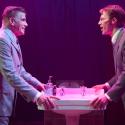
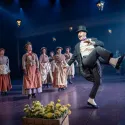
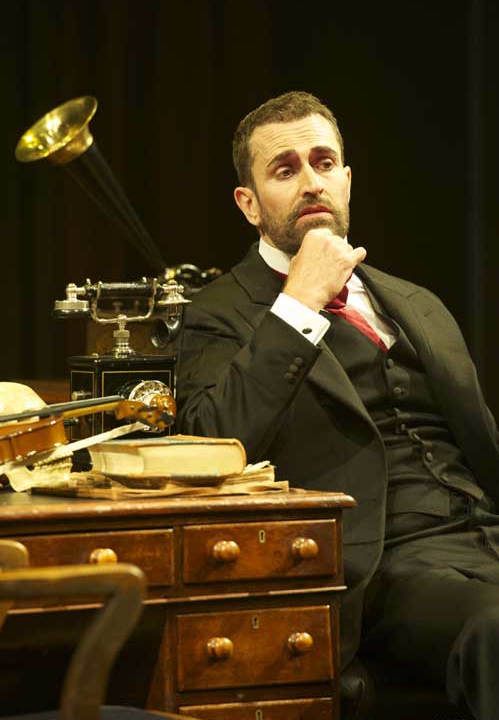 Such an Eliza needs a watchful Petruchio to respond to her playful, calculating Kate. But she doesn’t find it in Everett (pictured right), here returning to the UK stage after a 15-year absence, who spends a good deal of his stage time flipping his coat tails and speaks as if the script bore the word "incorrigibly" before every sentence. His Higgins is excessively sulky, slouchy, selfish to the last, and when not visiting his mother (Stephanie Cole), inhabits an office that has more than a touch of Sherlock Holmes’ lair about it.
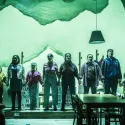
Director/ designer Prowse’s concertina-like stage back folds open into towering bookcases crammed with case notes, with Peter Eyre’s commanding but gentlemanly Colonel Pickering comfortably ensconced in an armchair à la Dr Watson – sharing his friend’s enthusiasms for the project but not his bad-mannered eccentricities – and regular interruptions from Susie Blake’s disapproving but indulgent housekeeper. Everett’s Higgins even enters the scene (via the stage lift) with a violin tucked under his rather famous chin.
It’s not a bad performance. But his trademark languor is at odds with the side of Higgins so passionate about his work that we first meet him out "collecting" dialects on a stormy night. And as the run progresses we’d hope for more flair, at least, in his delivery of Shaw’s colourful insults (at their first encounter alone Eliza is called a "bilious pigeon" and "squashed cabbage"). After all, this is the man who described Madonna in his memoirs as "an old whiny barmaid".
Shaw’s play is a social comedy with two serious, at first seemingly jarring, agendas: his very real concern with the increasing sloppiness of speech (he chaired the BBC’s Advisory Committee On Spoken English – this was a few years ahead of the codification of RP), and his great humanitarian interest in women’s rights. But it’s hard to feel that Chichester’s Eliza is ever really in danger. Phil Davis’s Alfred Doolittle, the father who sells Eliza for a fiver and recommends Higgins wallop her into submission, is very funny but never really threatening, and ends up marrying his latest wife – a woman so unladylike she’s actually played here by a man – to a peal of comically funereal church bells.
Pygmalion concludes much less happily than My Fair Lady. Unswayed by Higgins’ plea that he is in fact the least class-conscious person of all because he treats everybody equally awfully, Eliza leaves his household to marry the rather wet but eager toff Freddy (Peter Sandys-Clarke). Prowse closes the play with Everett hunched stage front, his back to the wedding scene, looking uncomprehendingly at the bunch of flowers Weeks has pointedly tossed into his lap from her bouquet. Is this Pygmalion unable to declare his love for his creation, or perhaps even to feel it?
What this production does make very clear is that this pathologically self-absorbed, hobbyistically misogynistic and to varying degrees troubled bastard has excluded himself from society to an even greater degree than Eliza, tripped over by theatre-goers in Covent Garden Flower Market, found herself in the opening scene. But Everett’s under-powered portrait brings us no closer to understanding quite why.
OVERLEAF: MORE GEORGE BERNARD SHAW ON THEARTSDESK
Mrs Warren's Profession, Comedy Theatre (2010). Felicity Kendal in plodding revival of Shaw's take on prostitution
The Doctor's Dilemma, National Theatre (2012). Tragedy is the spoonful of sugar that helps this medical satire go down
Widowers' Houses, Orange Tree Theatre (2014). A timely revival of a timeless satire
Man and Superman, National Theatre (2015). A theatrical trip to Hell with Ralph Fiennes has some heavenly moments
The Philanderer, Orange Tree Theatre (2016). Modern-dress Shaw is resonant but long-winded
Saint Joan, Donmar Warehouse (2016). Revival of Shaw classic is a tour de force for Gemma Arterton