Did you know that women watch porn? That they wank? Shock. Horror. Dismay. If you really are surprised by this non-revelation then maybe you need to get a ticket to see Sophia Chetin-Leuner’s Porn Play at the Royal Court’s studio space. But, wait a minute, it’s sold out already. Maybe because it stars Ambika Mod (remember her from Every Brilliant Thing @Sohoplace, or Netflix’s One Day?). Anyway, this show is West End bound so you’ll definitely get a chance to see it – its in-the-round staging would work well @Sohoplace. But while Mod is the draw, what’s the play about?
Mod plays Ani Sandhu, an award-winning 30-something Eng Lit academic who specializes in Milton studies, and whose addiction to violent porn gradually ruins her life. We see the way that her compulsion to masturbate affects her relationship with her boyfriend Liam, her Dad and her best friend Jasmine. Perhaps less credibly, it also affects her attitudes to her students and other academics, and, more convincingly, leads her to seek help for its physical effects on her body (from a doctor) and for its mental effects on her mind (from a self-help group, most of whom are men, and unbearable men at that). Unconvincingly, the poetry of John Milton offers a way of making sense of her predicament.
While the subject of the play is not without interest, Chetin-Leuner’s approach, for all its explicit episodes of frantic wanking, seems to me to merely glance at the real issues. As with any addiction, surely the interesting thing is why the individual is suffering, what does the repetition of any action give them that they can’t get elsewhere? In this case, what is so appealing about violent pornography that Ani can’t get enough of it? At one point, instead of just watching, she tries out some BDSM – with unsatisfying results. And for all the talk of Ani’s needs and desires, it is never really subjective, we never feel as if we’re inside her head.
In the end, this piece is a kind of morality play in which addiction is shown to be so exaggerated and so thoroughly punished that anyone can rub their hands and say, “You see, you shouldn’t do that!” I can’t help feeling it would be more useful to explore more deeply the reasons for repetitive behaviour – here rather vaguely explained by the traumatic absence of Ani’s mother who has died from cervical cancer – and also address the much harder question: how does anyone actually tackle their addictions? Instead, all we get is a defence of masturbation as a form of relaxation, as an attempted addition to love-making and as a shameful fact that, oddly enough, Ani’s Dad seems to accept without much trouble.
Okay, there is good satire in Porn Play, for example the encounter with a horrid male porn addict, and a couple of scenes – especially Ani’s arguments with Liam and her chat with Jasmine – are vigorously written and have dramatic potential. Likewise, the metaphor of Eve in Milton’s Paradise Lost, and also of his poem “Lycidas”, have a kind of imaginative resonance in this archetypal tale of a woman’s downfall and shaming, even if they are never developed much beyond this. I like the image of the apple from the shape of Ani’s award to the apple pie she’s eating at the start of the show. But her argument that the women in violent porn videos are only acting, and therefore are consenting, deserves more discussion than it gets.
Still, Chetin-Leuner makes several telling psychological points about how addicts lie to themselves and others: at one point, Ani repeats Jasmine’s anecdote about still being excited by the memory of a teacher who fondled her at school. The episode with the doctor finely balances the comedy of medical enquires with the discomfort of inflammation due to excessive masturbation. Watching anyone who is unable to control their compulsions, and knows it, is uncomfortable, and the playwright takes us on a journey from a rather jokey beginning though increasingly serious situations. But the content is feeble if you compare it to the savagery of the 1990s in-yer-face playwrights, such as Sarah Kane, Mark Ravenhill and Anthony Neilson.
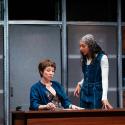
On the other hand, Josie Rourke’s production is quite entertaining not only because of Mod’s excellent acting, but also because it features a unique set, designed by Yimei Zhao, which has a kind of cream-coloured velvety vagina shape, and from whose folds the cast take out various props, from Apple laptops to duvets to a portable massage couch. Audience discomfort is increased by having to wear shoe covers to protect the set’s carpeting, and the backless seating is quite challenging for a 100 minute show. Although these theatrical devices reflect the script’s jumps from one aspect of its subject to another, and enhance its humour, they also make it difficult for the cast to navigate the stage environment.
And the cast is great. Mod certainly shines as the confident yet troubled Ani, and avoids excessive rawness or loudness in what is quite a restrained performance. In her conversations with Liam, Jasmine and her Dad, you can see her inner struggle between wanting to own the truth and sliding away from it. The other three actors play several roles each: Will Close is a frustrated and angry Liam, as well as a student, and fellow addict; Lizzy Connolly is a sympathetic Jasmine, as well as a student, doctor and mythological, narcissistic Eve; Asif Khan is a tolerant Dad, an old man and an aged academic. Mod and the others turn a rather superficial script into a show that, for all its defects, is worth seeing.