

Before seeing this play, I decided to eat a steak. It seemed the right culinary equivalent to David Mamet, one of America’s most provocative and, at times, especially past times, red-blooded writers. This play, whose British premiere was at the Royal Court in 1993 – when it starred David Suchet and Lia Williams – now arrives in the West End from Bath’s Theatre Royal. Oleanna was one of the most controversial dramas of the 1990s, and its ending – when audiences routinely cheered an older man’s violent assault on a younger woman – showed the power of theatre and its ability to polarise debate often, although not always, on gender lines.
Like Amy Berryman’s Walden, which had a short West End run earlier this summer, the title Oleanna evokes a particular aspect of the American Dream – the idea of a perfect society. (“Oleanna” is a Norwegian folk song, popularised in English by Pete Seeger, and critical of composer Ole Bull’s utopian settlements in 1850s Pennsylvania.) For Mamet, the American university – and especially the politically correct students who have been confronting their trad-minded professors now for decades – is an equivalent site where progressive ideas have gone sour. Set in a academic’s study, his play is a two-hander about an escalating dispute between John, a college professor, and Carol, one of his students.
Over the course of three meetings, John, who is disillusioned with the educational system and more concerned with buying a new and bigger house for his wife and son, as well as securing tenure, is initially over-friendly, in a patronising way, with Carol, who comes from a poor background and cannot understand why she is failing. At first, she is confused by his cynical mansplaining, but gradually, through her membership of a radical group, she acquires more force, and grows in confidence, making a feminist critique of John’s behaviour. And she reports him to the authorities. Which threatens his chances of tenure. In response, the professor becomes increasingly incensed and – when he hears Carol’s final demands – increasingly aggressive.
Mamet’s conception is that both John and Carol are caught in a classical tragedy: they are both right, but their points of view are incompatible. Traditionalist Carol wants to be taught the facts, what is right and what is wrong; postmodern John believes that right and wrong are relative. At first he has all the educator’s power, but slowly Carol acquires the intellectual tools – in this case a feminist ideology – to confront him. Mamet further twists the screw by giving Carol increasing transfusions of quasi-evangelical fervour, making her a beacon of political correctness. Although both characters are powerfully imagined, they are also both flawed.
In the context not only of #MeToo, but also of the so-called cancel culture and woke ideology, this argument about intellectual freedom and good behaviour still retains a strong charge. Everything in Mamet’s vigorous dialogues seems fresh: the professor who shows off and bores you with anecdotes about his life; the furious student who learns how to stand up to authority. In the end, the power shifts from him to her, and she has the chance of educating the educator. But, at the same time, the explicit question of what is a good education, and who can deliver it, remains unanswered – neither the pompous professor nor the student rebel has the keys to utopia.
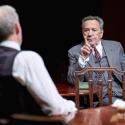
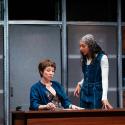
The great thing about Lucy Bailey’s 80-minute production, designed by Alex Eales, is that it changed my mind about the power balance in the drama. On previous occasions, I was certain that Mamet was more sympathetic to John than to Carol, now I’m not so sure. Bailey, and her cast – Rosie Sheehy and Jonathan Slinger – manage to make the characters equally troubled, and both equally wronged: through quietly convincing and unflashy performances they convey a sense that each of them is both perpetrator and victim. Both are equally emotionally grounded, and the final explosion of violence is deeply disturbing. Talking of disturbing, I was surprised to see that this venue has few anti-COVID restrictions. I only hope that my steak gave me extra immunity.









Add comment