

In its heyday, Rodney Ackland’s 1935 play The Old Ladies, adapted from a 1924 novel by Hugh Walpole, was a favourite with doyennes of the theatre world including Edith Evans, Flora Robson and Miriam Karlin. But it has languished unstaged in London for more than 30 years.
The Finborough is to be congratulated for giving it another go-round as a stage play, though it's a piece that deserves to be filmed. It also makes a spooky radio play, as you can hear in the BBC Radio adaptation of the novel with Edith Evans as Agatha (available online). In the small confines of the Finborough it builds up a decent degree of tension, but not as much, I suspect, as a skilfully edited TV version deploying higher-tech sound design and special effects might.
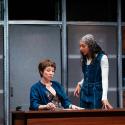
The piece is a three-hander, about a trio of elderly women living alone in the same building in Polchester, a fictitious cathedral city Ackland set several works in. The women can see the cathedral from their windows and hear its solemn tolling bells. Their bedsits have to be shoehorned into the teeny stage, Lucy Amorest (Julia Watson) getting the lion’s share, with the room of May Beringer (Catherine Cusack) represented by her single bed, and that of Agatha Payne (Abigail Thaw) by a rocking chair and a doll.
Over 90 minutes we watch as the natural little fissures in the women’s relationships turn into wide cracks through which antagonistic outbursts explode. Lucy seems the most sensible, a widow with an errant son she expects to arrive imminently; she attends church and has kindly Christian urges. May is of great concern to her, a wizened new lodger from St Leonard’s, who’s of a nervous disposition and can talk of little except her late dog Pip and her best friend Jane, who gave Pip to her, along with a lump of amber that has become May’s prize possession.
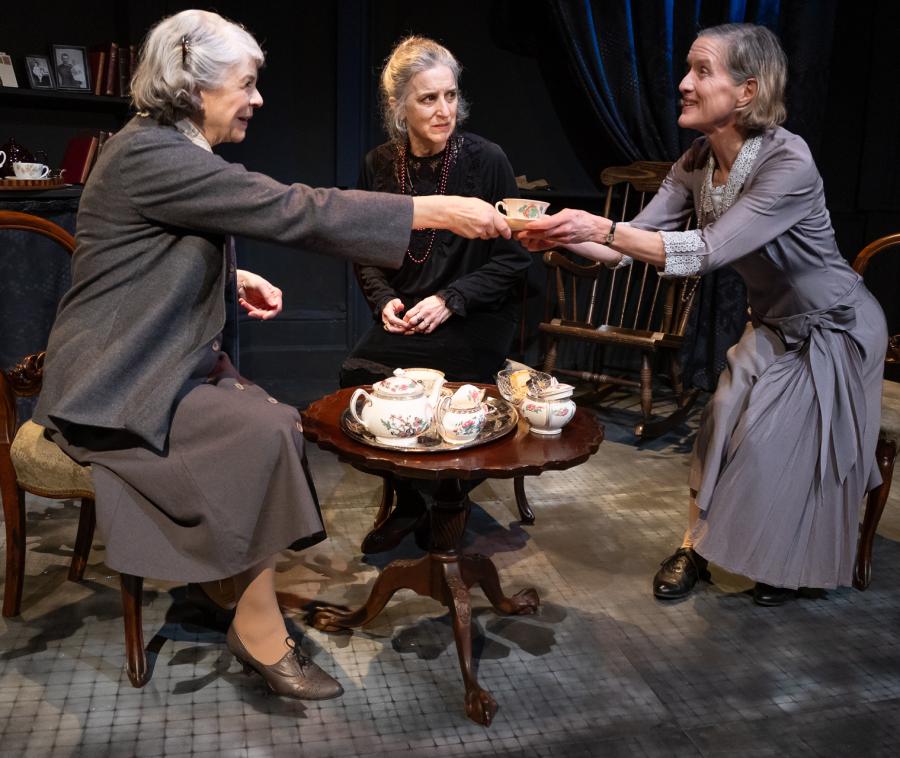
Stirring their pots is Agatha, a striking widow in comparatively exotic clothing who predicts the future with her playing cards. She takes an instant dislike to newcomer May, and a just as sudden desire to take the lump of amber off her hands. As it seems to be the foundation stone of May’s mental wellbeing, unsurprisingly she rejects Agatha’s offer point blank. Lucy tries to run interference between them, convinced May has a weak heart that too much of a shock will destroy.
Each woman is unhappy in her own way in this pre-welfare state era with no safety nets. Lucy has run out of money and has only a cousin and her elusive son Brand to turn to, though she has no idea where Brand is or whether he receives her weekly letters. May is openly fearful of her encroaching poverty and needs to “find a position” that doesn’t tax her too much. And Agatha hates being surrounded by people with no “gumption” who don’t love beauty. She longs for the days when she experienced passion; now she loves sweet sticky things, like nougat, and revels in colour, finding May insipid (Cusack is carefully costumed in a pale grey). Part of the amber’s appeal for Agatha is the array of colours it reflects in the light. And, of course, its value. She too needs money, if only to buy the amber off May. But she also covets the money Lucy has been promised by her ageing cousin and hopes to be loaned a share of it.
Predictably, this slow-burning but combustible mix ignites. The tension as we feel the shadows around the women deepening, and odd knockings on the walls gathering pace, is underpinned by the eerie sound of Agatha’s low muttering and groaning, asleep in her rocking chair, a sound May is acutely aware of. She begins to dread Agatha’s sudden appearances in her room, unannounced, renewing her demands to see, then to be given, the amber.
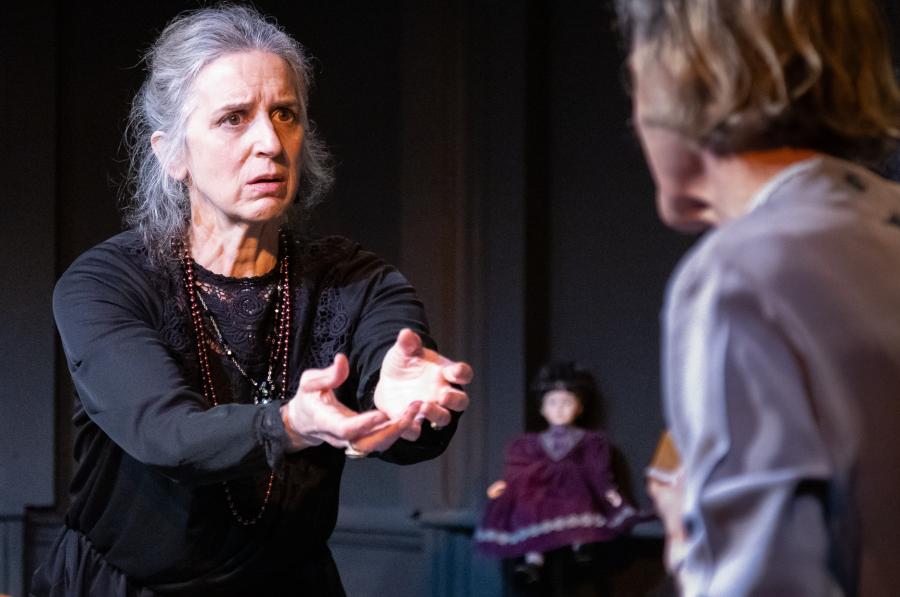
Abigail Thaw delivers an Agatha in the same mode as Rebecca’s Mrs Danvers, somehow alien, sinister and extremely caustic — she has fun mocking May’s way of talking and her soppy “bye-bye”s. Her distaste for May’s wimpish sentimentality and, as she sees it, Lucy’s lack of imagination is actually rather appealing — as are her mad hats — but she’s a sinister presence, her dark eyes staring out at us, haunting and haunted. Lucy makes the suggestion, its prejudice shocking now, that Agatha queerness may be because she's, gasp, a Roman Catholic…
Cusack is suitably highly strung and vulnerable, easy prey for Agatha’s gaslighting, and Watson is a perfect projection of middle-class “niceness”, slightly stolid but decent and gregarious. She spends money she can’t afford on a surprise for the other two women, a gesture of both her generosity of spirit and her profligacy. My only quibble with the casting is that all of the actors seem less elderly than written.
The three negotiate the squashed playing area as best they can, but its intimacy doesn’t allow for shocks. Agatha is always in sight, slowly rocking in her chair as if in a trance, but her sudden appearances in May’s room are a surprise only to May. You long for Agatha to suddenly manifest there, a technique television could pull off, and genuinely scare you too. Under Brigid Larmour’s direction, Lucy is presented as eminently sane throughout, and not a victim of her fantasies about her son, the prop in her loneliness. The play ends on a note of high anxiety, its plot lines fruitfully unresolved, but with its dramatic potential underachieved.
- The Old Ladies at the Finborough Theatre until 19 April
- More theatre reviews on theartsdesk









Add comment