As 10-year-old Satsuki observes as she arrives in the countryside with her little sister Mei, “We’re not in Tokyo anymore” – and they’re not in Kansas either, but there is a tang of Oz in the air. The 1988 Studio Ghibli film, My Neighbour Totoro has the classic status of The Wizard of Oz for a generation of youngsters brought up on whimsical Japanese animé. It’s a brave British theatre that transposes Hayao Miyazaki’s fantastical creatures from the screen to the stage. In the main, the RSC has pulled it off with style, charm and huge panache.
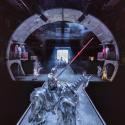
From the opening scene, an ingenious riff on the movie’s title sequence that through a series of witty reveals transports the audience from a flat screen to the three-dimensional world of the stage, we know that we are in safe hands. We meet Satsuki, Mei and their father barrelling along in a tiny truck piled high with their belongings. The girls’ mother is ill in a rural convalescent hospital and the family has moved from the city to the country to be nearby. The girls delight in their new home – an old wooden house with a pump for water and the fresh air. Even the initially alarming soot sprites, black balls of feathery fluff, rapidly cease to alarm. The neighbours – local rice farmers and a kindly granny – are friendly and there are the woods to explore.
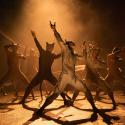
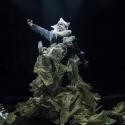
While Satsuki is at school, four-year-old Mei encounters the forest spirits, initially two small Totoros cheekily checking out the house’s new arrivals. Little furry creatures barrel around the stage, operated by graceful puppeteers in black pyjamas and veils, they are a cute foretaste of the wonder to come. Full scale Totoro is an enormous, furry blimp when we first meet him, asleep in the forest. He’s an ancient creature who can shake the earth with his toothsome roar, but from the moment Mei climbs on to his tummy, he's clearly a benign spirit. Over the course of the evening, we are treated to beautifully choreographed puppeteers manipulating ingenious creations designed by the Jim Henson company, whose late founder gave us the Muppets. It’s not just the giant Totoro, there’s a beautifully rendered Catbus – a 12-legged creature that can fly through the air like a giant glowing lantern, its eyes gleaming as it carries the children across the countryside to see their mother.
 It would be too much for actual child actors to take on these physically demanding roles, but it doesn’t take long to be convinced by Mei Mac that she’s an impulsive four-year-old who both delights and exasperates her thoughtful big sister, played by Ami Okumura Jones. Dai Tabuchi is a delight as the absent minded professor father while Nino Furumata gives an exact impression of the awkward local boy, Kanta from the original film.
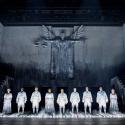
Faithful to the movie’s original and slight narrative, there’s only a little jeopardy in the second half. Overall, this is a warm bath of a production guaranteed to delight families and adults with its ingenious, continuously revolving and evolving staging. The lighting and lovingly crafted sets are a delight in themselves. There are words of wisdom about being kind and respecting nature – a brief homily about how human exploitation of the countryside led to the forest spirits hiding away from them. Among the props moved around the stage to convey shifting landscapes are a series of Shinto figures – roadside statues and shrines with deities. If audiences are interested in their spiritual significance, it's best to turn to novelist Peter Carey’s 2004 book, Wrong About Japan where he offers an insightful analysis of the movie's subtler religious references.
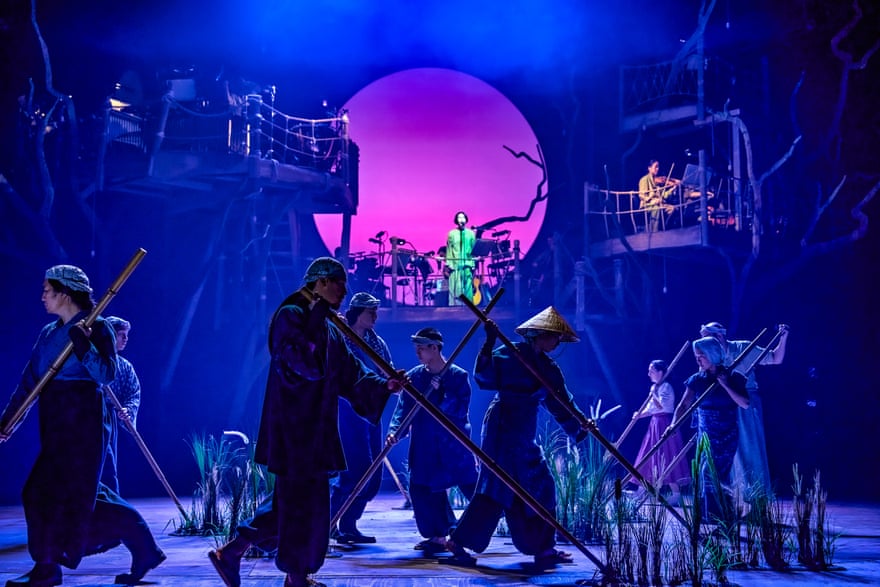
Director Phelim McDermott has collaborated with the film’s original composer Joe Hisaishi to extend the role of music in the stage adaptation. It now plays a stronger role than just a jaunty theme and a bit of atmospheric soundtracking. Musicians play live perched high on tree-house platforms in full view, while Ai Ninomiya (above centre) dazzles on stage, singing in both Japanese and English. If the second half lags just a little (there's one chase scene too many), My Neighbour Totoro is still a dazzling show and will doubtless be a hit for the RSC and the Barbican.