Has there ever been a successful dinner party on stage? It seems no sooner has the table been set than domestic disharmony erupts: opposing personalities obligingly clash, the veil of marital bliss is torn asunder, and terrible secrets are spilled along with the wine. In other words, dinner parties are the playwright’s bread and butter.
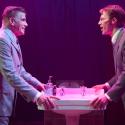
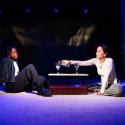
Torben Betts pays homage to mentor Alan Ayckbourn with his 2012 serving of darkly comic metropolitan angst, although the Seventies menu adds a soupçon of Mike Leigh. Uptight accountant Jess (Annabel Bates) and failed novelist Mat (Jack Johns) are the doomed middle-class hosts, forging ahead despite Mat revealing he’s discovered her adultery. Their motley crew of guests guarantees fireworks: socially inept, armchair radical Simon (Ralph Aiken); co-dependent widow Karen (Charlotte Pyke); Jess’s sister, relapsed addict and wannabe performer Annie (Nicole Abraham, pictured below with Gregory Cox); and her supposed fiancé, middle-aged, married luvvie Tony (Cox). Oh yes, and it’s the night of the 2010 Haitian earthquake.
 Reaction to the earthquake inspired Betts when he noticed a couple commenting on the tragedy while fixated on their phones, barely interacting. Thus his characters supply a steady stream of cross talk and self-absorbed sermonising, constantly speaking but never communicating. Technology adds another dimension to this irony, albeit a well-worn one, and Betts’s treatment isn’t exactly subtle – “Nothing. Nobody at all!” sighs Simon as he checks out of a conversation with Karen to check his email.
The disjointed exchanges are meticulously observed, but irk us as they do the beleaguered assemblage, particularly in Roger Mortimer and Deborah Edgington’s glacially paced opening. Having assembled this combustible collection of eccentrics, Betts waits an age to bring them together. The action plays out in the kitchen, refuge from the dinner itself, a conceit that never quite pays off.
Like Ayckbourn, Betts addresses class with wry astuteness
More engaging is the soap operatic second half, punctuated by a series of bombshells and the glorious mangling of both the Bard and Oliver! Frustrations mount as these lonely souls battle the hollowness of modern existence, desperately seeking acknowledgement of their specialness. Womaniser Tony laments being surrounded by people “all wanting to be famous, all wanting to be somebody”. Only Jess is content with “ordinary” existence, although the magazine-spread kitchen points to her need to keep up appearances rather than explore her desires.
Like Ayckbourn, Betts addresses class with wry astuteness. Simon launches into impassioned tirades about bringing down the system, but is envious of a sleek north London lifestyle he could never afford. Aiken encapsulates that dichotomy, revealing the vulnerability beneath the verbal diarrhoea. Bates presents a subtly disintegrating façade, and there’s good support from Pyke and Cox, respectively obsessive and louche without sliding into caricature.
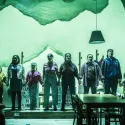
Nancy Surman’s set is edged with rubble, but although the Haiti references illustrate the solipsistic crowd’s lack of real compassion, ultimately it pulls focus. Betts’s concentration on First World problems, though entertaining, needs further justification.