If you were expecting a fusty, formal adaptation of Anthony Trollope – and one of his least known novels, to boot – Lady Anna: All At Sea will come as a breath of fresh air. Colin Blumenau’s production of Craig Baxter’s play, based loosely around the Trollope novel of the same name and commissioned by the Trollope Society to mark the bicentenary of the writer’s birth, speeds through its two-hour-plus run, keeping a nimble crew of seven on its toes and the audience engaged in its ludic conspiracies.
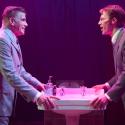
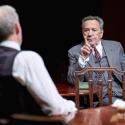
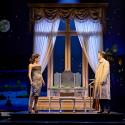
The “All At Sea” element, the “interloping” part of the story if you like, refers to Trollope having written Lady Anna, at his usual rate of nine pages a day, always polished off before breakfast, as we’re told more than once, on his sea voyage to Australia in 1871, and the immediate action is set on ship. His immediate companion on that journey was his wife Rose (Tim Frances and Caroline Langrishe as the couple, pictured below right), along with her maid Isabella, but the writer’s also engaged, albeit a little episodically, with his fellow travellers who act as a sounding board for the development of his novel.
Will she follow her heart, or the expectations of society?
The doubling here is frenetic as all players switch between their on-ship personae and their more important roles in Trollope’s drama of inheritance, class and social position. Any degree of melodrama in the original is played up here, complete with the authorial interpolations characteristic of the writer.
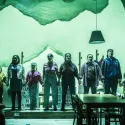
No doubt it could be called "meta-" something, but more simply put it’s a cast playing knowingly, and winningly, with their roles, not to mention quick changes of costume – or rather the accessories added on to gloss each different character – and rapid reappearances (in a matter of seconds) through all entrances of the Park’s main venue. Libby Watson’s design, in pale colours, has piles of heavy faux-volumes stacked around the stage, allowing for adjustment according to location – from the Stepping Stones of Bolton Abbey to London court scenes – which suggest both Trollope’s metier, and the weight of the legal profession that’s at the heart of Lady Anna’s predicament.
 Played by Antonia Kinlay (doubling as Isabella), she’s grown up in penury with an embittered mother (Caroline Langrishe, also Rose Trollope) after the departure of the latter’s husband, the Earl of Lovell – “wholly evil” is the only epithet he gets here – with an Italian lady. After his death – the immediate in media res action of the play – the title has reverted to his young cousin Frederic (Adam Scott-Rowley), while the money’s due to go to his family, unless Frederic can question the marriage's legality.
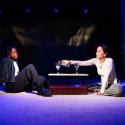
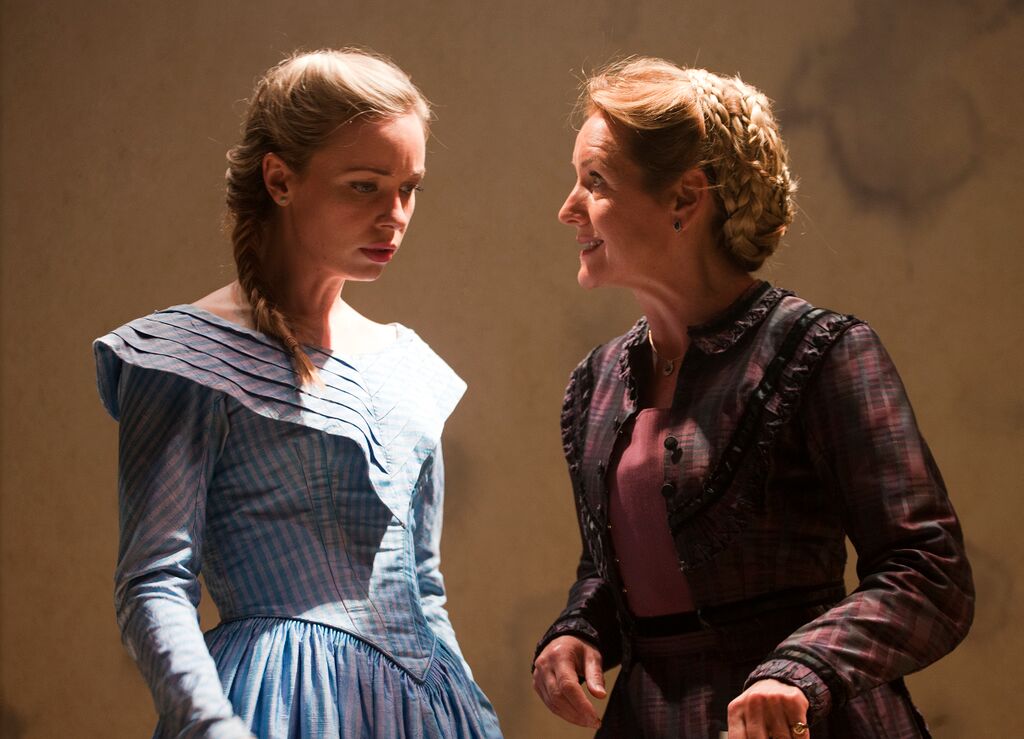
Which is where the wonderfully pragmatic lawyers come in – Tim Frances as the rotund perorator Sir William Patterson (as well as Trollope himself), Edward Halstead the rather more underhand executor Mr Flick. After contemplating spreading cash around to ease the passions of all concerned, they resolve on compromise rather than confrontation, coming up with the suggestion (and inveigling it into the head of Anna’s mother) that the new Earl should marry Anna and reunite the peerage with the pennies. The only problem, we learn in due course, being the pledge Anna has given to Daniel Thwaite (Will Rastall, also bonneting up as her maid), the son of the tailor who’d supported mother and daughter through their earlier indigence. (Antonia Kinlay as Anna, with Caroline Langrishe as her mother, pictured below.)
 It’s the old question: will she follow her heart, or the expectations of society? Or rather, because we’re watching the writer at work, what will be the path Trollope decides for her? (He even takes a wager with his ship companions on the issue.) In fact the denouement is a gentle one, with the young distinguishing themselves by their lack of self-interest, the expectations of snobbery defied. Even the lawyers veer uncharacteristically towards humanity, and only Langrishe’s character descends into harridan melodrama.
The young may be open-hearted but, as so often, the good don’t get the best lines: it’s the seniors, to whom guile and hypocrisy come rather more naturally, who have the verbal fun here. It’s all overseen by a tour-de-force performance from Tim Frances, whose bearded benignity controls the action with the deftness he also applies to a brandy balloon in one scene.
Baxter’s writing knows when not to take itself too seriously, and reveals a mean wit on occasions: given that we’re very nearly in dowager Countess territory, there’s one line, “Apology is not a singular act, it is a process,” that could have come straight from you-know-who. It’s far from the only bon mot to be found here. Blumenau’s pace and sense of play are almost feather light. No sign of a composer credit, but the score heard went nicely in the same direction, too.