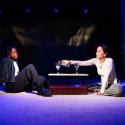
The absolute loyalty of a little boy to his under-deserving friend is what swells The Kite Runner’s heart and fuels its tragedy. So you can’t really blame Matthew Spangler’s stage adaptation of Khaled Hosseini’s 2003 bestseller for sticking faithfully to the novel’s melodramatic side. But Giles Croft’s production, a joint venture between Nottingham Playhouse and Liverpool Everyman that’s playing in between as part of the Brighton Festival, hasn’t quite found a way to balance narrative drive and emotional punch. That tight grip on the storyline never loosens long enough to really let the feelings fly.
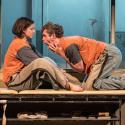
It’s no easy task. Hosseini’s much-loved fable of friendship, betrayal, guilt and redemption is set across three complex decades, vastly different continents and an epic, bloody slab of Afghanistan’s history. Amir (Ben Turner), a privileged Pashtun boy, and his Hazara servant Hassan (Farshid Rokey), spend their free time flying kites from the alleys and rooftops of Kabul. One day Hassan is cornered by racist neighbourhood sociopath Assef (Nicholas Karimi), and Amir watches his horrific assault from the shadows.
When the Russians invade Afghanistan in 1979, history hammers home the wedge that Amir’s crippling guilt has placed between them. He and his father (Emilio Doorgasingh) escape to a vibrant San Francisco vibrating to Kool & The Gang. Hassan is left behind to experience the rise of the Taliban.
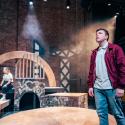
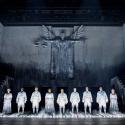
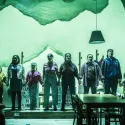
Karimi's orphanage-sacking, child-raping Taliban villain is duly OTTKept company by excellent tabla player Hanif Khan and his terse, tension-modulating rhythms, Turner barely leaves the stage. He plays Amir as a grown-up, as the Americanised narrator (with an MA, much to his father’s horror, in creative writing), and as a child. In the early sections, he captures the shy passions of a sensitive boy who announces "Baba, I wrote a story" as if he’s confessing to wetting the bed. Barney George’s elegant set keeps pace with his narration, projections billowing down over two kite-like curves of white sheet whose stirrings can suggest the expensive breeze inside Amir’s childhood home or the heat haze of a poverty-stricken Pakistan street.
But Rokey’s Hassan feels innocent and impulsive where Hosseini’s character (brilliantly played by child actor Ahmad Khan Mahmidzada in Marc Forster’s $75m-grossing 2007 film) was watchful and wise beyond his years. His acts of sacrifice feel more like naivety than quiet, considered nobility. Meanwhile the rest of the ensemble are hard-working but under-deployed in a production that’s full of words, words, words but thin on theatrical language. Only the kite-flying tournament is staged with real imaginative physicality, the cast's eyes fixed in the heavens as they work their hands on invisible strings or whirl old-fashioned wind-makers to create a soaring sound.
The much-loved source material isn’t perfect, and Karimi’s orphanage-sacking, child-raping Taliban villain is duly OTT, one white sleeve dip-dyed red from a public stoning. But the script is full of genuine horrors and misfortunes that are in danger of simply piling up: "I once saw them beat a woman so hard I saw mother’s milk leak out of her bones" remarks Amir’s Afghan driver of the Taliban as both car and story go racing on. Croft’s decent but too evenly weighted production covers the territory without giving Amir or its audience space to process. As storytelling it holds the spool and feeds the line. As theatre it too rarely lifts off the ground.