

The big news was that dashing Greg Wise was returning to the London stage after an absence of 17 years. Still best remembered as the handsome cad Willoughby in the film of Sense and Sensibility – now 20 years old – he appears in the intimate Park 200 auditorium as a middle-aged, care-worn father, oblivious to wrinkles and grizzled locks. He gives a performance so physically and emotionally charged, however, that his looks are irrelevant.
Kill Me Now is advertised as a dark comedy; it would be closer to the truth to describe it as a tragedy enlivened with glints of wit and humorously flatfooted or outspoken exchanges. Indeed, there are times when watching is a challenge, but then contemplating the circumstances of these characters, far less coping with their plight, would be, to say the least, a challenge. Canadian playwright Brad Fraser, drawing on family experience, looks the uncomfortable squarely in the face.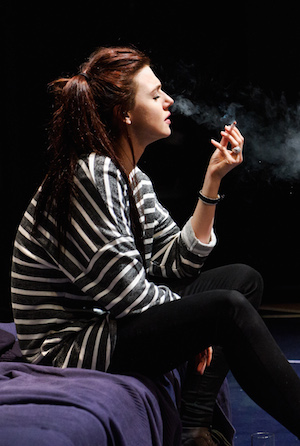 Jake Sturdy (Wise), a promising writer who has not written anything since his first, very successful, book was published 15 years ago, has been caring for his disabled son, Joey (Oliver Gomm) since he was a toddler. Both Jake's wife, Joey's mother, and his own mother were killed in a traffic accident, but his good-hearted, if uptight, sister Twyla (Charlotte Harwood, pictured left), clearly also damaged by the family history, is around to help. Joey's likeable school friend Rowdy (Jack McMullen), game for anything despite his learning difficulties (and self-described as "mildly retarded but well-hung"), is also on hand as Joey embarks belatedly on puberty. Meanwhile, Jake has been pursuing an illicit affair with a married ex-student, Robyn (Anna Wilson-Jones). They meet weekly, she making bridge club an excuse, he leaving home carrying full hockey kit to deceive his sister.
In the first scene, Jake is bathing Joey when he observes that his 17-year-old son is having an erection. Joey's twisted hands do not allow him to masturbate. How is he to cope with sexual arousal? How should Jake help him? Oliver Gomm heroically maintains Joey's distorted shape and speaks in a blurred voice which still manages to be intelligible. There must have been discussion about employing a disabled actor; whatever the reason for casting Gomm, he is absolutely convincing.  If teenage changes add to the family's problems, absolute disaster strikes when Jake contracts a disabling illness and the carer himself needs care. Robyn is drawn nervously but fruitfully into the circle. There is a final plot twist which it would be a shame to disclose, but it arises logically from what has gone before. The normal shift of power in the adult-teenager relationship is exacerbated in the circumstances and it becomes clear that determination and strength of character are not affected by physical disability.
Braham Murray, a seasoned director of Fraser's work – this is their sixth collaboration – guides the actors, every one of whom is superb, surely through the swift, filmic scenes. With audience on all four sides of the space, some sitting inches from the set, the effect is of 100 minutes of forensic emotional dissection.
Fraser has described himself as confrontational and previous plays have given rise to controversy and cancellation. This one, seen here in its European premiere, is sometimes hard to watch, but it is honest rather than voyeuristic and the characters' struggles, presented without sentimentality, are ultimately gripping as well as moving to share.












Add comment