

In the age of austerity, it’s getting harder and harder to avoid cliché. Especially well-meaning cliché. For example, all cuts to welfare are bad; we must defend government support of the needy at all costs. But clichéd ideas rarely make good drama so when I first heard about Rebecca Lenkiewicz’s new play, whose theme is the cuts in the legal aid budget, I must confess that my spirits dropped. Was this going to be another case of theatrical journalism?
Things didn’t really improve when I read the programme note: in this, Andrew Caplen, President of the Law Society, attacks the Legal Aid, Sentencing and Punishment of Offenders Act of 2012 because it “severely curtailed” legal aid. This has condemned those who have few resources and a claim under clinical negligence cases, employment matters, family law cases, housing disputes, debt cases, immigration – well, the list goes on. I agree that these are truly distressing cuts, but how do you dramatise them?
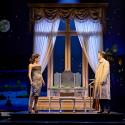
Lenkiewicz’s play, which is proudly sponsored by the Legal Society, begins by introducing us to Gail, a bright but harrassed lawyer who runs a small and underfunded firm whose cases are concerned with those most in need: the victims of abuse, those threatened with eviction and those who might lose their children. In a nice quirky touch, Gail is on a blind date with Ken, a separated man who is trying to get access to his kids. So while Gail thinks she is having a night off, Ken is trying to get free legal advice.
Not all is rosy in the Tory garden
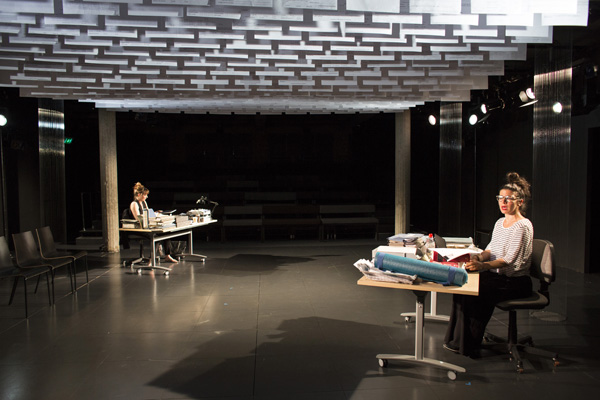
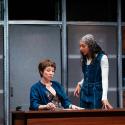
Gradually, the play shows us Gail’s office life (pictured below), with her colleague Laura, and one of her regular clients: the wonderfully eccentric Shaun, whose mother has died and who is about to lose his tenancy. At the same time, we watch Aisha, a young Pakistani woman, whose new marriage to Riz slowly turns sour as he virtually imprisons her in his mother's home, and then beats her. Shaun, Aisha and Ken are all invisible victims, whose personal problems have, suggests Lenkiewicz, been shunted into the background by changes to the law.
In the second half of the evening these invisibles take centre stage, and the power of their testimonies pushes the lives of Gail and Laura into the shadows. But while it is good to be reminded that not all is rosy in the Tory garden, The Invisible is not a good play: it lacks drama, it lacks a compelling story, and it lacks focus. This is a play of vignettes, of often amusing scenes – especially the two blind-dates – with little coherence or debate.
 At its worst, the lively writing becomes declamatory. There are lots of well-meaning declarations, but little in the way of contested ideas. As a piece of political theatre, the news is even worse: there is a depressing ending that implies that we can do nothing to actually fight the system. Very little indicates a way forward or a chance for change. The main relief from this pessimism is Lenkiewicz’s quirky humour, and there are lovely individual passages about diverse subjects, such as the joy of pets, the thrill of being Spiderman or the attraction of television’s Dr Kildare.
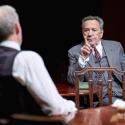
Michael Oakley’s efficient production has solid performances by Alexandra Gilbreath (a luminously sincere Gail) and Nicholas Bailey (an uncontrollable Ken), supported by Sirine Saba (Laura/Aisha) and Scott Karim (Riz and Laura’s boyfriend), with lovely cameos by an attractively hilarious Niall Buggy (Shaun and another of Gail’s dates). But despite the fun of individual moments, there is a thinness of relationships, an absence of drama and a lack of ideas. Worst of all is the fact that none of the terrible cases presented here would be solved by getting more legal aid. Neither Shaun’s mourning for his dead mum nor the moribund marriages of Ken and Aisha would have benefited from lawyers – their pain is more existential than that. And this is the visible hole at the centre of The Invisible.






Add comment