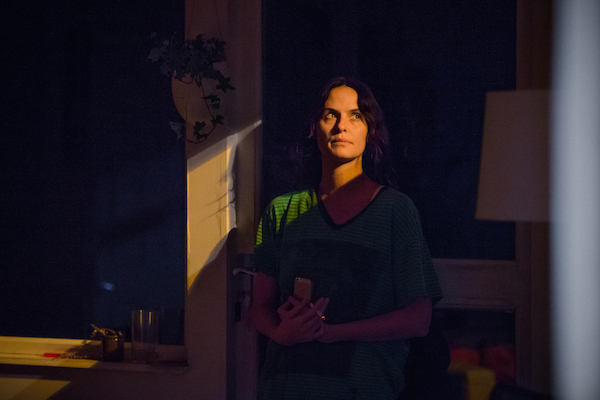
It’s night, and the woman (Leanne Best) is waiting for a phone call. She’s desperate for the voice of her lover – or rather ex-lover: they split three nights ago. Both have secrets they will disclose over the course of their final conversation. Both have positions to defend. The scene is set for a coupling of melodrama and banality. In Daniel Raggett’s version of Jean Cocteau’s La Voix Humaine, everything is somehow generic – grief included.
Sarah Beaton’s set reeks of suburban claustrophobia and the woman on stage is nothing special either. She’s in her pyjamas on the sofa, hair awry. The windows of her modern box-build are double glazed in plastic frames and hung with granny-beige blinds. Bland nick-nacks and tedious how-to manuals heap Ikea shelves in a room dominated by a cyclopian wide-screen TV. A small replica Rothko splashes a sick umber rectangle on a blank expanse of wall. A Lucozade bottle retorts in orange from the coffee table. The windows keep the audience out.
 The way we listen in on Best’s one-sided conversation is through headphones. It’s a gimmick (her voice carries through the set) which complicates this production’s staging and muddies its sense. If the audience can only hear Best when she’s on the phone, they are either in the position of the phone or the partner. In both instances, her ex would be audible – but as he is never heard it begs the question: why have the headphones in the first place? Their primary function seems to be to pipe Mike Winship's abstracted soundtrack through the performance which conveys what emotion should be felt when Best’s performance misses its mark.
It’s the first half that requires this most. Best is frantic but the monotony of her hysteria is wearing. Either it’s a feat of conscious brinksmanship with the audience’s emotional boundaries, or merely an unremitting absence of nuance. Best’s energy goes outwards, and the sense that she’s keeping things from her ex or locked in violent conflict with herself, or even hearing another voice at the end of the phone is lost in the disjointed torrent of words and cut connections and punctuated by friable “hello?!"s.
The latter half is calmer and dramatic direction is assured through a succession of disclosures which allow time for silences to expand awkwardly and tension to build. The complexities and power imbalances of their relationship emerge - only to be countered by a shocking revelation which foregrounds the ethics involved in disclosing personal vulnerabilities and the enormous power that can be mined in being utterly helpless.
Neither he nor she are particularly appealing characters – and that in itself is interesting. But when the question at the heart of the monologue – is true human contact possible when we are bodily absent – is laughably outdated by the multiplicity of connections modernity offers, the tragedy of the woman’s plea (“Yes, talk, talk, say anything, doesn’t matter what,”) is a matter of the perennial human condition rather than a function of technological alienation. What's left is the banal question of the way forward when the person most loved is also the most cruel.
- The Human Voice is at the Gate Theatre until 6 October 2018
- read more theatre reviews at theartsdesk