

The Middle East is on fire – again. So Ryan Craig’s brilliantly provocative play, The Holy Rosenbergs, is more relevant than ever. Near the start, a rabbi says, “Everyone feels strongly about what’s happening out there”, and since he’s referring to tensions between pro-Israel and anti-Israel Jews, he’s definitely touching a nerve, both in the play and in the audience. Yes, this revival of Craig’s family drama, originally staged at the National Theatre in 2011, and now with a cast that includes Adrian Lukis, Tracy-Ann Oberman and Nicholas Woodeson, retains all of its power to disturb.
Set in 2009, in the Edgware home of David (Woodeson) and Lesley Rosenberg (Oberman), the plot begins with a visit from local rabbi Simon on the eve of a memorial service for their son Danny, who has been killed fighting against Hamas. Simon tells their daughter Ruth – who works as a human rights lawyer in Geneva – that she’s not welcome to the event because the Jewish community disapproves of her investigating war crimes in Gaza. Another son, Jonny, cares more about having fun than following their patriarchal father into the family catering business, which is in decline. Despite Lesley’s pleading, David won’t quit, hoping instead to bounce back by catering for the wedding of the daughter of bigshot Dr Saul Morganstern, a childhood friend.
In Act One, Craig gives a vivid portrait of David, head of the family, who is proud of his ancestral name and his long Jewish heritage, exemplified by a joke that a Rosenberg provided the food for the Last Supper. Yes, THE Last Supper. But he’s also suicidal and runs his failing kosher catering company with a mixture of optimism and recklessness. Although he wants to be respected by the Jewish community, his ideas about his status are based on illusion, as the long-suffering Lesley is quick to point out. She reminds him that the family name has been tarnished not only by a food-poisoning scandal, but also by the politics of their daughter Ruth. The ethical question is: should Ruth be prevented from attending the memorial because her work offends the community?
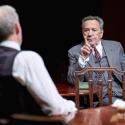
In Act Two, two outsiders arrive: one is Saul, who is having doubts about using David’s company for his wedding because Ruth’s politics are so offensive that the community will turn on anyone associated with her family. It seems that Rosenbergs have to keep their daughter under control, or their business will collapse. The second arrival is that of Sir Stephen Crossley (Lukis), Ruth’s human rights boss, and this sparks a passionate debate about the nature of the Israeli state, the human rights of the Palestinians and the limits of a just war in Gaza. Although these passages are the same as in the first production, so little has changed that they feel as hotly relevant now as ever.
Craig introduces more layers of complication, Arthur Miller style, examining both the emotional lives of the Rosenbergs and the politics of the Middle East. The importance for the community of supporting the state of Israel is balanced by his stimulating advocacy of the importance of international law, while the quintessentially English Stephen is also portrayed with some nice satirical touches. The question of whether a Londoner like Danny should have gone to fight for a homeland that isn’t really his own is raised, and Jonny’s desire to set up a gambling website and assert his independence from his family likewise contributes to the mix. If anything, the play is a bit too rich in detail, and the plot twists could be more sharply delivered.
Yet there’s a lot to enjoy here: the characterization, especially of the proud yet agitated David, is superb and Craig gives each character plenty of room to express their points of view. As the family tensions intensify, each of them – kids as well as parents – is shown to have positive virtues as well as human failings. Each person’s political opinions are shown to come from both their experience of family life and their reactions to the wider world. The moral questions about doing the right thing feel, in today’s bitterly conflicted age, ever more achingly meaningful, while the psychology of behaviour that avoids facing the truth – anything from exaggerated gestures of hospitality to talking about the weather – is as convincing as it can be.
Lindsay Posner’s well-focused production, which balances pain with humour, is set in a recognizably real suburban interior, designed in detail by Tim Shortall, and fields some emotionally truthful acting. Woodeson powerfully embodies his character’s contradictory persona, at different moments charmingly boastful, cringingly fearful and deeply exhausted. Oberman’s Lesley fusses around her visitors as a distraction from grief over the loss of her son and anxiety about her husband and daughter. Dorothea Myer-Bennett and Nitai Levi (Jonny) give compelling accounts of contrasting siblings, with Myer-Bennett’s Ruth both a paragon of conscience and a woman who has no life but her work.
Of the visitors, Lukis’s Stephen clashes strongly with Dan Fredenburgh’s Saul in a scene which proves that plays of ideas, with arguments about state-of-the-world politics, still carry a thrilling charge, even when the topic is exceptionally familiar. Finally, Alex Zur’s Rabbi Simon comes across as both well-meaning and out of his depth. As well as some good jokes about the lives of north-west London Jews, the play also has a couple of very moving moments when the family’s grief is acknowledged and deeply felt. Some bits might feel a touch clunky, but the same applies to Ibsen. The Holy Rosenbergs is a powerful reminder, if ever this is needed, that an excellent piece of new writing is news that stays news.
Add comment