Just when you thought you couldn’t take any more one- or two-handers, online or in the theatre, along comes the supreme masterpiece to jolt you out of any fatigue. Every line counts as Winnie, buried up to her waist and then up to her neck, determines that words will never fail her. And what poetry there is in even the most banal observation, the endless repetition. I could probably watch a different actor in the role every month, and still find riches and unexpected insights in Beckett’s great play, which hasn’t dated in any way. Juliet Stevenson at the Young Vic gave us a quirky indomitability; Lisa Dwan, a lesser-known genius of a performer with no less an ability to use her voice through the octaves, mixes lilting garrulousness with an Irish melancholy that leads us to the ultimate heart of darkness.
The initial vision of Trevor Nunn’s production is a coup in itself. We’re seated, in twos and threes but numerously, on the level of the theatre space, wondering how well we’re going to see. Blackout, lights up – an oblong high up. Surreal beyond Beckett’s definition of “a pathetic unsuccessful realism, the kind of tawdriness you get in a third rate musical pantomimie”, Rob Jones’s design burns itself on the mind’s eye. 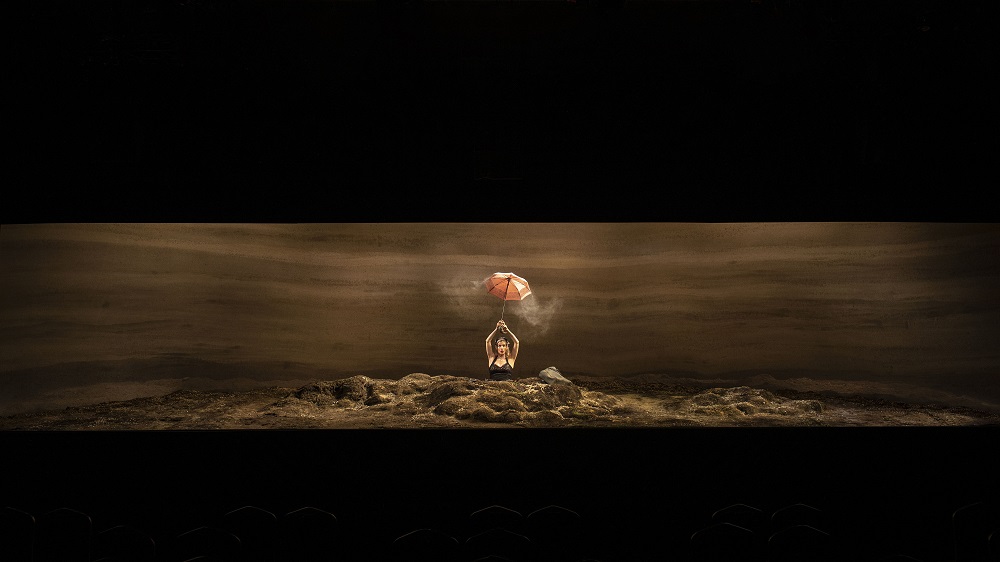 There, of course, in the middle, is Dwan’s Winnie – still “well-preserved…big bosom” as Beckett asks her to be. The bright everydayness of her chatter belies what’s to come. We admire her heroic pursuit of the lettering on a toothbrush, her observation that “not a day goes by - hardly a day without some addition to one’s knowledge however trifling, the addition I mean, provided one takes the pains.” We’re touched by whatever she gets out of grunting Willie (Simon Wolfe) behind the mound: “what a happy day for me..it will have been. So far”.
There’s physical beauty, too, in Dwan’s gestures – more than a match for Beckett’s detailed stage instructions. That only makes the second act all the more shocking. The terrifying chalked face, the hair: it’s probably wise that no publicity photos have been supplied of the look. In this even more phantasmagorical transformation, Beckett revisits themes in truncated form (so musical, but no opera could or should be made of this, and Nunn, unusually for him, wisely refrains from music at any point). At first we feel language has broken down – Dwan articulates the monosyllables as if in a trance, a terrible recreation of senile dementia. But then a new story emerges, and shared memories with Willie, who makes his last, surprising emergence. What a use of language, after Lewis Carroll and Joyce; and what a delivery of it. If this role is for women what Hamlet is for men (and women too, of course), then Dwan has scaled the mountain with fearless and infinitely diverse aplomb.