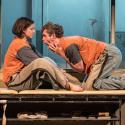
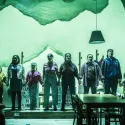
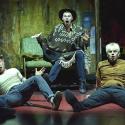
Families. Whether it's the House of Atreus, the court at Elsinore or the Archers, they tend to be of compelling interest. For most of us, loyalties, guilty secrets, truths that will out, petty jealousies and sentimentality tend to be the order of the day more often than towering passion and murder. And that is what Andrew Keatley focuses on in this gentle, poignant, often funny play about a family reunion in the run-up to the "things can only get better" election in 1997.
It is in many ways a sweetly old-fashioned piece, recalling not so much Ayckbourn as Dear Octopus, Dodie Smith's pre-war celebration of familial tentacles in the Golden Wedding gathering of three generations of the Randolphs. Things are a bit less grand in the Pennington household: although there are countless bedrooms in their manor house (nicely introduced by means of a house-shaped celebratory cake) the cooking and - harder to believe - loo-cleaning are done by the lady of the house, Olivia. She and her retired law lord husband, William, have summoned their children and grandchildren to spend the Easter weekend together in honour of his 75th birthday. What can possibly go wrong? Comparatively little does. As in Dear Octopus, plot is not the point.
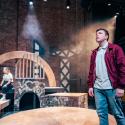
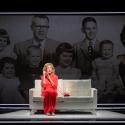
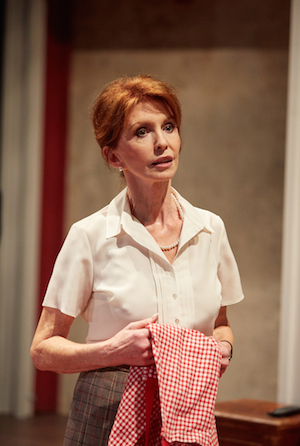 William (Clive Francis) can still be a martinet, but he has vascular dementia and knows that a stroke could claim him any day. Olivia (Jane Asher, pictured left) is long-suffering, but she is no doormat and can tell him - illness notwithstanding - that he is a selfish so-and-so. Their two sons are frequent visitors: Giles (Alex Hanson), who is a doctor, is devoted to his autistic brother, Samuel. Their sister Alice has been estranged from her father since she had a mixed-race child out of wedlock 17 years ago. Alice and the teenaged Aurelia end this long absence by joining the throng, which includes Giles's brittle, unhappy wife, Sophie (Anna Wilson-Jones), and their two children Simon and Emily.
There are outbursts. Samuel (Nick Sampson: quirky but never a caricature) has an episode involving self-beating and spilt tea. The strain on Sophie's marriage to Giles, caused in part by his devotion to his brother, begins to tell. William is rude and hurtful to everyone, including 22-year-old Simon whom he threatens with no inheritance if he doesn't undertake to provide a Pennington heir. But ultimately everyone manages to be civilised and the ghastly old man gets his birthday cake and possibly even the chance to learn something about humane behaviour before death strikes.
 Throughout, the notion that time is running out, that things have to be put in order, resonates. More interestingly, the question is raised of what exactly it is to be grown-up. Samuel is a child-like adult, asking direct, embarrassing questions, but his openness brings out the best in others; grand William is really a spoilt baby addressing his doctor-son as "boy", while teenage, straightforward Aurelia (Amber James) simply ignores protocol and humanises her grandfather on equal terms.
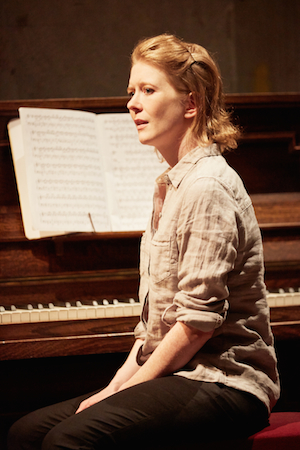
The real-life families in the cast - Katie Scarfe (pictured right) playing daughter to her mother, Jane Asher, and Tom Hanson, son to father Alex - acquit themselves well. Young Hanson's Simon has a nice line in acerbic put-downs and the timing and affection in both pairs perhaps owes something to a lifetime's experience.
In Antony Eden's production, all the interactions are handled deftly, if sometimes handicapped by the far too frequent scene changes between very short exchanges. This is not a particularly original play and it has its sentimental and jarring moments, but it is good-hearted and often amusing. The 1997 setting, with its suggestions of a new beginning, is no doubt ironic; in 2015 social mobility is at a standstill and the occupants of manor houses are more entrenched than ever.