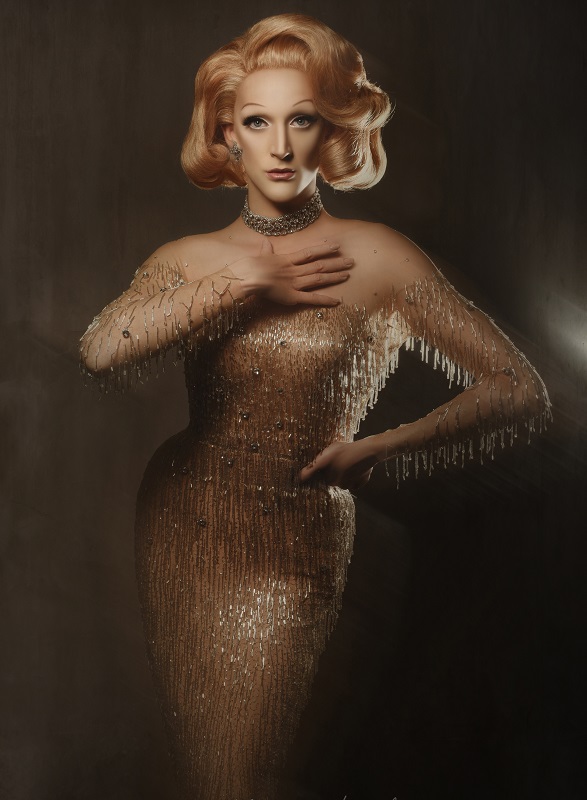
Getting the look right is half the battle: in that, Peter Groom's one-time-Captain Marlene Dietrich is a winner from the start. The looks at the audience nail it too, heavy-lidded and lashed but transfixing, charismatic, winning instant complicity. As with all the best one-(wo)man cabaret-style shows, though, this is no mere impersonation. Groom has the mannerisms and the mostly soft-grained delivery, but he delivers the familiar songs in his own register, with a special intensity that helps to make this selective light shone on a great 20th-century figure ultimately elegiac.
It isn't Groom's aim to offer the portrait of a Mensch in the round. That will be the duty of the newly-launched House of European Art, due to enshrine Marlene alongside two other great Europeans, essayist Hubert Butler - labelled without hyperbole "the Irish George Orwell" - and Simone Veil. Nevertheless by focusing on Dietrich's move from Nazi Germany to America and General Patton's enlisting her as a Captain in the American army who ultimately finds herself at the gates of destroyed Berlin where her mother may or may not still be alive, Groom (pictured below by V's Anchor Studio) and his co-writer/director Oliver Gully do enough to establish the chanteuse's humanist credentials.
 Marlene attempts to brush all that aside in what I take to be material from genuine interviews given in later years, probably the ones which Maximilian Schell incorporated in his film portrait. As well as the time-travelling, there's a paradox here: Dietrich's assertion that the image and the real person are completely separate is belied by the narratives this sequinned show icon supplies, the most moving of all the one before the final numbers. The vision is that of the 1960s, when Marlene gave the lie to the play's "I never went back" with a triumphant tour of Germany alongside Burt Bacharach conducting a full orchestra, but then the play's cut-off point presumably comes before that.
We get some of the daft, repetitive stuff of the Weimar years. But there's nothing inane about the repetitions of Pete Seegar's "Where Have All the Flowers Gone?", a miracle of simplicity with the tension simply screwed up a semitone with each new verse; Groom delivers this and "Lili Marlene" with absolute poise and implicit emotion powerfully released for a couple of seconds in the deadly calm. Wilton's Music Hall plays its part in an atmospheric sense of ruin and the isolation is heightened by having no pianist or other participants on stage, while subtle shifts in Fraser Craig's lighting assist the changing moods and the ultimate bleakness.
The centrepiece, almost like an intermezzo, is Dietrich's 1942 act for the troops, full of single entendres but in total control of "the boys". That makes the sudden seriousness all the more devastating. When the singer speaks of no sense of victory in 1945, only total exhaustion, one is reminded of the reports from First World War soldiers in Peter Jackson's magnificent if too quick-fire They Shall Not Grow Old. This is as much of a war requiem as the best we've witnessed in the past couple of weeks. At an hour, it could be longer, but perhaps best always to leave your audience wanting more - the art of the great performer.