Pity the A-level English student: for them the “rarely seen masterpieces” that creep onto the curriculum and into the theatres. Judging from the frequently giggling reaction of the audience last night of around 100 17- and 18-year-olds, Eugene O’Neill’s tricky tragedy Desire Under the Elms isn’t going to be winning too many A*s among them next summer. Which is a pity, because this is a tough, gnarled play which strips human instincts to their bones. Hatred is its key emotion, loneliness its key condition.
David Attenborough in his unputdownable book The Life of Birds tells of the female dunnock who will mate with two males, one a reliable home-maker, the other a sexier one, so as to ensure through deception better genes and a solid start in life for her chicks. Stupid males, wily female - it’s Darwinism, and so is this plot of a young wife to an old man who seeks the love and sperm of his son. The men blindly collude in this because at stake is not (they think) their masculinity but the principle of ownership: the child matters less than their proprietorial rights to the farm where they live.
Destitute but much-married old Ephraim Cabot married a widow to get her farm; he then worked her to death looking after their son and his two elder sons by his first marriage. Thus the youngest son believes himself entitled to inherit the farm that his mother brought to the marriage - alas, poor deluded fool. For into this jungle steps old Ephraim’s third wife, a young widow herself on the make, and using her feminine wiles to plant the son’s child into the father’s nest, thus having both better sex and inheritance.
He fights his son like a lion fighting his cub, silently, roughly, as they establish who’s boss
All through this stark drama - which is almost more of an opera in verbal form, with arias and duets rather than true dialogue - recurs the central question of ownership and entitlement. In the period in which O’Neill set it (he wrote it in 1924, but the mores inhabit mid-19th-century pioneer America) “claims” to land were the substitute for property law, claims sold from hand to hand speculatively, with unproven title. Thus whether Ephraim actually owns the farm is moot; he certainly has squatters’ rights, and that, in the New England pioneer jungle, is probably enough. He fights his son like a lion fighting his cub, silently, roughly, as they establish who’s boss. And that goes for the woman too.
The farm is on rocky, unyielding land - O’Neill returns repeatedly in the text to the assonance of “stones” and “lonesome”. The life is grinding and without prospect, so those homesteaders find their dreams plagued with the rumours of gold and easy living out in California, thousands of miles south-west. At the play’s opening Ephraim’s two older sons decide to abandon the stony reality for the golden dreams. (The trees of the title seem redundant in so ready a location for tragedy.) But a woman, especially a pretty young woman, is as irresistible as nature in the green.
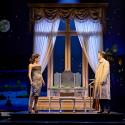
You have to put a great deal on stage here and the Lyric’s stage is dauntingly narrow and high, but the play’s physicality and ideas are well drawn in Sean Holmes’ production. Ian MacNeil designs a stark skeleton, a square of fiery sky, little shifting boxes of cramped rooms, great spaces over the roof, the sketchiness given emotional heat and impulse by some fine lighting by James Farncombe and atmospheric sound by Christopher Shutt.
The story builds slowly in Act 1 (to much murmuring and sighing from the A-level students) and with a classical Greek inevitability reaches climax in Act 2, as characters who’ve hitherto been inarticulate break out into sobbing passion (much student giggling). Abbie, the wife, murders the new baby in order to demonstrate to the agonised son that she loves him more than the child. I can’t believe in this; I blame the author for trying too hard for a mythic plot. I can’t believe a woman of 35 who's lost her only baby a decade earlier would so easily sacrifice her second to prove a point to so dumb a donkey as Eben Cabot.
The pivotal performance didn’t persuade me much either. Denise Gough makes a worldly and pretty Abbie, but I longed for something quirkier, more vulnerable - or else some of the elusive, beckoning, fecund and pliable magic of a feminine witch among these ignorant men (Sophia Loren, gulp, played the role in the Fifties film with Burl Ives and Anthony Perkins).
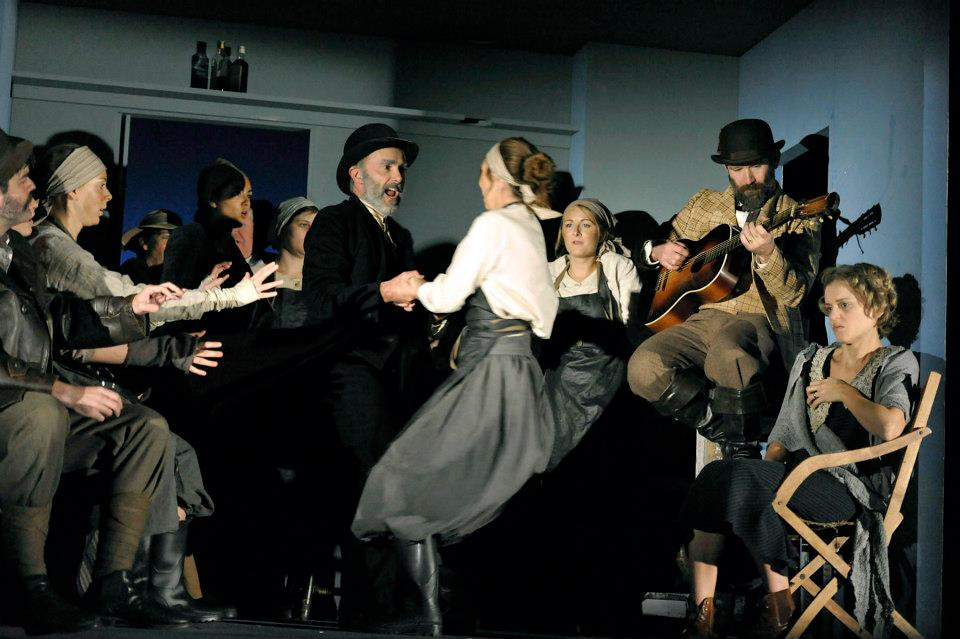
But happily there is Finbar Lynch’s magnetic characterising of the father as a small, wiry, concave little man in a round hat who's a life force to be reckoned with under his black Protestant suit. He dances up a storm, crowing that he’s nearly 76. He tenderly runs his hands over his young wife’s body, adoringly crooning the Old Testament’s voluptuous Song of Songs: “Thy breasts are like two fawns, Thy belly is like a heap of wheat fenced about with lilies, Oh my Rose of Sharon”. He has the best of O'Neill's flavoursome, poetic lines: of his sons - “They hated me because I was hard, I hated them because they were soft.” Of such men was white America made.
Morgan Watkins's Eben, as tall as his father is short, but just as concave, has the toughest call in the text. Eben, we’re asked to believe, switches quickly from being in thrall to the ghost of his kind dead mother to becoming the plaything - in the very room in which his beloved mother's corpse was laid out - of a ready young woman who warbles at him, “I’m your mother now.” Compared with a miracle of humanism like Long Day’s Journey into Night, this has a dangerously schematic feel and Watkins and Gough between them didn't have the actor's skills to hoik the climactic surrender into felt tragedy.