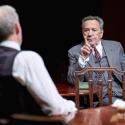
When Dostoyevsky was asked why he wrote Crime and Punishment he famously replied, “To further my career and get shortlisted for book prizes.” He didn’t, of course. I made that up. But what artist/writer/actor creates a piece of art/writing/acting without at least a bit of shallow consideration for their career? (What?! Just me?) The opening of my play Making Stalin Laugh at JW3 in London has been a joyous reminder that there’s so much more to writing than getting good reviews and checking the number of Twitter followers you have once an hour. Not that I do that, of course. No. Definitely not.
It’s partly that my play is about the Moscow State Yiddish Theatre (or GOSET to use their Russian acronym), whose surviving stars and writers were executed by Stalin on 12 August 1952 along with the other leading figures of Soviet Yiddish culture. It’s as if Judi Dench, Alan Bennett, Jeremy Paxman et al were all lined up and shot on the same day. For GOSET, a bad review didn’t just mean your play might close early, it could literally be a death sentence. And yet the actors got on with being exactly as brilliant and shallow and egotistical and charismatic as, well, actors.
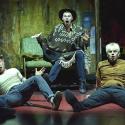
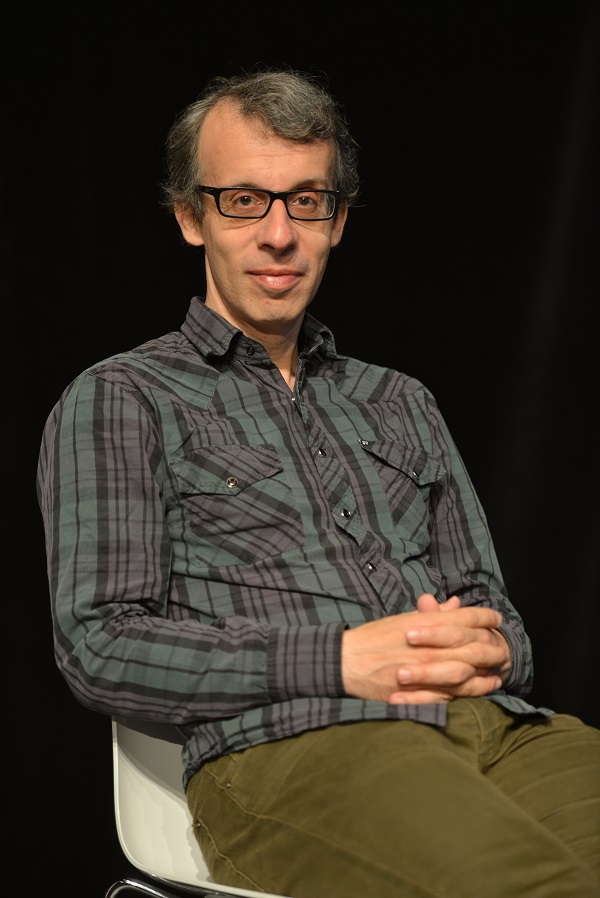 I come from a Yiddish theatre family myself – my grandfather was a playwright, my grandmother an actress – although I didn’t grow up speaking Yiddish. I actually learnt it at Oxford while researching a PhD so I literally speak Oxford Yiddish, or the Queen’s Yiddish if you prefer. There are lots of prejudices against what was once the language of 11 million Jews of East European origin: that it has no culture, no grammar, that’s it’s just a bastardised German (on the contrary, Yiddishists used to say that German is just Yiddish with an army and navy) (David Schneider pictured above. Photo by Flix'n'Pix).
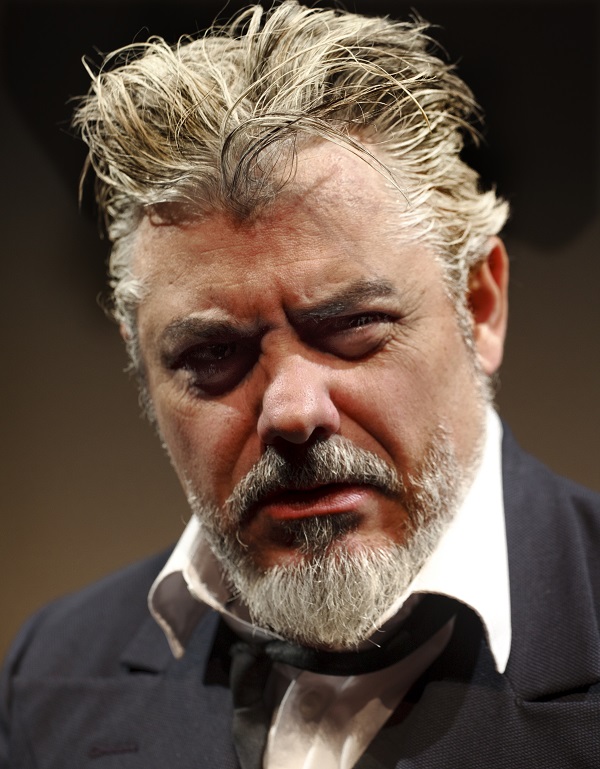
The story of GOSET instantly deals with the preconceptions of Yiddish as a poor relation in the family of languages and cultures: Eugene O’Neill and Max Reinhardt admired the company, Chagall designed for them, Shostakovich picked out their leading actor, Solomon Mikhoels, as the greatest King Lear he’d ever seen. It’s this that I wanted to celebrate in my play. I love that the poster has the “Blow winds and crack your cheeks” speech in the original Yiddish text, the original Yiddish font even, the one the actors would have held in their hands. I love it that a poem by the Yiddish poet Peretz Markish, which has probably not been read aloud for 60 years, is given such a wonderful airing by Darrell D’Silva (pictured below) who plays Mikhoels (and objectively, and I can of course be objective about my own play, his is a quite remarkable performance). I love sitting at the back of the auditorium and watching the audience learn the remarkable story of this now forgotten culture (not that I’m there every night, you understand. After all, there are Twitter followers to be counted etc).
 Above all, the staging of the play has brought me into contact with others wishing to preserve Soviet Yiddish culture from oblivion: a woman from Amsterdam who’s unearthed GOSET’s original music; a Russian couple who are best friends with the daughters of Mikhoels, one of the most famous men in Russia at the time of his murder, now both in their 90s; and most movingly of all for me, the last actual survivor of GOSET, Oytzer Namast, editor of yiddishmoment.com, itself a tiny remnant of a once great Yiddish newspaper industry. Oytzer escaped the Soviet Union via Siberia and China and spoke to me in the declamatory GOSET Yiddish I’d only previously heard in hissing, half-audible recordings. A voice from the past I’d spent years researching conjured up as if magically by my play.
So for once I won’t be worried about the reviews (OK, I admit it, that’s not entirely true). Whether they’re good or not, I’m already overjoyed that the show has played its part, however small, in ensuring that a culture Stalin tried to bury isn’t gone for ever.
Right. Time to check how many Twitter followers I’m up to.