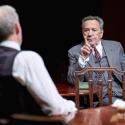
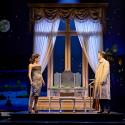
William Nicholson’s drama about the short-lived love between the academic and writer CS Lewis and the American poet who initiated a lengthy correspondence with him in the 1950s, Joy Davidman, can be a devastating tearjerker, especially at close quarters such as a cinema or an intimately scaled auditorium. In the boxy vastness of the Aldwych Theatre, once home to the RSC and Tina: The Musical, its strongest points can struggle to be appreciated, however.
Key to the piece is its portrait of the slow dissolution of the writer’s strong Christian certainties. It opens with Lewis (Hugh Bonneville) in full flow, giving his standard lecture on God’s love for his creatures. The sentences spool out with practised inflections, solemn and wise, humorous moments here and there lightening the message, as when he imagines God as a man in love, waiting yearningly for his phone to ring. Why does God make us suffer so much? Because pain is like a chisel, working away at us stones to make us perfect. Does he believe this wholeheartedly? There’s a pat feel to the words, as if they are covering something more upsetting.
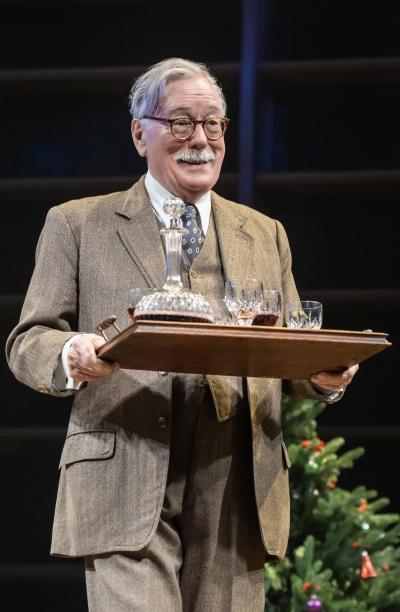
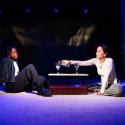
What Lewis is burying under this verbiage is the pain he experienced at the death of his mother when he was eight. It will take Joy (Maggie Siff) and her Lower East Side directness to penetrate his shell. His life before she invades it is filled with verbal sparring of a particularly English-academic kind, the witty banter of the intellectual elite, who lurk in Lewis’s Oxford senior common room to trade well rehearsed barbs and bouquets. And at home his expert interlocutor is his brother Warnie (WH Lewis, played by trusty Jeff Rawle, pictured right), a no-nonsense major with whom he shares a cold, draughty house.
These words-bound fellows with their casual sexism — they view men as having intellect, women souls — already view bachelor “Jack” (Lewis’s nickname), and his attentiveness to the fans with whom he corresponds about his novels and lectures, as something of an oddity. So when he admits that one of his fans — a woman, and an American woman at that, shock horror! — is coming to visit him with her young son, they are quietly horrified. “Americans don’t do inhibition,” one dolefully notes. They conjure an image of her as a kind of loud Barbara Stanwyck type in a leopardskin coat. The reality is a pleasant, funny fortysomething woman in sensible plaid who trades jibes with them from the off.
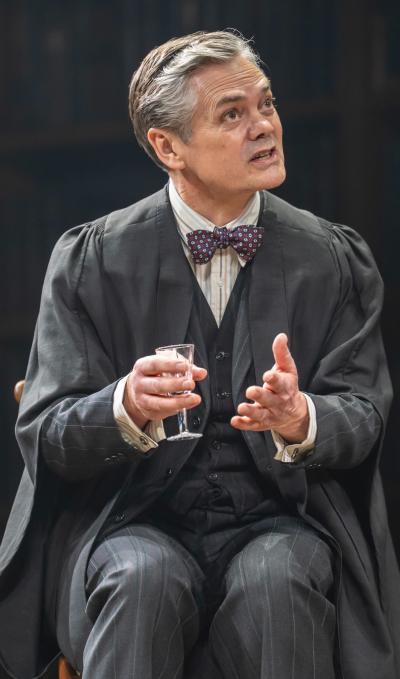
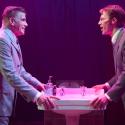
There is a welcome humour to these Act 1 scenes, with Joy puncturing the men’s complacency by revealing she is a published writer who once shared a poetry prize with Robert Frost. Have they heard of him, she naughtily asks. The standout in this group is Timothy Watson’s Christopher Riley (pictured left), a trenchant controversialist and Lewis’s polar opposite. (Watson, for Archers fans, was the voice of dastardly Rob Tichener.) Siff is exceptional casting in this role: quick-witted, with precise comic timing, sometimes brazen yet in no way brassy. She can lob Lewis’s homilies back at him, such as, ”Pain is God’s megaphone to rouse a deaf world,” ironically a favourite of his. Her vision of England as an empty place by day, where people are hunkering down after a massive party the night before, is delightful, her candour a tonic. Of course she can wear Jack down.
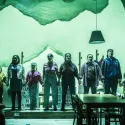
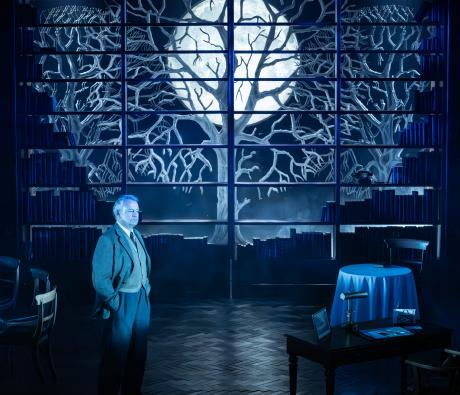
So can her young son Douglas, a huge Narnia fan, who is naturally thrilled to meet the books’ author. A backdrop of a magical tree lit by a giant moon represents the world of Lewis’s imagination (set design by Peter McKintosh), which Douglas makes forays into. It’s in total contrast to the dusty carrels of the main space, which morphs from common room to Lewis’s study at home and eventually to the hospital ward where the suddenly stricken Joy is treated for bone cancer. Scene changes are executed dexterously by the cast, a swirl of people moving props and furniture to the accompaniment of a string quartet.
The early stages of the play work well, almost as a fast-paced comedy of manners, with the stuffy English profs squared up against the upstart American. When Lewis decides to help her out by marrying her so she doesn’t have to go back to her cheating husband, the transaction is done with all the sensitivity of a man offering a business loan. This section too is weirdly comic, especially the registry office ceremony, after which Lewis rushes back to work, muttering, “I shouldn’t be here.”
But the text increasingly requires more intimate set-ups, as Joy and Jack move in together, tour Wales, commune at her sickbed, have a religious marriage ceremony. The painful emotions Lewis is at last experiencing again mar his usual verbal fluency: an extract from the lecture the play opened with is reprised, word for word, but now the phrases are stuttered out and his confidence falters. Words are being defeated; the magic apple brought to a dying mother in Lewis’s The Magician’s Nephew, a volume Douglas totes around with him, is a fiction.
It’s here that you start to ponder the choice of venue for the production. It originated at the Chichester Festival Theatre, which has marginally more seats than the Aldwych but has a thrust stage that can create an intimate feel. The play’s new home allows less scope for subtle shadings and quiet gestures; all has to be projected clearly to the back of the cavernous space. Is this why Bonneville and his director, Rachel Kavanaugh, have opted for Jack’s delivery to be brisk and vocally secure? That approach works well in act one, but it undermines the pathos of the later scenes, transforming a sudden cry of terrible pain into a bellow and making something closer to a whisper impossible.
Bonneville is a dab hand at men in authority, be they landed gentry, senior policemen or Paddington’s adoptive dad, but here that certainty needs to crumple, haltingly and movingly. I left entertained but unexpectedly dry-eyed.
- Shadowlands at the Aldwych Theatre until 9 May
- More theatre reviews on theartsdesk