

Before the lacerating spats of Albee’s Martha and George, and the circular kvetching of Beckett’s characters, there were August Strindberg’s pioneering excursions into dark psychological truths. Only a handful of his 60 plays are staged here regularly, but thankfully Dance of Death (1900) is one of them.
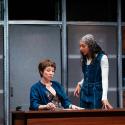
This rendition of a moribund marriage can be a gift to its male lead, as Laurence Olivier and Ian McKellen have shown. Edgar, a pugnacious army captain, is a prototype of the bullied child who matures into a bully, as he himself recognises. He can also be scathingly funny, a trait that Will Keen’s powerful portrayal majors in at the Orange Tree in director Richard Eyre’s new adaptation. At times, Keen seems to be channelling Ade Edmonson in The Young Ones, an exasperated, choleric man who is always on the verge of exploding — at his neighbours and army colleagues, “scumbags” all, and especially at his wife of 25 years, Alice (Lisa Dillon, pictured below). His face is a map of his conflicting emotions, twisted by a succession of emotions: fear, wry humour, incandescent rage, pain.
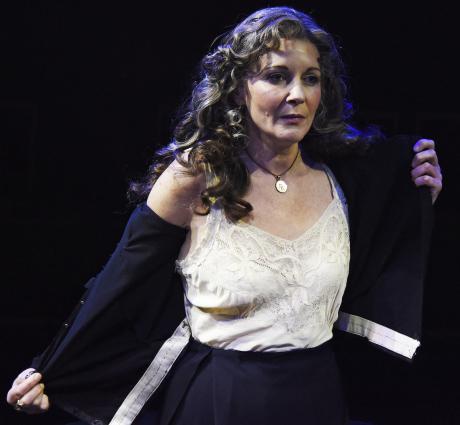
Dillon holds her own in this furious contest, despite seeming ill-equipped for it at first sight. As their silver wedding approaches, she seems sad and put-upon, lonely in her impoverishment. She is a victim, we assume, trapped in a chilly stone building on what has become a quarantine island (Eyre has set the piece in 1918, when the Spanish flu was rampant). Her insufferable spouse has by now driven her two surviving children and her friends away.
But we soon sense the steel in her backbone, the guile in her game-playing. When she bellows for her (departed) maid to appear, her abandoned acting career is evoked and will continue to be a touchstone for gauging her behaviour. Is she a fantasist? A liar? A good actress? Dillon gets much comic mileage out of her professed hatred for Edgar: the exclamation “Is he dead?” after he collapses is delivered with an excited relish that gets a big laugh. But does she mean it, or is this her assigned role in the ritual humiliations she and Edgar construct for each other as a daily domestic routine? Bumbling into this crazed circus comes Kurt (Geoffrey Streatfeild), Alice’s cousin, now an unhappy divorcé whose ex-wife has been awarded custody of their children. He is on the island in an official capacity, supervising the quarantine arrangements, so is automatically socially desirable to the other islanders. Edgar, still prickly about a promotion that never came, despises him; Alice, we come to realise, has seen him as bait in her campaign against Edgar. It’s Albee’s get-the guest time.
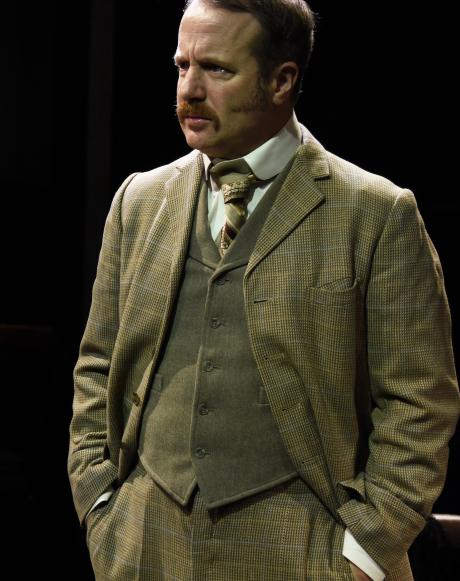
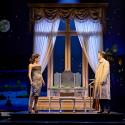
The usually stalwart Streatfeild (pictured above) is slightly miscast here, highlighting what is both a strength and a weak spot in Eyre’s production. His Kurt is suitably naive compared to the practised manipulators he is visiting, but almost “English” in his confusion at what he sees as their depravity, the “hell” they live in, the “putrid” smell of their home, the miserabilism of their marriage. It’s rather like watching a stuffy, home counties pen-pusher getting to grips with a swingers’ orgy. The role calls for an actor who can move in a trice from lust to disgust, and back again, which Streatfeild can’t quite manage vocally, though physically he manages well.
What Eyre does achieve, though, is to make the piece (dread word) relatable. Not because it now comes with echoes of lockdown, featuring Kurt distributing face masks to Edgar and Alice on his arrival. It’s a production that meets local audiences on common ground; its characters’ psychological kinks, the way they talk about themselves, are in a dramatic key they are attuned to. Unlike the National Theatre of Norway’s extraordinary, savage version, seen in the vast expanse of the Coronet in 2023, whose personnel seemed almost like creatures from a fever dream by comparison.
So when Edgar dances to his beloved Entry March of the Boyars, hammered out on an old upright piano by Alice, it’s a great comic moment that humanises him, culminating in Keen doing star-jumps and can-can kicks (choreography by Scarlett Mackmin). His kinder tendencies, in evidence in his youth when he cared for his young sisters at his own expense, also seems less far away here than in the Norwegian version. When Kurt tells him he is probably more “right” than Alice in the contest of wills between them, and Edgar seems close to tears, the broad emotional scope of the adaptation becomes clear.
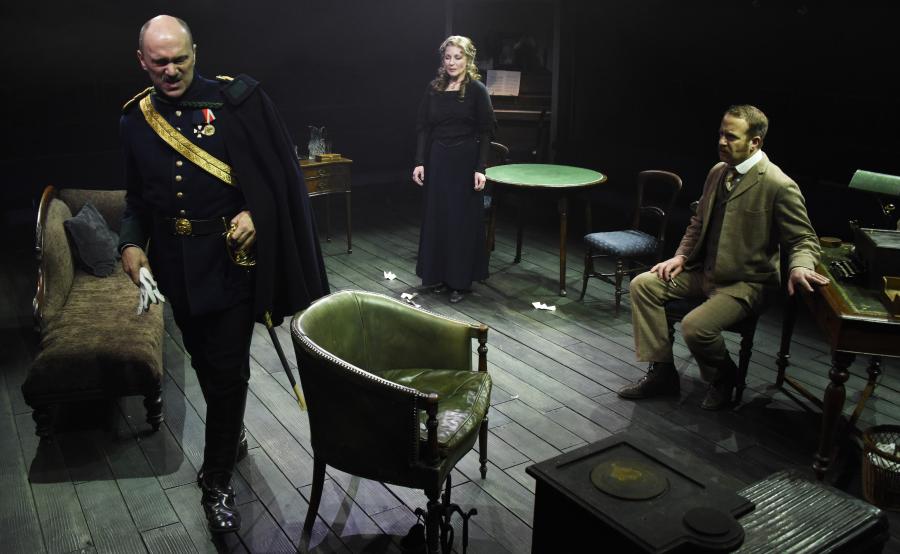
Perhaps the intimacy of the Orange Tree space encourages this kind of engagement with the characters. It’s almost too small for the production’s ambitions, with furniture threatening to spill out into the audience. Designer Ashley Martin-Davis finds room, amazingly, for a desk with a telegraph machine, a chaise longue, several chairs and a stove, as well as a niche for Alice’s piano. The design, with its familiar yet crowded furnishings, underlines the cramped emotional confines of the marriage, where the acrid debates run in the same worn-down grooves.
Kurt, possibly this battle’s actual victim, leaves the couple’s vampiric “hell” having had the extent of Edgar’s moral cannibalism revealed to him. Or has he? Has Dillon’s seductive spiderwoman snagged him in a web of untruths? Edgar’s weary final line, “Rub it out and move on”, leaves the proceedings fruitfully unresolved, ready for hostilities to resume once more, as they were always going to.








Add comment