It’s not often that the works of 17th-century French classicist playwright Jean Racine make an appearance in the West End, and you can’t fault the ambition of the Donmar’s artistic director, Josie Rourke, in bringing us this new version of his romantic tragedy. But if it’s admirably courageous, truth be told, it makes for rather punitive viewing.
The new translation of Racine's 1670 text, which was originally composed in Alexandrine couplets, is by Alan Hollinghurst, the Booker-winning novelist. In unrhymed pentameter, it is cool, pellucid, direct; what it is not, and perhaps does not attempt to be, is especially dynamic. Rourke’s production matches it with cool elegance and a graceful clarity. But by far its biggest asset is Anne-Marie Duff, whose performance as the play’s titular Palestinian queen burns so brightly that it almost thaws the tundra of chilly restraint that surrounds it.
Duff gives a long, low gasp, as if he has drawn a blade from her flesh
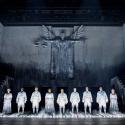
Designer Lucy Osborne reconfigures the auditorium, with audience seated on three sides of a stage covered in yellow sand and dominated by a skeletal, geometric staircase of rough blond wood. More sand trickles from the ceiling in fine columns, as if measuring out the unstoppable passage of time towards the moment when Berenice and the two men who love her must all face the extermination of all their hopes of happiness. Titus, Emperor of Rome, must assume leadership in the wake of his father’s recent death – a destiny that will bring him glory but cost him Berenice, as the Romans will never accept a foreign queen as their ruler’s wife. His friend Antiochus, King of Comagene, has long loved Berenice too – but her passion is all for Titus. As the trio move towards the realisation, and finally acceptance, of the irremediable nature of their pain and sacrifice, there’s a bleak desolation about the drama that is at once clean and cruel.
 Barefoot in a red and gold, one-shoulder gown slit to the thigh, pale tresses tumbling past her waist, Duff is regal yet radiant. Her eyes sparkle, her face is luminous with joy: there can be no doubt that this is a woman – and what’s more, a powerful woman – made ecstatic, and vulnerable, by love. When, after a period of growing doubt and anxiety, Titus tells her that they must separate, she gives a long, low gasp, as if he has drawn a blade from her flesh; and her tears glitter on cheeks ashen with shock as Antiochus reveals his own helpless devotion to her.
Rather less compelling are the love triangle’s other two corners. Dominic Rowan plays Antiochus a little like a frustrated public schoolboy; he’s decent, slightly drippy, and virtually leaps up the staircase to bring Berenice the news that she’s about to be dumped by Titus, before reminding himself that that would be ignoble – and more to the point, would make her hate him – and thinking better of it. Meanwhile, Stephen Campbell Moore as Titus has the right massive heft and tormented expression, dark circles beneath his eyes, his features etched with distress and anxiety; but he has an unfortunate habit of falling into a melodic speech pattern that is slightly soporific and sometimes detracts from the words he is speaking.
In the end, as the trio face one another across their blighted lives, there’s a quality of compromise, waste and enduring misery that feels both authentic and timeless. But this is agony of the tidiest kind, and its broken heart is bloodless.