

Whatever your opinion of Vaughan Williams, it’s unlikely that you think of him as an essentially theatrical composer. Yet he did write at least three important (as well as several less important) works for the stage: a ballet (not so-called), Job, a one-act opera (also not so-called), Riders to the Sea, and a full-length music drama, The Pilgrim’s Progress, based of course on Bunyan’s famous but probably no longer much read allegory of that name.
Since its none too successful first performance at Covent Garden in 1951, VW’s Pilgrim’s Progress has suffered much the same fate as its source. One seems to know quite a lot about it: that he had first thought about it before World War One, that he had eventually composed a single episode called Shepherds of the Delectable Mountains in 1921, that he worked more on it in the Thirties, then gave up and reworked a lot of the material into his Fifth Symphony. But as for its overall character and effect in a good performance one remained uncertain.
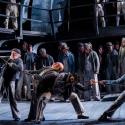
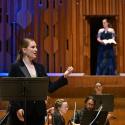
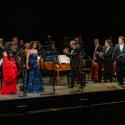
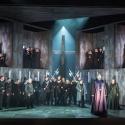
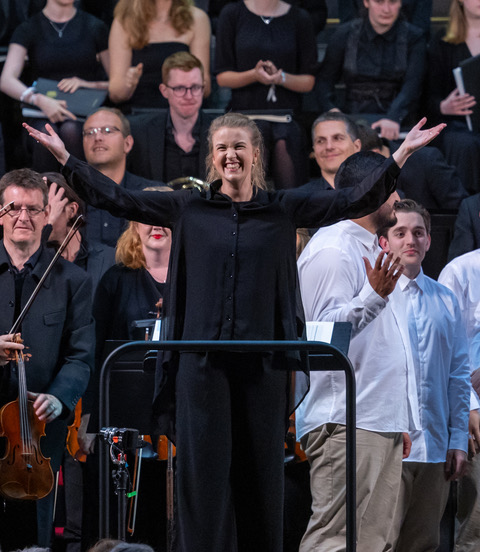 Now British Youth Opera has put together a production that has revealed a (to me at least) quite unexpected musical power and dramatic – if not strictly theatrical – force, under a masterly young conductor barely out of the Academy by the name of Charlotte Corderoy (pictured right). This was a semi-staged performance in Gloucester Cathedral as part of the Three Choirs Festival, and I have to say that the staging, such as it was (directed by Will Kerley), was more or less of an irrelevance (main picture). From halfway back in the nave little of it could be seen without craning one’s neck from left to right, while the TV monitors showed it only in bits and pieces alternating with shots of the orchestra and conductor. Moreover the young voices were now and then overwhelmed by the orchestra, so that one could sometimes follow the action, if at all, only with the help of the printed libretto in the (rather expensive) programme book.
Sounds ghastly, you will say. But all I can say is that despite these limitations, the score itself made an impact that, as I write the next day, is still echoing in my mind. The other day I was rude on this page about Vaughan Williams’s Sancta Civitas, for being not much more than a bunch of mannerisms. The Pilgrim’s Progress absorbs those mannerisms into a thoroughly modern, wide-ranging but fully integrated and individual style that no longer sounds like a lazy regurgitation of yesterday’s ideas, even though, as I said, some of the ideas were in fact yesterday’s.
It has some surprising ancestry. The influence of Wagner’s Parsifal – on its technique, not its style – is palpable. The plot has obvious parallels. The negative/positive dualism, the opposition and interaction of the harmonic brutalism of Job and the Fourth Symphony with the redemptive hymnody of the Fifth, is Wagnerian in character if coarser in execution. Like the Pilgrim himself (pointedly not called Christian, as in Bunyan), the music rides a switchback between these opposites, and the listener rides with it, constantly uplifted then dumped then uplifted again. Above all VW’s often derided orchestration here triumphs, with superb writing for brass especially: again coarser in effect than anything in Wagner, bluffly English.
 What can I say about Corderoy? She is a former organ scholar, who apparently learnt the instrument in double quick time on an organ built by her father in her bedroom, then decided to be a conductor, and here she was aged 25, conducting one of our top orchestras in a difficult, complicated work, in a hostile acoustic, in a packed cathedral. Her control was immaculate, her grasp of the music’s elaborate ebb and flow apparently flawless. The Royal Philharmonic Orchestra played for her like angels.
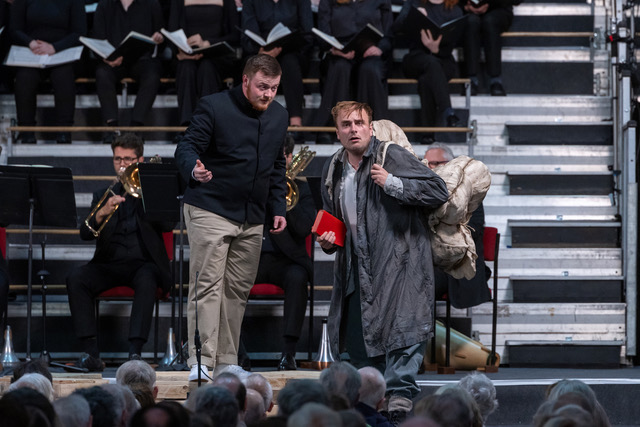
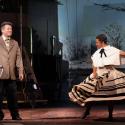
She was also well supported by a talented, hard-working cast of young singers, all, like her, recent graduates or not-yet graduates, who alas couldn’t always fill the echoey spaces and sound-swallowing vaults, but were excellent whenever they did. All except Ross Cumming (a fine, moving, tormented Pilgrim) were multi-parted, and not always easy to distinguish for sure with the poor sightlines and muddling acoustics. But Emyr Lloyd-Jones was outstanding as Bunyan himself in the Prologue and Epilogue, and especially as Watchful in the beautiful intermezzo between the first two acts which VW added during rehearsals; Matthew Curtis doubled skilfully in the very different roles of the Speaker-like Interpreter and the hypocritical Mr By-Ends; Angelina Dorlin-Barlow sang eloquently as the Woodcutter’s Boy, a serene, consoling figure who speeds Pilgrim on his way to the Delectable Mountains (Pictured above: Matthew Curtis as the Interpreter and Ross Cumming as Pilgrim).
Above all the Three Choirs Festival Youth Choir sang out with radiant energy in the great hymnic climaxes that inspire one to question what VW called his cheerful agnosticism. It’s true he was brought up in a vicarage and old habits die hard. But do they retain their conviction without help from within?
Add comment