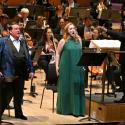
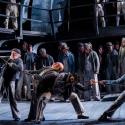
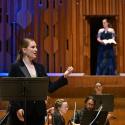
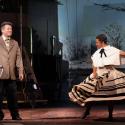
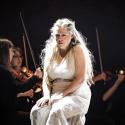
Amanda Majeski pushed the boundaries as Janáček's tormented heroine for director Richard Jones at the Royal Opera. Here there were confines – no “concert staging” this, but a laissez-faire affair with scores and music stands, occasionally obscuring the stage directions – but she still conveyed the essence in front of Simon Rattle’s throbbing, luminous London Symphony Orchestra and flanked by other cast members of uniform excellence.
Not for Majeski the composer’s definition of Russian playwright Ostrovsky’s Katya – the opera is performed in Czech, of course, but the LSO gives the Russian spelling for its title, not the Czech "Káťa" – as being “of such a soft nature that I fear if the sun shone fully on her, she would melt, yes, even dissolve”. This Katya is strong in her visions and tough in her determination – Majeski uses the chest voice powerfully – but harried by fear of damnation (when freed from a director’s vision, the references to God and the devil seem all the more ubiquitous, highlighting the reflection of a superstitious Russian provincial town in the 1840s). The lushness and sometimes the fragile warmth come more from the magnificent phrasing of the LSO strings, underpinned by soft or powerful but always impactful bass lines. In the last act, Katya’s ultimate sense of no way out sees a perfect dramatic marriage of soprano with Rattle’s orchestra, especially in intense pianissimos. 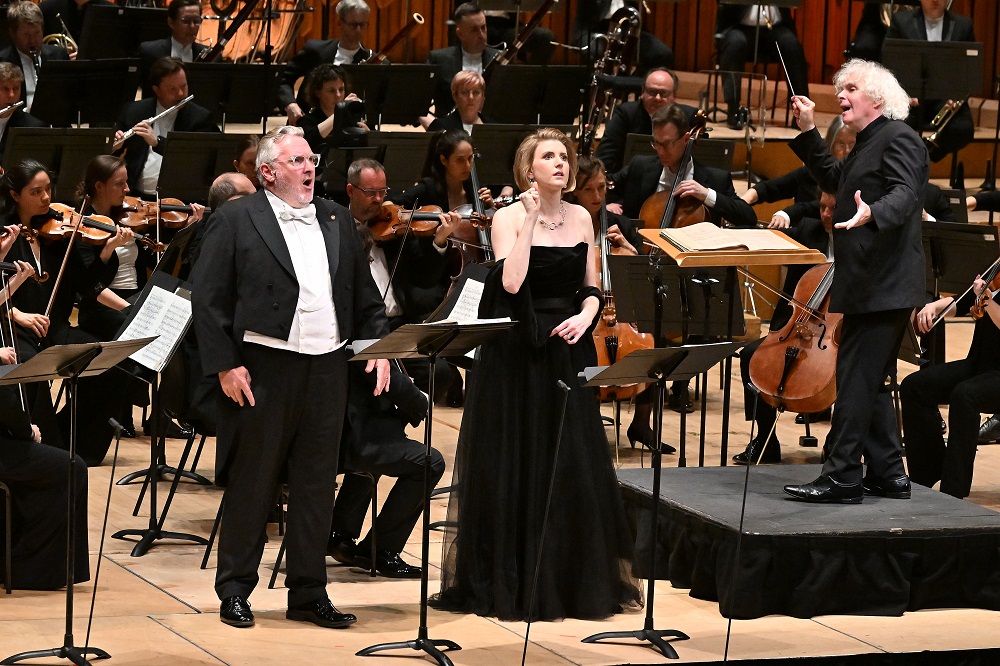 The conductor’s way is familiar now: not the most agile and fluid of Janáček interpretations, but paying heed to the composer’s unorthodox colourings in every bar and line. Muted trombones especially carry the threat, the inevitable fate of the unhappy Kabanov household. Rattle has chosen singers who can all hold their own against the foregrounded orchestra. Even artists about whom there can sometimes be doubts offer their best work: Simon O’Neill as a ringing Boris, Katya’s big desire, sounding totally comfortable in the Czech language and interacting well with her despite concert constraints of little actual touching, and Magdalena Kozena, for whom the language is a given but who, more importantly, vividly conveys the impetuousness and spirit of the foster daughter (and Katya’s tempter) Varvara.
Katerina Dalayman, who not so long ago was playing another downtrodden Russian wife, Shostakovich’s Katerina Izmailova, rises to the forceful presence of the mother-in-law from hell, the Kabanicha, without overdoing it. Even what’s usually presented as a parodistic sado-masochistic scene with the equally awful Dikoj works brilliantly – the orchestra squeezing every inch of character out of its part in the unsavoury conversation, Ukrainian-British bass-baritone Pavel Hunka stepping in for a cold-ridden John Tomlinson to give the most physically demonstrative performance of the evening (Dalayman, Hunka and Rattle pictured below). Andrew Staples runs him close as the bewildered husband tied to his mother’s apron strings. 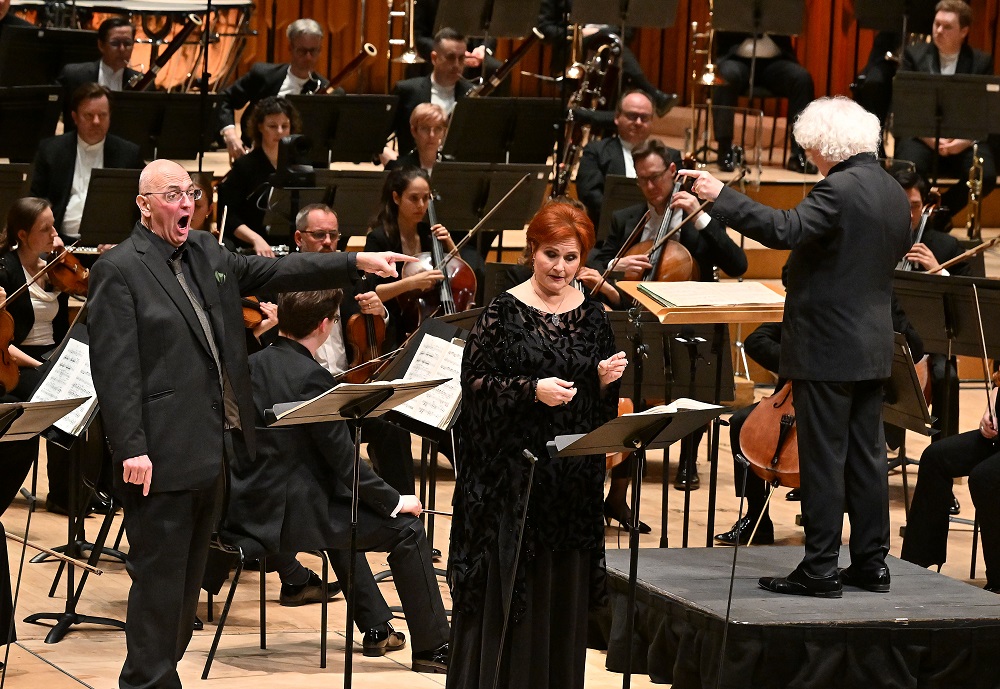 If Ladislav Elgr is slightly more score-bound, he presses all the right sympathetic notes as Varvara’s progress-friendly lover Kudryash. The London Symphony Chorus fulfils its mostly wordless role in Act 3 (very short choral interjections, otherwise the voice of the Volga) but could have been limited to a small number; the two appearances on either side of the stalls are a distraction, and the last one, together with more indeterminate walk-offs from the principals, almost mitigates the power of the desolate ending (the only one among Janáček’s operatic masterpieces not to transcend tragedy). But not quite: the force of Rattle’s perfecty nuanced interpretation just about holds to the last. No doubt Janáček always works best on stage if the production gets it right, but I'd be happy to revisit this as a recorded performance.