William Kentridge’s production of Monteverdi’s L’Orfeo marks a double début at Glyndebourne – neither the director nor the opera, considered by many to be the first proper example of the genre, have appeared here before. Kentridge – who made his name as an artist chronicling oppressive power structures in South Africa – now takes on the ultimate oppressive power of Death, turning the story of Orpheus into an account shimmering with anguished hopes and thwarted possibilities.
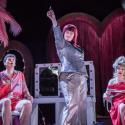
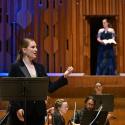
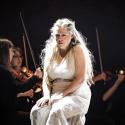
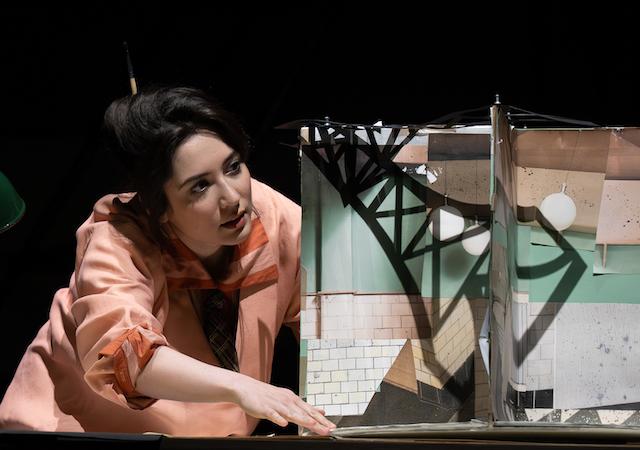
Kentridge’s distinctive style of animation – a continuous process of drawing pictures in charcoal, then rubbing details out, and adjusting them with new charcoal lines – seems particularly appropriate for a tale of a man wrestling to rewrite his past. In Alessandro Striggio’s original libretto, it is “Music” who narrates the story, but here Kentridge translates that creative spirit into an artist played by Francesca Aspromonte (pictured below) in her studio, conjuring up images ranging from bird-filled trees to Piranesi-style prisons as she tracks the details of Orpheus’s tragedy.
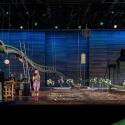
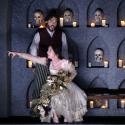
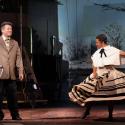
Orpheus’s love Eurydice has a frustratingly small role in Monteverdi’s opera – only 12 lines in all. But Kentridge addresses that by having Euridice simultaneously played by dancer Roseline Wilkens, an assertive stage presence who tips and swirls so that her black and white skirt spins out in concentric circles. At the start of the first act, the video projection shows a tree being sketched across several sheets of paper, which flutter in the breeze, before being replaced by vintage maps that overlap with the scudding silhouettes of birds and clouds. As Krystian Adam’s Orpheus prepares to sing about his love for Euridice, this backdrop creates the feel of a fertile mind in constant action, an eruption of ideas trying to make sense of a world that’s often as cruel as it’s random.
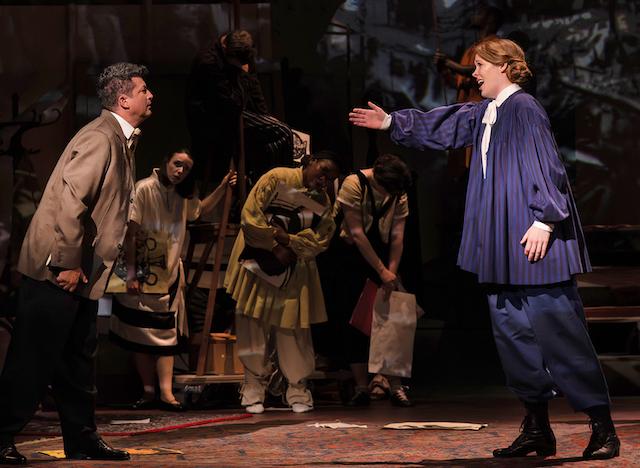
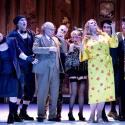
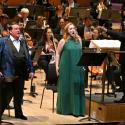
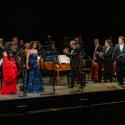
The Polish tenor Adam – who performed the same role at the Zurich Opera last year in a very different production in which Orfeo was implied to commit suicide – here brings a beautifully modulated sensitivity to his singing. There’s a genuine sense of quasi-philosophical exploration as he tries to understand how his initial failure to woo Euridice has turned to the incredible luck of her wanting to marry him. When Xenia Puskarz Thomas’s superb Messenger (pictured above right) reveals – in a voice like a gash of pain – that Eurydice has been bitten by a snake and has died, we watch Adam wilt like dehydrated plant. Behind them, the projected backdrop rotates in slow motion – powerfully evoking a state of grief in which even the laws of gravity (obviously sensed rather than understood by Orfeo and his contemporaries(!)) do not register any more.
I was one of the critics who failed to make it to the actual opening performance because of sinkholes in a bridge that stopped any trains from London to Lewes making it past East Croydon. On this second night, the Orchestra of the Age of Enlightenment, conducted by Jonathan Kent, alternated between silky smoothness and captivating elegance in its deployment of the score. As the nymphs, shepherds and spirits who help tell the tale, the Glyndebourne Chorus bring a vibrant energy to the narrative as it shifts from pastoral ecstasy to stygian despair. The lucid empathetic storytelling flows like a river, and it feels like no time before the first half has ended, and the celebration of Orpheus’s love has descended to the gates of the Underworld.
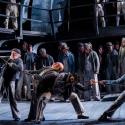
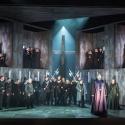
Some reviews have criticised this as a production in which Kentridge’s art eclipses Monteverdi’s opera, but I couldn’t disagree more. For me, both the drawings and the quotes from Rilke (whose 1923 Sonnets to Orpheus helped inspire this production) set up a fantastically dynamic dialogue with Monteverdi, in which we feel the timelessness of what the opera says about lost love and life’s injustices. When Kentridge’s famous megaphones become part of the constantly moving collage of art on Sabine Theunissen’s set, they simultaneously evoke Orpheus’s power of self-expression and faceless power, which could either represent a political regime or the Underworld. When his Hieronymus Bosch-like creatures – made from random tools and metallic materials – stride across the set, they create an industrialised hellscape that allows the story to resonate from the ancient world to the modern era.
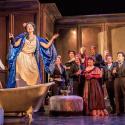
Bass singer Callum Thorpe – whose cavernous range so impressed audiences when he played Polifemo in the London Handel Festival’s Aci By The River – here becomes a fantastically imposing Caronte, challenging Orpheus as he’s accompanied by a sinister swell of trumpets. The relationship between Davide Giangregorio’s Plutone and Leia Lensing’s Proserpine provides a thought-provoking interlude, before the terrible moment – beautifully lit by Urs Schönebaum – when Orfeo looks back and loses his love for ever.
The final scene, in which Caspar Singh’s imposing Apollo descends from the heavens and Janus Fouché’s video designs spin us into outer space, is one of the moments when the dialogue between the music and the visual aesthetic becomes its most exhilarating. This is a thrilling pairing of director and composer, which at the very least will provide interesting new insights and may even whirl you into the stratosphere.