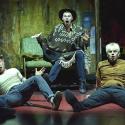
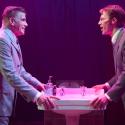
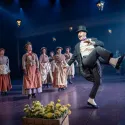
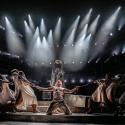
What can you do with lots of big sheets of white paper, three rolls of Sellotape and a couple of torches? These are items from the “props incident room”, as he would call it, of Phelim McDermott’s workshop. With them, and the other workshop that is his fertile imagination, he has conjured up a very special show.
It was originally to have been a collaboration with the leading minimalist composer Philip Glass at the piano, but his health problems wouldn’t allow him to appear. So McDermott, the man who staged Glass’s Satyagraha and Akhnaten for English National Opera, had to rethink the piece. What has emerged is a personal odyssey, from childhood obsessions to adult preoccupations, via the inside of a cupboard.
That cupboard is one of the places where he has experienced the thrill of putting on a show, waiting for the doors to be pulled open by his friend Louise. He's feeling it again at Soho Place, beginning the piece by summoning this excitement from a seat among the audience. It's a promise to reunite you with the thrill that only live theatre can bring. He felt it, growing up in Manchester, when his mother first took him to see Max Wall in Waiting for Godot at the Royal Exchange, extending his range in London with actors called Olivier, Finney, Kingsley, Mirren. “There are lots of ghosts in my heart,” he proclaims, “theatre ghosts”.
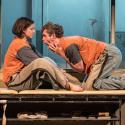
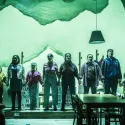
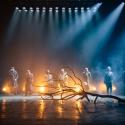
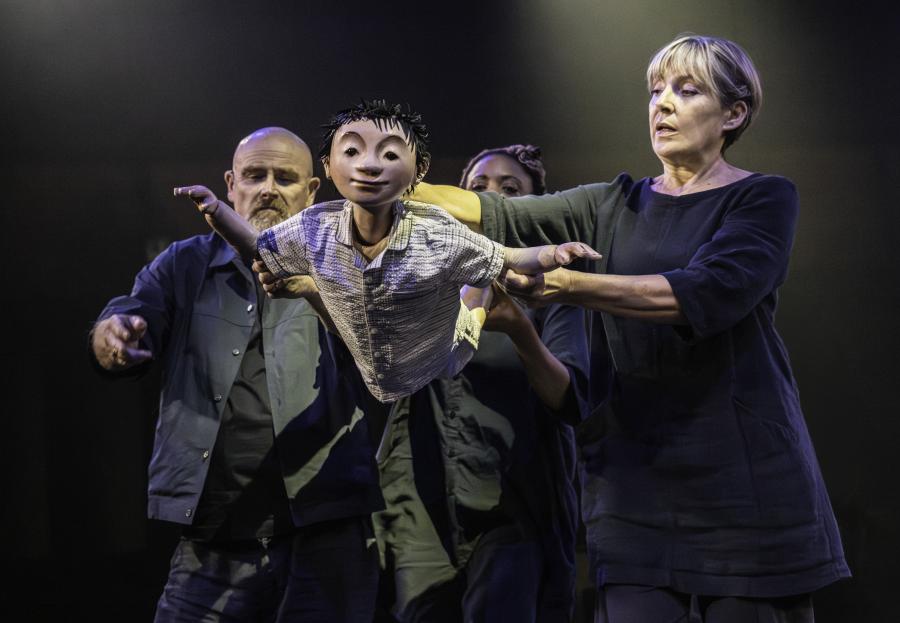
Gradually the stage fills up: a band sets up in one corner, three actor-puppeteers arrive (pictured below). As the evening proceeds, McDermott will greet a little boy-puppet (his son Ridley) and start limning out the world of the play – which originates, unexpectedly, with Maurice Sendak’s In the Night Kitchen, a text that could have been written for McDermott to adapt, with its story of a small boy’s adventures in dreamland. Glass was to provide the music. But it didn’t happen; Sendak died.
McDermott then adds another thread to this tapestry: the album Glassworks, which he had listened to avidly as a teenager and later rediscovered in the old Anderson air raid shelter at the bottom of his family’s garden. (Did his parents abandon it there, driven mad by its repetitive style, as many are?) The album triggered his lifelong passion for Glass’s music, which he watched the composer playing with an ensemble in old VHS videos. Recognition dawned as he noted Glass’s habit of flipping his head back at key moments: “He’s conducting with his hair!”
Finally he sees Glass in person, wandering around Covent Garden, follows him “at a safe distance” – a phrase that will crop up in a poignant context later in the piece – then gazes through the window of the sushi restaurant Glass finds. But before the narrative surges on to McDermott’s first proper meeting with Glass, it goes on many walkabouts, whizzing back to his seven-year-old self wanting to make theatre as magical as Billy’s Wonderful Kettle, a sort of northern Aladdin, then on to a story about a master ceramicist’s pupil who has to learn kintsugi, the art of reuniting broken pieces with a golden solder, and on to the joys of lying in a flotation tank, the origins of Lao Zu’s I Ching, a proposed three-tiered model of consciousness, the real meaning of Tao…
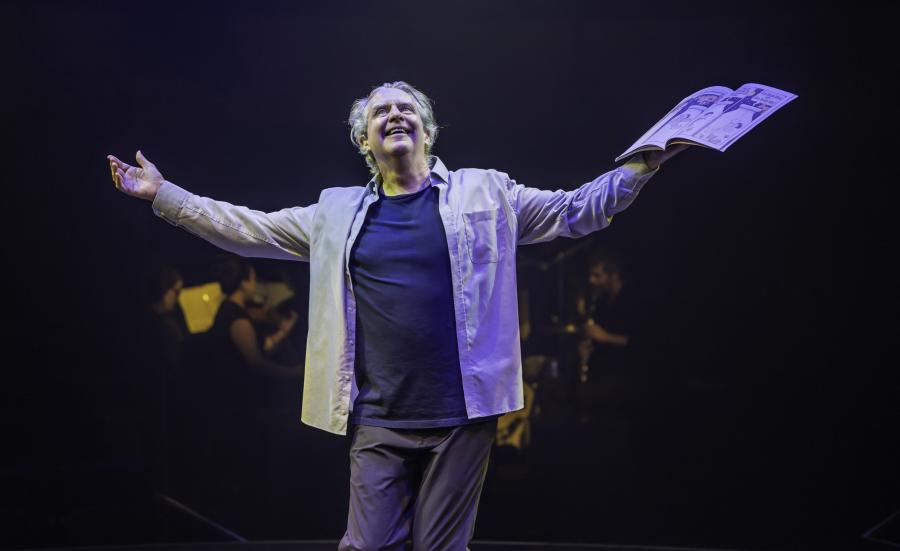
None of this would work without the governing intelligence and humour of its writer-performer. McDermott is a great actor for starters, savagely funny, with a mad gleam in his eyes at times, who understands that if you are miming taking a pot out of a kiln, wearing oven gloves will make it comic but oddly real. He's also a writer who knows when to slam a piano lid down or throw in a terse line to halt a buildup of pathos. His greatest talent, though, is creating something out of very little, a talent that has always elevated his work with Improbable, his theatre company, and is a weird echo of Glass’s compositional practice.
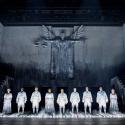
Here McDermott’s small team create a red fire under a kettle, a boy flying over a New York landscape, a man playing the piano. It’s just paper, torches and skill, creating shadow puppets on a big paper screen (really hard when you have to work in the round, as Soho Place’s stage demands), a row of upright kitchen implements standing in for the Manhattan skyline. The puppeteers even make the paper piano-player’s head look like Glass’s, and yes, it flips its head back and conducts with its hair.
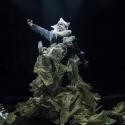
The most stunning of these puppetry moments comes when McDermott, wearing a dirty ruff and battered hat, stands like a statue while being “dressed” in wodges of the scrunched up paper, a paper boat-hat put on his head, a Beckett character at a fancy-dress party.
The cleverness of the script is that it reconstitutes itself, even as McDermott struggles to put on a show that keeps being scrapped. What can his show be about? It eventually becomes clear it’s about what goes into making a show, how theatre happens, even if it’s not-happening. And where music comes from, too (Glass tells McDermott he has no idea). It’s a serious stab at dramatic kintsugi, putting pieces together whose value is actually in their imperfection. The not-happening of the show is not a problem but its essence.
In fact, a show did emerge, first seen in this country at the 2019 Manchester International Festival. And it has new music composed and played live by an invisible Philip Glass. Go see this extraordinary production to find out for yourself how that leger de main works.
- Tao of Glass at Soho Place until 12 September
- More theatre reviews on theartsdesk